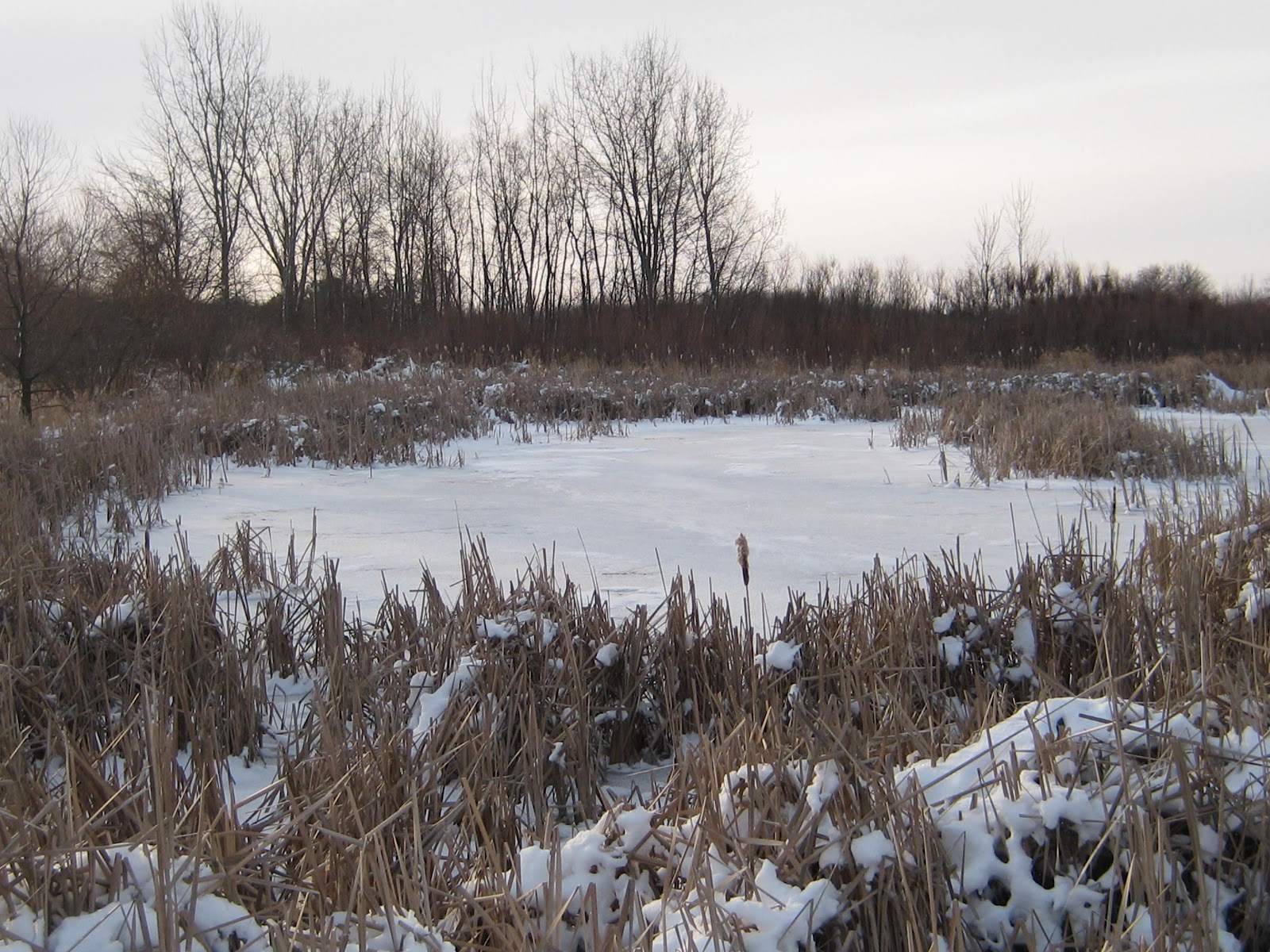
Saturday, March 17, 2012
March 17
Saturday was a good day at Forest Hill for a hike with my dog, Remi. The early morning weather was mostly sunny with a temperature of 51 degrees and no wind. Walking past the storage building, I noticed a pair of Starlings beginning their annual nest building on top of the propane tank. I stood at the crest of the hill before proceeding down to Mallard Marsh where a pair of Mallards took off just north of the trail. I continued through Bobolink Meadow where a noisy Killdeer flew overhead. Also, I recalled earlier in the week being surprised to see the largest flock of Wild Turkeys that I’ve seen around here, numbering about fifty birds, walking silently in the neighbor’s field north of North Woods. This time of year turkeys demonstrate a different flocking behavior. Groups of bachelor gobblers rejoin up with all of the hens and form large groups just before the mating season. After 2 or 3 weeks, when breeding season begins, the birds will break up again into mating flocks consisting of 2 or 3 adult gobblers and 5 - 15 hens. Next, I entered North Woods and hiked west along a muddy path. Continuing past the boardwalk, I could hear the calls of Leopard frogs off to the west. Exiting the woods, I stopped to examine the deer remains. I circled Succession Field where I spotted hundreds of small spider webs clinging to the dead vegetation. I entered South Woods and followed the edge of Swanson Swamp where I paused as my ears were filled with a symphony of early spring sounds including: Chorus Frogs, Redwing Blackbirds, Crows and a drumming woodpecker. Exiting the woods, I arrived at Artist Overlook where I paused to enjoy the song of a Song Sparrow perched in a nearby tree. Proceeding onward, I could hear several Spring Peepers coming from the south side of Sora Swale. Following the south trail, I noticed some geese foraging in the neighbor’s field off to the south. I came to Frog Fen and turned to climbed Reflection Hill where I gazed at Grebe Pond. I descended the hill and arrived back at the Classroom Building where I recalled a sight to behold earlier in the week as waves of hundreds of Mute Swans flew in formation high overhead heading west. This bird was introduced to North America in the late 19th century. Recently, it has been widely viewed as an invasive species because of its rapidly increasing numbers and impacts on other waterfowl and native ecosystems. For example, a study of population sizes in the lower Great Lakes from 1971 to 2000 found that Mute Swan numbers were increasing at an average rate of at least 10% per year, doubling the population every seven to eight years. Several studies have concluded that Mute Swans severely reduce densities of submerged vegetation where they occur. Finally, Remi and I hopped in the van and drove for home.
…Joy at our feeder,
Joy to my eyes and heart
Where-ever birds
May be.
Feathers, beaks, wings, feet,
Brown, blue, red, yellow, green -
Feeding my joy, feeding my heart,
Feeding my life.
Mary Lathrup
Saturday, March 10, 2012
March 10
Saturday was a good day at Forest Hill for a hike with my dog, Remi. The early morning weather was partly cloudy with a temperature of 23 degrees and a stiff southerly wind. Before descending the hill, I gazed west and saw no evidence of snow cover. I paused at Mallard March where I noticed a pair of geese swimming in the partially thawed pond. Continuing through Bobolink Meadow, I was pleased to spot my first male Redwing Blackbirds of the season and hear their familiar whirring calls. I turned at the entrance to North Woods and headed south toward Willow Wallow. I passed the pond and continued west where I observed 3 whitetail deer loping from north to south across Succession Field. Stopping at the deer carcass, I observed mostly hair and bones. I proceeded around the edge of the field where I spotted what could be the last patches of snow for the season. Arriving at Artist Overlook, I paused to see 4 mallards take off from Sora Swale. Also, I was reminded of the many Painted Turtles that sun themselves there in the summer. I wondered what they were doing now. Unlike humans, which need to keep a fairly consistent body temperature regardless of their surroundings, these turtles are ectotherms, which means their body temperature depends on their environment. In the winter, they find a spot in the mud at the bottom of the pond under the ice. Their body temperature drops to approximately that of the surrounding water. Their metabolism slows to a crawl, and they won’t come up for air until spring. Even though they abstain from breathing, they still have some minimal oxygen requirements, which they meet by taking up oxygen from the surrounding water through their skin. Next, I proceeded down south trail and circle back to the east side of Sora Swale where I saw another pair of geese walking on the ice. Next, I came to Frog Fen and turned south toward Brady Cemetery. I passed the cemetery, entered Native Grassland and headed north. I paused at Grebe Pond where I saw a few geese, several Hooded Mergansers including the white-faced males and some Common Mergansers including the white-bodied males. Continuing north around the pond, I came close to a male Redwing Blackbird perched in a tree announcing its nesting territory. Approaching the end of the trail, I scared up 2 female pheasants. I arrived back at the Classroom Building where I noticed lots of sparrows on the bird feeders. Finally, it was time to get in the van and shove off.
Birds in a
bare bush
beneath quiet
noonday beams,
tail flicking,
preening,
dreaming Spring dreams.
There, on the
high branch
backs to the sun
- sparrows -
steeped warm.
A calm March
has begun.
Sally Plumb
Saturday, March 3, 2012
March 3
Saturday was a good day at Forest Hill for a hike with my dog, Remi. The early morning weather was mostly cloudy with a temperature of 31 degrees and light snow flurries driven by a strong westerly wind. Before descending the hill, I paused to view the western landscape dusted by an early morning snow. I walked briefly and stopped by Mallard Marsh where I recalled the leaping Leopard frogs of summer and wondered where they were now. Leopard frogs typically hibernate underwater. A common misconception is that they spend the winter the way aquatic turtles do, dug into the mud at the bottom of a pond or stream. In fact, they would suffocate if they dug into the mud for an extended period of time. However, they must be near oxygen-rich water and spend a good portion of the winter just lying on top of the mud or only partially buried. They may even slowly swim around from time to time. Next, I hiked through Bobolink Meadow and entered North Woods where I followed the trail west and saw a few deer tracks. Before exiting the woods, I spotted my first Robin of the season as well as a Tufted Titmouse and a Chickadee. I exited the woods and stopped by to look at the deer carcass. I proceeded around Succession Field where the trail was flooded from heavy overnight rain. I entered South Woods and followed the trail along the edge of Swanson Swamp. Before exiting the woods, I spotted some Raccoon tracks on the boardwalk. I exited the woods and passed Artist Overlook where the light snow had created an interesting pattern on the grassy trail. Walking along the edge of Sora Swale, I noticed Remi’s footprints in the snow as he walked in front of me. I continued on the south trail and fondly recalled seeing some Monarch Butterflies here last fall. Their annual migration is a unique and amazing phenomenon. Some fly as far as 3,000 miles to reach their winter home in the Sierra Madre Mountains of Mexico where they roost in Oyamel Fir forests at an elevation 11,000 feet. To stay warm, tens of thousands of them can cluster on a single tree. Next, I came to Frog Fen, turned north and noticed a few pheasant tracks on the trail. Climbing Reflection Hill, I paused to view Grebe Pond. Suddenly, the open water on the north end exploded as 5 Mallards and 2-dozen geese took off and flew overhead. A couple of geese remained behind walking on the thin ice. Descending the hill, I arrived at the Classroom Building where I checked out the bird feeders. Finally, it was time to get in the van and head for home.
Harshness vanished. A sudden softness
has replaced the meadows' wintry grey.
Little rivulets of water changed
their singing accents. Tendernesses,
hesitantly, reach toward the earth
from space, and country lanes are showing
these unexpected subtle risings
that find expression in the empty trees.
Rainer Maria Rilke
Saturday, February 25, 2012
February 25
Saturday was a good day at Forest Hill for a hike with my dog, Remi. The early morning weather was partly sunny with a temperature of 25 degrees and a steady breeze out of the northwest. Before descending the hill, I gazed to the west and noticed how 4 inches of fresh snow had blanketed the ground once again. I passed Mallard Marsh and walked through Bobolink Meadow where I was disappointed to see fresh snowmobile tracks. The snow cover made me wonder how the creatures of summer were doing. For example, how was the Garter Snakes’ hibernation going? Their hibernation, more properly called brumation, is quite different from hibernation in mammals. They do not sleep the winter away nor do they live off their fat reserves. They are alert, if sluggish, and if it’s cold enough, they don’t even lose weight. Because they’re cold-blooded, their metabolism slows down so much that they hardly use any energy. They don’t eat for months. They survive underground below the frost line in dens where temperatures remain above freezing, although some minor dips below freezing can be tolerated. They generally hibernate in aggregates and have become famous in some locations, notably Manitoba, Canada where one den may hold 10,000 snakes. Here in Michigan, smaller groups of garter snakes hibernate together in such places as old groundhog burrows or rocky outcrops, in spots safe from predators and with enough moisture to keep them hydrated. Turning at the entrance to North Woods, I followed the trail south toward Willow Wallow. I passed the pond and entered Succession Field where I saw a pair of bluebirds flying near the birdhouse. Next, I stopped to check the deer carcass, barely visible through the snow. I continued along the edge of South Woods toward Artist Overlook where the rising sun shown through the bare birch trees. I turned north back to Willow Wallow and followed the trail along the edge of the pond. Before ascending Reflection Hill, I observed a pair of cardinals fluttering through the autumn olive shrubs. I climbed the hill, gazed at Grebe Pond, descended the hill and headed toward Brady Cemetery. Passing the cemetery, I entered Native Grassland and followed the trail along the east side of Grebe Pond where I spotted a dozen Mourning Doves and 3 Starlings perched on the power line. As I got closer, only 1 dove remained. Arriving back at the Classroom Building, I noticed that the birdfeeders were quiet. I was pleased that our new webcam will allow everyone to observe birds at one of the feeders anytime. Finally, I jumped in the van, turned on the heater and headed for home.
I welcome you to the feeder today
A woodpecker, a dove and even a jay
A cardinal, a junco and a chickadee
A wonderful sight for eyes to see
You all seem to know your place
You dart in and out with such grace
Grains and seeds I will provide
Snow has covered your food supply
Winter is long. There’s chill in the air
Come eat your fill. I have feed to spare
My ears enjoy your every song
There’s plenty of room. You all belong
The cold weather will soon go away
I welcome you to the feeder today.
D. DeGraaf
Saturday, February 18, 2012
February 18
Saturday was a good day at Forest Hill for a hike with my dog, Remi. The early morning weather was partly sunny with a temperature of 30 degrees and a stiff wind out of the north. Before starting the hike, I paused to gaze west and noticed 4 inches of overnight snow had whitened the landscape. I descended the hill, passed Mallard Marsh and walked through Bobolink Meadow where I was surprised to see 3, quarter-inch larvae crawling on the snow. Entering North Woods, I followed the trail west. I exited the woods and stopped to see the deer carcass that continued to decompose. I assumed the hawks and crows that I had seen around here earlier in the week had been feeding on the flesh. I walked around the edge of Succession Field and observed a few white oak leaves still clinging to a tree. Entering South Woods, I hiked along the edge of Swanson Swamp. I exited the woods and continued to Artist Overlook where I paused to observe Sora Swale. A solitary Mourning Dove flew overhead heading east. Following south trail, I noticed some twig galls on a small white oak tree. Galls are abnormal growths comprised of plant tissue found on twigs or branches. These deformities are caused by a tiny wasp that produces a chemical inducing the plant to produce large, woody twig galls. Most galls are aesthetically not pretty, but normally cause little damage to the tree. Gall formation begins when a female gall wasp injects her eggs into a stem. Upon hatching from the eggs, the larvae begin feeding on the host tissue surrounding them. The plant’s defensive reaction to this intrusive irritation is to isolate the toxins or activities of the invader in a tough, tumorous mass of tissue called a gall. Ironically, in doing so the plant provides food and shelter for the developing larvae. After completing their growth and metamorphosis, often many months later, the adult wasps escape by chewing an exit tunnel through the wall of the gall. Next, I turned south at Frog Fen and was surprised how close I got to a single crow perched high up in a leafless Cottonwood tree. Heading toward Brady Cemetery, I noticed clusters of dehydrated wild grapes on one of the white pine trees. Passing the cemetery, I entered Native Grassland and followed the trail north along the edge of Grebe Pond. I arrived back at the Classroom Bldg. to see lots of movement at the bird feeders . Finally, I got in the van and headed for home.
Winter lingers,
as though,
Mother Nature
is unfulfilled.
Snow falls insistently,
endlessly, it seems.
Insulating life within
a cocoon of purest white
covering our world
with a blanket of
coldness, aloneness.
Each solitary flake
securing its place
within nature's plane
securing solitude,
and timelessness,
within its icy touch.
Isolating, insular
encapsulating
Mother Nature's
chilling season.
Hazelmarie Elliott
Sunday, February 12, 2012
February 12
Saturday would have been a good day at Forest Hill for a hike with my dog, Remi. However, we were 90 miles north in Missaukee County near Lake City hiking with our friends, Jeff Reynolds and his dog Winnie where we planned to hike on his 80 acre hunting preserve. The afternoon weather was partly cloudy with a temperature of 21 degrees and a breeze out of the west. On our drive to the site, we were pleased to spot a Bald Eagle perched high up a tree. We arrive to notice a couple inches of fresh snow covering the 5 inches already on the ground. We left the cabin and followed the trail through a lovely stand of Balsam Fir. Just off the trail, we noticed a large, dead birch tree covered with Pileated Woodpecker holes. We got off the tail and headed into a cedar swamp where we followed several Coyote tracks. Coyotes are opportunistic and will eat almost anything available. Small mammals such as mice, voles, shrews, rabbits and squirrels are preferred foods. However, insects, fruits, berries, birds, frogs, snakes, plants, and seeds round out their diet. In areas with high deer numbers, carrion is an important food source. Coyotes are most often seen during their breeding period, which occurs in Michigan from mid January into March. They are active day and night; however, peaks in activity occur at sunrise and sunset. They generally feed at night. Next, we moved along toward a clearing where we saw lots of dead Bracken Ferns on the ground. In the open field there were lots of deer tracks as well as places where they scraped away the snow to look for edible grass. We also found some coyote scat and the remains of a deer. We got back on the trail and followed it through a stand of Tamarack trees where we noticed their tiny brown half-inch cones. Tamarack or Larch trees grow mostly in the cold regions of Northern America. They are unusual in that they are deciduous, their soft, needle-like leaves, borne in dense clusters, drop in the fall, and new leaves do not appear until the following spring. The bark of this tree is good for medicinal purposes. The inner bark is used as a poultice in treating wounds, frost bites, boils and hemorrhoids. The outer bark is used together with another plant as a treatment for arthritis, cold and general body aches. Tamarack wood is described as tough and durable often chosen as a material for snow shoes, knees for wooden boats, posts and poles. Other uses include firewood, lumber for wood houses, boat paddles, kitchenwares like spatulas, and handcrafted objects. Next, we arrived back at our starting point and noticed some beautiful Blue Spruce trees. Finally, we got back in the car and headed for their house.
I stood beside a hill
Smooth with new-laid snow,
A single star looked out
From the cold evening glow.
There was no other creature
That saw what I could see
I stood and watched the evening star
As long as it watched me.
Sara Teasdale
Saturday, February 4, 2012
February 4
Saturday was a good day at Forest Hill for a hike with my dog, Remi. The early morning weather was partly sunny with a temperature of 25 degrees and no wind. Approaching the bird feeders, I saw the usual visitors plus a couple of Purple Finches. Also, I was pleased to see the new heated birdbath. Having decided to reverse my course, I passed the Barn and continued south into Native Grassland. I stopped to gaze at Grebe Pond that was covered with an opaque layer of grayish-brown ice. Next, I passed Brady Cemetery and headed due west past the “Road Ends” sign and followed the two-track along the edge of a our neighbor’s field. Observing our southern boundary, I was pleased to spot several, small, healthy Norway spruce trees that we planted 2 years ago. Also, I noticed some fresh deer tracks in the mud. Turning north onto the south trail, I hiked along the edge of Sora Swale where I spotted some opossum tracks in the snow. Also, just off the trail, I saw some rabbit scat on a patch of snow. Rabbits produce two types of scat or droppings; dry brown pellets like what I saw and soft green pellets, composed of only slightly predigested plant food. The soft green ones contain essential nutrients and are rarely seen because the rabbit eats them, a process called reingestion, or coprophagy. I paused at Artist Overlook to observe a snowless landscape reminding me how mild the winter weather has been. After descending the hill, I hiked along the perimeter of Succession Field. Entering South Woods, I walked along the edge of Swanson Swamp where I noticed the sun peaking through the trees. Exiting South Woods, I continued around a snowy trail of Succession Field and stopped to see the deer carcass that was being scavenged by some unknown animal. I entered North Woods and followed the trail east to the boardwalk where I noticed a pile of fresh wood chips on the boardwalk and 3”X 6” hole about 20’ up a Beech Tree. It was quite clear that a Pileated Woodpecker had recently been there. This bird is about 15 inches in length and is one of the largest woodpeckers in North America. It has a black body, a red crest, white stripes on its neck and black and white stripes on its face. In the spring, I often hear their drumming sound as they establish nesting territories. Exiting North Woods, I hiked east through Bobolink Meadow where I could see the Classroom Building and Barn in the distance. As I climbed the hill from Mallard Marsh to the Storage Building, I noticed a few fresh mole mounds. Finally, I found my van and headed for home.
…Reaching my sacred spot
I stand in quiet reverence
Woodpecker tapping loud
Chickadees in winged chorus
The only sounds heard
Peace fills me
The music of the universe
Plays within my soul
Breaths slow, warmth spreads
Despite winter's chill
Stilled as a statue in place
A hushed whisper in my ear
As snow flakes fall upon dry leaves
Life's burden lightened, spirit renewed
Pilgrimage complete, turning in retreat
Hastened steps return me home
Richard Bramante
Subscribe to:
Posts (Atom)