Friday, June 10, 2016

June 9


Thursday, Remi and I returned to Forest Hill Nature Area for our weekly hike. The early morning weather was partly sunny with a temperature of 52 degrees and still air. After gazing west from Energy Hill, I walked down along the edge of Mallard Marsh where the Reed Canary grass was displaying its colorful flowers (panicles). I continued through Bobolink Meadow where no Bobolinks were seen, however I did spot a female Goldfinch perched on top of a young Norway spruce. Shortly after entering North woods, I noticed a single Wild Iris blossom near the footbridge while further down the path the forest floor was covered with a healthy mix of Virginia creeper and Poison Ivy. Continuing west, I glanced skyward to see a nearly full canopy of leaves. Exiting the woods, I followed the trail west around Succession field where I was surprised to see that a Goat’s Beard flower had already gone to seed. Also, bushes of Blackberry and Multi flora Rose where in full bloom. Turning south, I followed the trail through a lush corridor of oak and hickory while being serenaded by a variety of birds. Turning east, I passed through Birch row where I saw several small globs of white froth attached to young plants, including Wild Carrot. This particular one was made by the nymph of a spittlebug call a Meadow froghopper. Following the perimeter trail, I passed Sora Swale and headed east past Frog Fen. Approaching Brady Cemetery, I quietly passed a perching Robin fledgling that was ready to test its wings. Nearby, I paused to pick a wispy flower from a Wild Grape vine and take in its perfume-like fragrance. Passing the cemetery, I continued north through Native Grassland where Spiderwort was beginning to bloom. Nearing the barn, I noticed Grebe Pond was being covered once again with a green layer of the invasive Water meal. Continuing around the barn, I checked out the rocks that have become a great place to see snakes and wasn’t surprised to see a Garter snake. Finally, we got back to the car and headed home.

Place to hike
Often repeat
Earthen trails
Touch my feet
Path of discovery
Meandering kind
Lessons of the wild
Touch my mind
Walking in nature
My only goal
Times with her
Touch my soul


D. DeGraaf

Friday, June 3, 2016

June 2


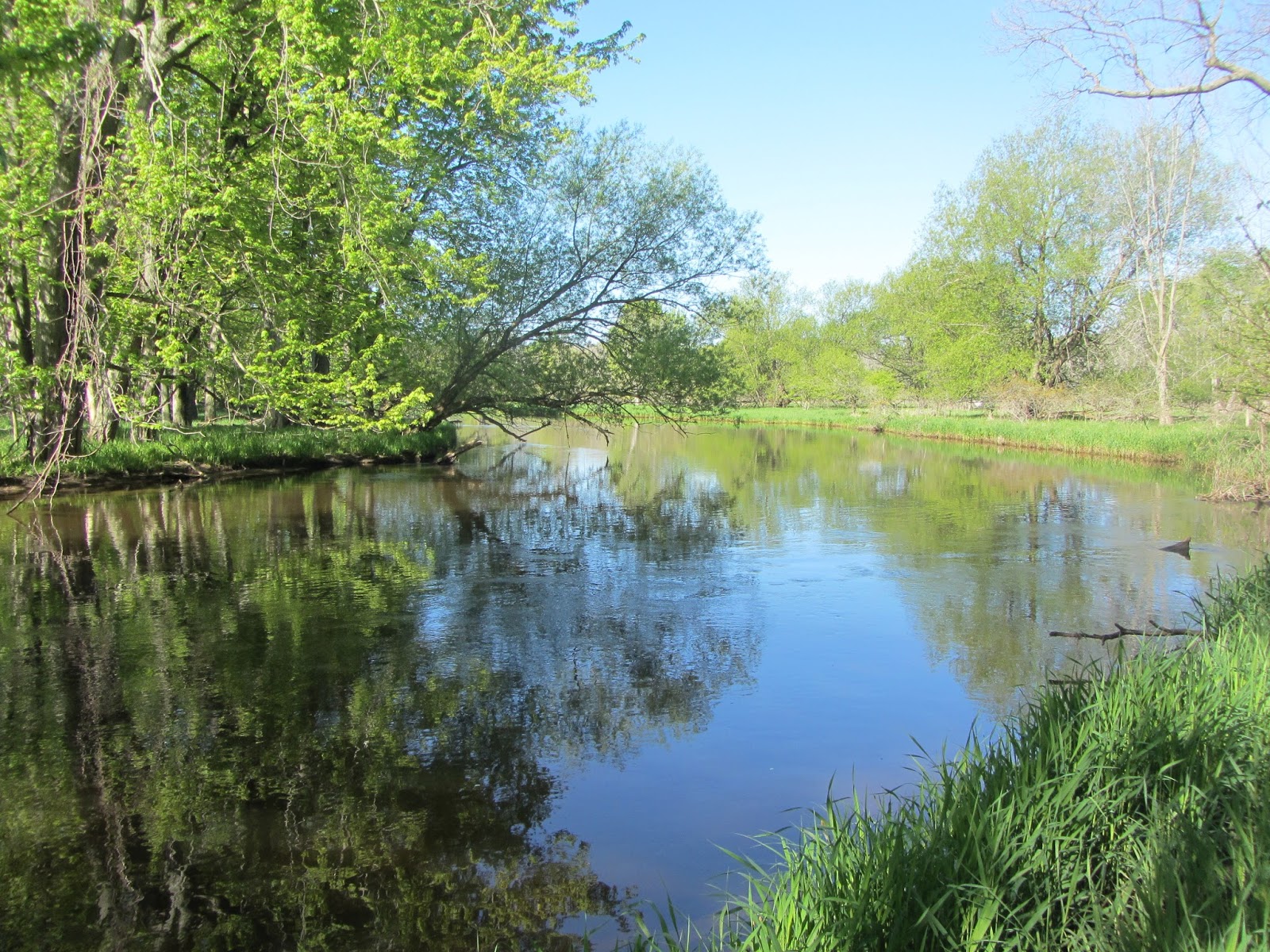
Thursday, Remi and I traveled 22 miles south of Alma to hike in part of the Maple River State Game Area just west of the village of Maple Rapids. The early morning weather was mostly sunny with a temperature of 61 degrees and no wind. Leaving the car on the dead end of a dirt road that also served as our trail, we headed south along the bank of the Maple River where I paused to take in this peaceful riparian landscape. On both sides of the trail, I spotted spring wildflowers including lots of white Meadow Anemone, a few white Virginia Waterleafs and a few purple-white Daisy Fleabanes. Next, I saw a the blossoms of Tall Meadow Rue. Further along, I looked up into a live Ash tree to see and hear a Song Sparrow. On a nearby Basswood tree, I noticed the new leaves had some holes caused by the feeding of the tiny Leaf-miner beetle. Continuing south, I heard a beautiful bird call and soon found its source perch high in a dead, leafless ash, a colorful male Rose-breasted Grosbeak. This bird’s sweet, robin-like song has inspired many a bird watcher to pay tribute to it. A couple of early twentieth-century naturalists said it is “so entrancingly beautiful that words cannot describe it,” and “it has been compared with the finest efforts of the robin and… the Scarlet Tanager, but it is far superior to either.” Present-day bird watchers have variously suggested it sings like a robin that has had opera training, is drunk, refined, in a hurry, or unusually happy. After turning around and heading back, I noticed a patch of Morning Star Sedge with its seed head that resemble a medieval spiked club. Also, close by, I could see the flower heads of Reed Canary Grass. Approaching the car, I could barely make out a needle-thin female Blue-fronted Dancer Damselfly resting on a Dogwood leaf. Finally, we found the car and head back toward Alma.

Curtain opens on the month of June
Sounds of spring, creatures in tune
On the blossoms, buzz of the bees
Westerly wind rustles the leaves
On the maple, red squirrel chatters
Voices of the wild, all that matters
On the pond, green frog croaks
Cardinal calls, high in the oaks
Robin, the melody, Downy, the beat
Nature in harmony, choirs complete

D. DeGraaf


Tuesday, May 24, 2016

May 21


Last Saturday, Remi and I traveled 100 miles west of Alma to hike at the 189-acre Lake Harbor Park near the coastal town of Muskegon. The midday weather was sunny with a temperature of 70 degrees and a gentle westerly breeze off Lake Michigan. From the parking lot, we followed an earthen trail west into a dense forest of mature broadleaf trees and conifers where I noticed the leaf litter had large patches of both Periwinkle and fragrant, but toxic Lilly-of-the-valley Also, I recognized a few pink blossoms of Lunaria Silver Dollar and yellow blossoms of what appeared to be Rough Cinquefoil. Continuing west to the lakeshore, I paused to see that the water level remained high. It’s amazing to me that just three years ago, the level was at an all time low and since has risen four feet to near record high. Next, I turned around and headed inland on a boardwalk that took me over a sand dune down into a wooded area where I easily spotted a perching male cardinal. I’ve often wondered how these birds can be so conspicuous and yet survive predation. It turns out that they are probably bright and loud for the same reason: to advertise what good mates they’d make. Brighter males have higher reproductive success, hold better territories, and offer more parental care. By responding to redness as a sign of a promising mate, females have encouraged the evolution of bright coloring in males. Furthermore, they tend to have high survival rates because they don’t endure the stress of migration. Further down the path, I paused to enjoy the variable call of a perching Catbird. Continuing east, I came upon a tree whose bark had been recently eaten by a Porcupine. Also, beside the sandy trail, I spotted a few tiny white blossoms of Lyre-leaved Rock Cress. Finally, the trail led back to the car and we headed back to Alma.

Whitecaps ride the wind
Surf pounds the sand.
Scenes of the coast
Vistas that are grand
Sandpipers wade
Ring-bills soar
Scenes of spring
Up and down the shore
Freshwater treasure
Living things depend
Great Michigan Lake
Glad to see you again


D. DeGraaf

Friday, May 20, 2016

May 19


Thursday, Remi and I traveled 9 miles southwest of Alma to hike with a fellow outdoorsman through part of his 130-acre property along the Pine River. The early morning weather was sunny with a temperature of 52 degrees and no wind. Leaving the car parked at his house, we headed south through an open field and stopped by a small vernal pond where the water was blackened by thousands of newly hatched tadpoles of the American Toad. Since female toads lay between 4000-8000 eggs, it was not surprising to see so many. Also nearby, mixed in with the grasses were some patches of Sheep Sorrel with their tiny red flowers. Historically, this plant has been used to treat a variety of ailments from inflammation and diarrhea to scurvy and cancer. What's interesting about this herb is that every single part of the plant can be used medicinally. Continuing south, we entered a forest of mature hardwoods where I spotted several blossoms of Swamp Buttercup as well as Arrow-leaved Violets. Just off the trail, I found a large, fresh Pheasant Back Mushroom. This edible fungus has an aroma similar to watermelon rind. Trudging through the flooded river flats, I noticed some white blossoms of Rock cress and blue blossoms of Woodland Phlox. Reaching the bank of the Pine River, we paused to observe the gentle easterly flow. Turning north, we saw evidence of Beaver activity including several gnawed stumps and an old lodge. Also, I spotted the delicate, fern-like leaves of Yarrow beginning to show themselves. Next, we turned around and headed east into another woodlot where I noticed some of the May Apples were beginning to bloom as well as Wild Geranium. Having completed our loop, we saw and heard a few geese out in the field. Walking north back to the house, we had to wash the mud off Remi before finally taking off for home.

Gone, winter white
From the forest ground
Below a closing canopy
Floor of lifeless brown
Next, the vernal sun
Warms the litter scene
Mosses and sedges
Introduce the green
Finally, spring colors
Long overdue
Finally, Mother Nature
Sprinkles violet blue


D. DeGraaf

Tuesday, May 10, 2016

May 9


Tuesday, Remi and I returned to Forest Hill Nature Area for our weekly nature hike. The early morning weather was mostly sunny with a temperature of 41 degrees and no wind. Leaving the car, I headed west and paused at the crest of Energy Hill to look at the western landscape. Next, I descended the hill and proceeded past Mallard Marsh where both male and female Redwings were busy tending to their nests, hidden in the cattails. Continuing west through Bobolink Meadow, I noticed a few yellow blossoms of Wild Mustard. I followed the trail through North Woods where the forest floor revealed large patches of Woodland Sedge, a few Wood Violets as well as a single Jack-in-the-pulpit. Exiting the woods, I circled west around Succession Field and passed through Birch Row where I paused to look and listen to a Yellow Warbler, perched high overhead. Turning into South Woods, I stopped on end of the boardwalk on Swanson Swamp to scan this remote wetland. Shortly after leaving the woods and turning east, I noticed an apple tree was beginning to blossom. Following the perimeter trail south and east, I made it to Native Grassland where I paused at the grove of Box Elder trees to listen to the multiple calls of a Catbird. Just ahead, I could see that Grebe Pond was clear and quiet. Continuing north, I noticed to the east across Rich Rd. that construction of the neighbor’s new house was nearly finished. Approaching the barn, I spotted a Pied-billed Grebe swimming near the pond’s shore. Note: the black band on its beak is only there during breeding season. Finally, we found the car and headed for home.

So many hikes, so many times
So many miles, so many climbs
Much we’ve seen, much we’ve heard
Lots of creatures, beast and bird
Memories of vistas, above and below
Clouds of sky and drifts of snow
Memories of wildlife, west to east
Favorite flora, large to least
A need to explore, a place to fulfill
Remi and me at Forest Hill


D. DeGraaf