Monday, July 16, 2018

July 16


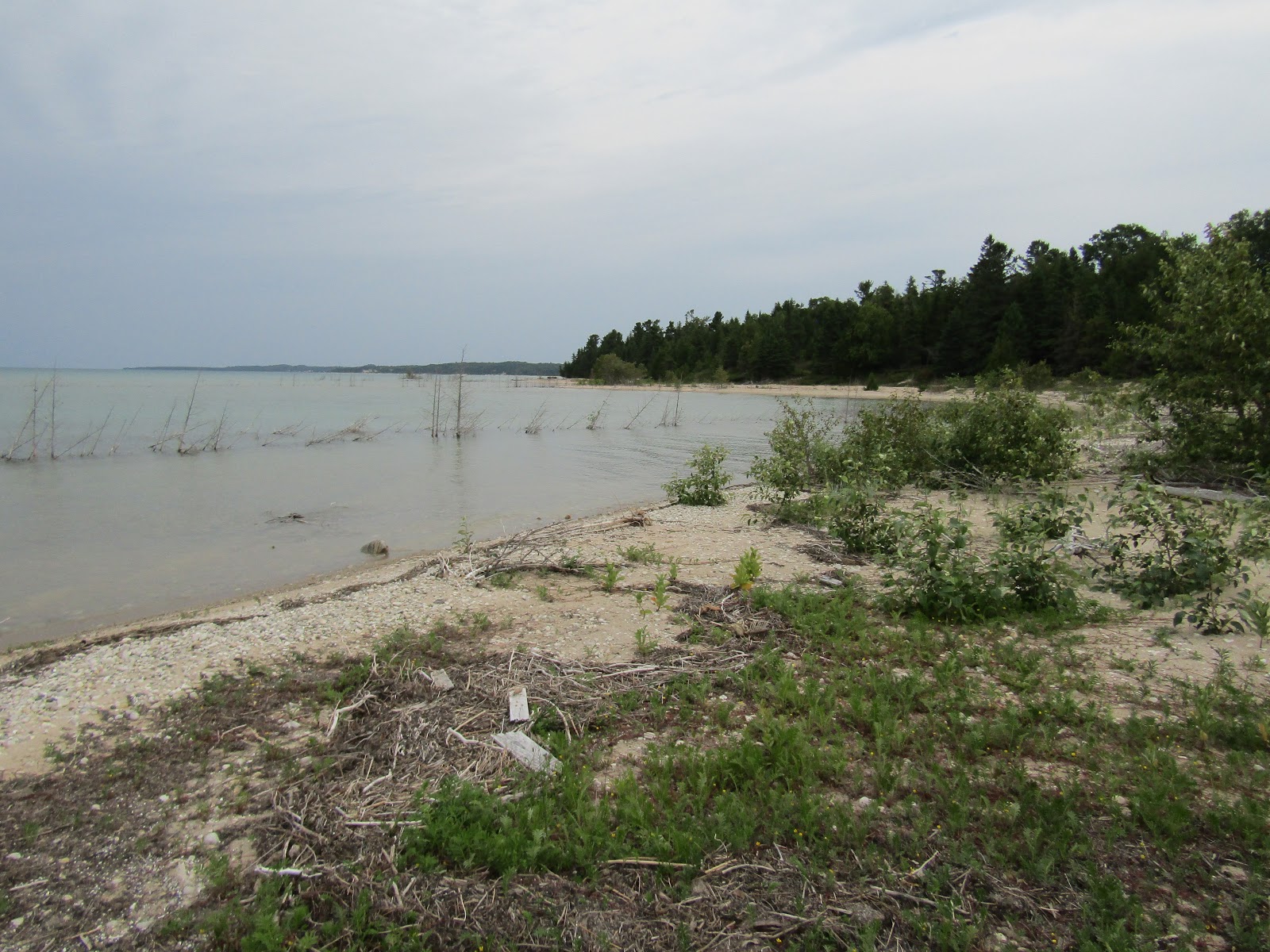
Last Thursday, while vacationing on Beaver Island, I did an early morning beach stroll from our rental house on the coast of Lake Michigan. The weather was cloudy with a temperature of 70 degrees and a gentle breeze off the lake. Before starting out, I stood facing the lake and noticed, as I did a year ago, that the water level remained high, flooded the old shoreline and drowned several young cedar trees. Heading south on the soft sand, I spotted a variety of small white crustacean shells scattered about including: snail, clam and the ubiquitous Zebra Mussel. Also, nearby I came upon part of the Synsacrum bone of a gull. Walking away from the water onto the fore dune, some colorful blossoms caught my eye including: Hoary Puccoon, Swamp Milkweed, Oxeye daisy and the aromatic Lake Huron Tansy, listed as a threatened Michigan species. Nearby, I saw a patch of Bearberry with some unripen fruit. Pausing to observe how the breeze moved through Cottonwood leaves, I was serenaded by a Song Sparrow. Continuing south along the beach, I came upon the fresh carcass of a Herring Gull, noting its size, plumage and lack of any sign of predation. Just ahead, I noticed blossoms of Common Dogbane and was surprised by their pleasant aroma. After observing a Monarch Butterfly fluttering up ahead, I was pleased that it landed on a Milkweed blossom long enough for me to zoom in and photograph it. After my hike, while reviewing my photos, I was pleasantly surprised to see I had inadvertently captured the partial image of a Monarch caterpillar on an adjacent plant. Still heading south, I spotted some foraging Canada Geese and a floating Ring-billed Gull. Near my feet, I watched the gentle waves wash over a bowling-ball size boulder of Granite Gneiss. Turning around and retracing my steps, I spotted a predaceous Robber Fly walking on the sand searching for food. Nearby, I noticed a Silverweed plant with its small yellow blossoms and burgundy runners. Finally, I made it back to the house just before rain started to fall.

Finally spotted you
Ended my search
Fluttering near
Paused to perch
Wings of orange
Border of black
Symbol of summer
Welcome back
On Milkweed flower
For a while stay
Magnificent Monarch
Beauty display

D. DeGraaf

Monday, July 9, 2018

July 9


Last Wednesday, I drove 17 miles north of Alma to hike in the 25-acre Williams- Blackburn Preserve, another property owned by the Chippewa Watershed Conservancy. The early morning weather was sunny, hazy with a temperature of 75 degrees and no wind. Leaving the car parked in the Bentgrass Ct. cul-de-sac, I headed south and then east on an easement next to fenced-in private land where lots of wildflowers were in bloom including: Oxeye Daisies, Field Yellow Clover and Black eyed Susan’s. Next, I turned south again and entered the wooded preserve where I looked east down a steep bank at the Chippewa River. After passing an old Red Pine plantation, I continued south down a steep bank onto a flat oxbow peninsula formed by the meandering river where a Robin greeted me from the dense canopy.On the ground, I noticed lots of wild Ginger and a few clumps of Gray’s Sedge. Reaching the river’s edge, I paused to observe the gentle current while listening to a duet sung by a Tufted Titmouse and Wood Pewee. Back on the trail, I continued to explore the peninsula where I spotted a tiny Single-dotted Wave Moth resting on a Cinnamon Fern leaf as well as a Crane fly perched on a blade of grass. Barely visible in the blanket of green vegetation that covered the ground was a striking dime-size mushroom called a Scarlet Elf Cup. Approaching the west side of the peninsula, I noticed a massive oak tree had fallen over the river channel. Working my way north, I climbed up the steep bank and followed the trail west where I spotted a Little Wood Satyr Butterfly perched on a leaf as well as an immature Nursery Web Spider resting on another leaf nearby. Continuing west, I came upon a spot of froth on a cattail leaf created by a Spittlebug. Turning around, I retraced my steps east and then north toward the trailhead where I spotted an Elephant Ear plant whose leaves were approximately 18 inches long. Nearby, I observed a significant accumulation of fresh sawdust at the base of an oak trunk created by a colony of Carpenter Ants. Finally, I returned to the car, turned on the AC and headed to Home Depot for some shopping.

Welcomed sight
Pleasant sound
Forging the earth
Carving the ground
Channel is full 
Current is swift
Burgeoning banks
Nature’s gift
Flowing water
Worthy of praise
Chippewa River
Admire her ways

D. DeGraaf

Monday, July 2, 2018

July 2


Last Friday, my wife, Caroline & I drove 23 miles south of Alma to hike in a section of the 10,000 acre Maple River State Game Area. The early morning weather was sunny, hazy with a temperature of 68 degrees and no wind. Parking in a small lot on the east side of US 127, we followed a wide grassy trail east where we immediately paused to smell the aromatic blossoms of an Elderberry bush. Continuing east on the trail covered with Mayweed, I spotted several Crab Apple trees whose leaves were infected by Cedar-Apple rust. Near my feet, I noticed a few blossoms of Black Nightshade. The white flowers are followed by edible berries that ripen to black, thus the name. Just ahead, more blossoms that caught my eye included: Swamp Milkweed, Hedge Bindweed and Moth Mullein. Still further, I came upon the carcass of a Muskrat. Upon closer inspection, I witnessed another one of nature’s cycles as hundreds of newly born maggots were feeding on the dead animal. Next, we turned south and followed a boardwalk to a duck hunting deck nestled in the cattails. Returning to the main tail, the fragrant scent of blossoming Milkweed plants caught our attention. We continued east where I spotted a Milkweed Beetle on a Milkweed leaf as well as hundreds of tiny Differential Grasshoppers hopping and basking in the sun, including instars in various stages. On the ground nearby, I noticed some blossoms of Birdsfoot Trefoil. After reaching a wide drainage ditch, we turned south where I saw some prickly flower stalks of Teasel as well as Canadian Thistle blossoms. On a nearby cattail leaf, I spotted an Orange Meadowhawk Dragonfly while overhead a Great Blue Heron flew past. After climbing to the top of the observation deck, we paused to scan the expansive cattail marsh to the west. Leaving the deck, we began retracing our steps to the north where I observed a Song Sparrow perched on a cattail seed head. Turning back to the west, I spotted some flower buds of Buttonbush and blossoms of Indian hemp. Continuing west toward the parking lot, we were glad to find some cooling shade as the temperature and humidity rose rapidly. Finally, we found the car, turned on the AC and headed for home.

Landscape of summer
Nature at her best
Monarch on Milkweed
Goldfinch on the nest
Mother goose in front
Goslings close behind
Queen Anne’s lace
In a meadow you’ll find
Above the placid pond
Swallows dip and glide
Between cattail reeds
Frogs and toads reside

D. DeGraaf

Monday, June 25, 2018

June 25


Last Thursday, I drove 20 miles northwest of Alma to hike in the 5-acre, Hiawatha Hills Preserve, owned by the Chippewa Watershed Conservancy. The early morning weather was mostly sunny with a temperature of 59 degrees and no wind. Leaving the car parked at the end of the Cedar Ct. cul-de-sac and before starting my hike, I immediately spotted some Yarrow blossoms, some Goat’s Beard seeds and a Gray Garden Slug feeding on a Milkweed leaf. Following a narrow earthen trail north through a woods of mature Beech and Maple, I came to the edge of the Chippewa River where I paused to look and listen to the gentle current as well as the song of an Eastern Phoebe. Nearby, I caught a glimpse of an American Rubyspot Damselfly perched on the inflorescenceof Reed Canary Grass. When it wants to fend off a rival, this damselfly flicks its wings open to flash the ruby spot. Wandering along the shore, I spotted: a few blossoms of Forget-me-nots, a clump of Bottlebrush Sedge, some common Arrowhead leaves, some raccoon tracks and a clam shell in the mud. Turning eastward, I faced the rising sun to commemorate the solstice and welcome in the summer season. Following the trail east, I passed through large patches of Lady Ferns and Cinnamon Ferns. Looking up at the lush canopy, I noticed small holes in some Basswood leaves caused by feeding of the Leaf Miner Beetle. Also, I was amazed by the dark green venation pattern in the light green leaves of a mature maple. Unfortunately, this is a symptom of a disease call Iron Chlorosis. Somehow the tree is deficient in iron that is needed for photosynthesis to take place and chlorophyll to form. Following the trail as it turned south, I was serenaded by a Northern Cardinal. Turning west, I came upon a centimeter-long Longhorn Caddisfly with antennae more than twice its length, perched on a fern leaf. These insects are an important food source for fish and a popular bait simulator for fly fishermen. Finally, I completed the loop back to the car and took off for home.

You had barely left
When maples turned gold
Started to miss you
When November blew cold
Began to wait
When nights were long
Waited some more
When ice was strong
Longed for you
When deer were lean
Hoped you’d come soon
To spread your green
You finally arrived
Been almost a year
Welcome back summer
Glad you’re here

D. DeGraaf

Monday, June 18, 2018

June 18


Last Thursday, I drove 45 miles west of Alma to hike in the 63-acre, Quigley Creek Natural Area, another one of the Chippewa Watershed Conservancy preserves. The early morning weather was sunny with a temperature of 59 degrees and no wind. Exiting the car parked alongside of 4 Mile Rd., I was greeted by the melodious tunes of a Rose breasted Grosbeak. After the bird flew across the road and perched in a far off tree, I caught a brief glimpse of it. Next, I headed south on an earthen trail through a dense woods along the edge of Quigley Creek. This narrow stream begins two miles northwest of here and flows southwest for about a mile and a half where it empties into the Muskegon River. Continuing south along the creek bank, I spotted some green unripen fruit of Baneberry as well as some yellow blossoms of Butterweed. The forest floor around me was blanketed with a variety of ferns including: Maiden Hair, Sensitive, Bracken and even a solitary Christmas fern. Also, hidden in the lush vegetation was some kind of unknown thistle as well as some unknown star-shaped green flowers. Next, I paused to enjoy the soothing sounds of this gently flowing creek. Proceeding south, I took in the sights while being serenaded by a Tufted Titmouse. Out in the water, I noticed a decaying log contained its own little diverse plant community. After turning around to retrace my steps, I came upon a patch of lovely Pale Yellow Iris. Continuing north, a shiny orange blob on the ground caught my eye. A closer look revealed it was a colorful fungus that I had never seen called Hemlock Varnish Shelf. This is a type of reishi mushroom that has a long history of use in Chinese medicine. Rishi mushrooms can also be used to make tea and dye wool. Numerous studies have looked at this fungus for its antioxidant properties and its potential use in therapy for cervical cancer. One of the most novel uses of Hemlock Varnish Shelf is as a skin substitute during wound healing. This substance, commercially sold as Sacchachitin, has been proven to promote and speed up skin healing. Approaching the trailhead, I also spotted a cluster of the familiar Pheasant Back Fungi clinging to a tree trunk. Finally, I returned to the car and headed east for home.

I welcome these June days
When whitetails stop to graze
I welcome the warming sun
On fields where rabbits run
I welcome the scent of clover
That spreads the meadow over
I welcome the forest scene
With all its shades of green
Nature’s month of glory
Part of her seasonal story

D. DeGraaf
Monday, June 11, 2018

June 11


Last Friday, I returned to Lumberjack Park near Riverdale to hike on their recently completed nature trail. After a little over two years of development, I am pleased to announce that the trail is now open to the public. The early morning weather was partly sunny with a temperature of 59 degrees and a gentle breeze from the northeast. Leaving the grass parking area off Lumberjack Rd., I followed the White Pine Trail east where I noticed the May Apples were starting to display raw fruit. After a short distance, I veered to the right and followed the Riverview Trail along a high bank of the Pine River where I paused at one of the scenic overlooks. Continuing east, I left the trail briefly and hiked down to the river’s edge to view the gentle current while being serenaded by a Tufted Titmouse. Back on the trail as it turned sharply to the north through a corridor of Red Pine trees, I stooped to observe a mating pair of White Wave moths. Just ahead, I joined up to the Mud Creek Trail as it ascended a slope and turned south to the edge of the creek where I spotted several white blossoms of Canada Anemone and Daisy Fleabane. Also, fluttering near the ground were a dozen or so Ebony Jewelwing damselflies, both male and female (white spots on wing tips). On the bridge, I paused to watch the water flow west while listening to a Song Sparrow. After noticing the blossoms of a Ninebark shrub as I left the bridge, I followed the trail as it turned west past a patch of Wild Iris. Next, I turned south and walked on a boardwalk over wetlands covered with reeds, ferns and skunk cabbage. Up the steps, I continued south on the Sugar Maple Trail to the other trailhead and parking area off Madison Rd. From there, I followed the Sugar Maple Trail as it looped east, then north and then west where I paused to hear a Red-eyed Vireo perched high in the lush maple canopy. Reconnecting to the Mud Creek Trail, I retraced my steps north back to the White Pine Trail and followed it due west where I spotted some edible Oyster Mushrooms growing on a tree trunk. Finally, I made it back to the car and headed home

Off the noisy road
River flows ahead
Nature all around
Pristine path I tread
Corridor of conifers
Pines of white and red
Pavement of needles
Pristine path I tread
Over a muddy creek
Cross a bridge instead
Walk a wooden way
Pristine path I tread

D. DeGraaf

Tuesday, June 5, 2018

June 5


Last Saturday, I drove 32 miles northwest of Alma to join about a dozen members of the Chippewa Watershed Conservancy for a bird hike in the 165-acre, Hall’s Lake Natural Area, one of the Conservancy’s preserves. The early morning weather was overcast with a temperature of 52 degrees and a steady northeasterly breeze. Leaving our cars parked on Broomfield Rd, we hiked west through a dense deciduous forest while listening to the call of a Tufted Titmouse. Continuing west, I noticed the leaf litter was sprinkled with two kinds of small white blossoms: Starflower and Canada Mayflower. Pausing at a high bluff above Hall’s Lake, we listened to the song of a Northern Water Thrush. Turning north, we continued along the lakeshore where I spotted some Cinnamon Ferns with their cinnamon-colored spore stalks from which the name derives. Next, we stopped to listen to the song of an American Redstart coming from the dense canopy. Up in a nearby Birch tree, we could barely see a Robin sitting on its nest while on the ground I noticed a single Bunchberry blossom. Proceeding north on a footbridge over a marshy area, we were surrounded by large patches of Wild Iris in bloom. Back in a secluded area, I discovered the ball-like flower clusters of Tufted Loosestrife. As the trail curved west along the lake, I stooped down to get a closer look at some fresh Oak apple galls as well as some Bubblegum Slime Mold. Turning north, we followed the trail as it ascended to the top of a hill where we paused to hear a single call of a Crested Flycatcher followed by the call of another Northern Water Thrush. Turning around, we stopped briefly to explore a peat bog where I stepped out on thick mat of Sphagnum Moss growing over the water and jumped up and down to watch it bounce. Nearby, I spotted a lovely blossoming Calla Lily. Continuing south toward the trailhead, we passed by a few Wild Columbine blossoms. Finally, we got back to our cars and headed home.

Curtain opens
On the month of June
Far from the shore
Call of the Loon
Dragonfly perches
Wings to dry
Down in the duckweed
Turtles lie
Muskrat moves
Through cattails green
Mother Nature
Directs the scene

D. DeGraaf