Monday, October 15, 2018

October 15


Last Thursday, I hiked in Chippewa Watershed Conservancy’s Ball Preserve. Unlike most of the preserves, this 5-acre parcel is only accessible from the Chippewa River. The early morning weather was overcast with a temperature of 50 degrees and a strong westerly wind. From the west end of the property I looked upstream a few hundred yards where I could make out the shoreline of the Audubon Woods Preserve. With no trail to follow, I made my way around the convex-shaped riverbank where I paused to take in the sights and sounds of this riparian landscape. Further along, I paused again as a strong gust of wind blew several colorful leaves off the trees overhead into the rapidly flowing current. On the less turbulent water near shore, I observed a few Water Striders scurrying about. Near the eastern boundary of the preserve, I turned inland to explore more of the property that consisted of a dense broadleaf woodland. Perusing the leaf litter, I spotted mostly samples of Sugar Maple, Silver Maple, American Beech and American Hornbeam with an occasional Red Maple and Big Tooth Aspen. Scanning the entire property, I could clearly see that it formed the inside bend of the meandering river. Looking skyward I noticed the canopy was thinning out while on the ground I spotted a few Lady Ferns retained their summer green color. While continuing to walk around, I discovered more signs of autumn including: the yellowing of Spicebush leaves and the reddening of White Oak leaves. Next, I came upon some fresh Oyster Mushrooms growing on a tree trunk. Besides being edible, these fungi play a growing role in mycorestoration, a process of using mushrooms to clean up pollution. Because they secrete enzymes that break down toxic chemicals, these mushrooms have been used to clean up oil spills as well as remove heavy metal compounds from dumpsites. Near the south end of the property, I came upon a large, weathered metamorphic rock with its distorted surface layers. Finally, I took off and headed for home.

Around the bend
Clear and cold
Surface in motion
Leaves of gold
Floating branches
Budweiser can
Debris of nature
Litter of man
Needles and twigs
Onward they go
Artifacts of autumn
Flow river flow

D. DeGraaf

Monday, October 8, 2018

October 8


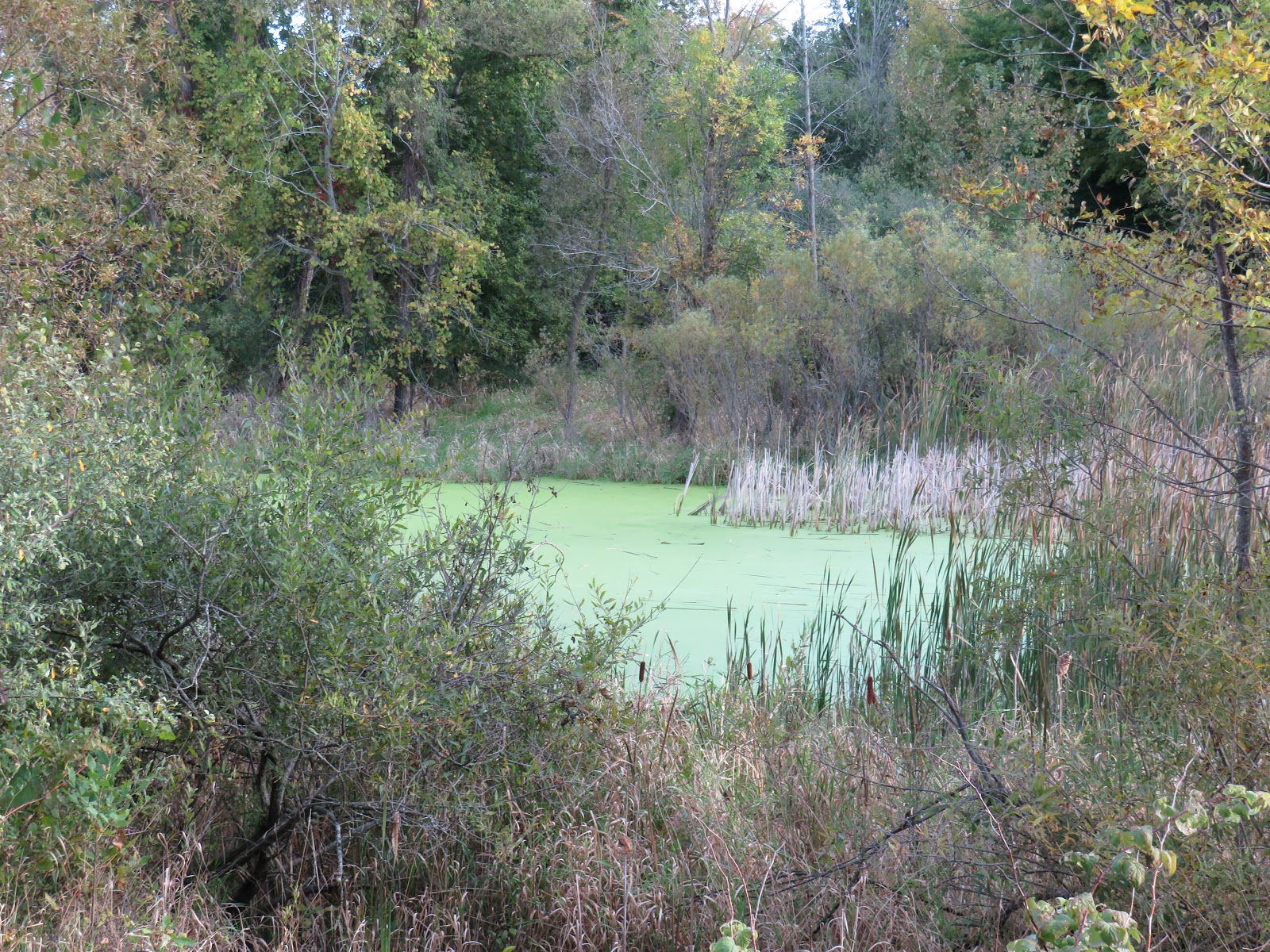
Last Thursday, I drove 20 miles northwest of Alma to hike in the 2-acre, Winawa Preserve, another property of the Chippewa Watershed Conservancy. The early morning weather was partly sunny with a temperature of 54 degrees and a gusty wind out of the northwest. After parking the car off Nottawa Rd just north of Wing Rd., I entered the north side of the preserve and hiked south into a landscape marked by small clearings surrounded by shrubs as well as mature broadleaf and conifer trees. Exploring the area, I gazed skyward to watch a tall Cottonwood tree rustling in the wind while on the ground I spotted some of its leaves including some that were losing their green color in accordance with the season. Other seasonal indicators that caught my eye were the reddening leaves of Poison Ivy and Virginia creeper. Colorful ripened fruit that I noticed included Wild Grapes and Multiflora Rose hips. This berry-like fruit can be eaten raw but making a hot or cold tea out of them is a popular way to enjoy their unique flavor. To make the tea, these hips can be mashed and steep in hot water. Continuing to walk around the northern part of the preserve, I came upon a large stand of invasive shrubs including Autumn Olive and Bush Honeysuckle with their bright red berries. Making my way south, I came to the edge of a shallow, 1-acre pond covered with Duckweed and Watermeal. Being the main reason for the preservation of this land by the Watershed Conservancy, this body of water harbors one of the best populations of Western Chorus Frogs in Isabella County while also serving as a crucial migratory stop for Sora and Virginia Rails. As I circled the pond, I spotted the colorful fruit of Virginia creeper while also hearing the familiar call of Redwing Blackbirds. Since the breeding and nesting time for Redwings who used this spot was long over and they headed south several weeks ago, it is likely that these birds are migrants from northern areas who are passing through on their way south. Finally, I returned to the car for my trip home.

Landscape of autumn
Transformed once again
Creature of summer
Retreats to its den
Milkweed pods
Dry up and shred
Silky white seeds
Escape and spread
Goodbye to the goose
Farewell to the crane
October commences
In nature’s domain

D. DeGraaf

Monday, October 1, 2018

October 1


Last Friday, while in Chicago for a family reunion, my wife, Caroline and I hiked in the 13-acre, Montrose Point Bird Sanctuary, 7 miles north of the Loop. The midday weather was mostly cloudy with a temperature of 62 degrees and a gentle lake breeze from the northwest. After being dropped off by a taxi, we followed a woodchip-covered footpath east into a wooded area where I spotted several patches of White Snakeroot. The common name of this species derives from the erroneous belief among early settlers that the bitter rhizomes were beneficial in the treatment of snakebites. In fact, the foliage and rhizomes are highly toxic, causing fatalities from 'Milk Sickness' because the toxins can pass through the milk of dairy cattle to humans. Veering south, with the city skyline in view, we entered a meadow punctuated with the purple hue of New England Asters along with a few seldom seen Harrington Pink Asters as well as some wispy floss of Milkweed seeds busting from the pods. Upon further exploration of the meadow, I spotted: a Monarch butterfly, a small Fiery Skipper Butterfly and a large Field Grasshopper. In addition, a bush, smothered with invasive Sweet Autumn Clematis vines caught my eye. Turning east, we walked along the sandy Lake Michigan shoreline where I paused to observe some moderate wave action. Next to the pier, I caught a brief glimpse of a female Hooded Merganser while on a far fence post, I saw a Palm Warbler in non-breeding plumage. Upon further investigation, I noticed some lovely Evening Primrose as well as some dainty Nodding lady’s tresses orchids. Also, I walked by a few blossoms of Silverweed as well as a patch of Nut Sedge. Winding around back into the woods, I was surprised to come face to face with a perching immature Cooper’s hawk. Just before completing the circular trail, I paused to watch a Bubble Bee feeding on Calico Aster flowers. Finally, we reached the trailhead and called a taxi to return to our rental.

Onset of autumn
Behold! Some signs
Debut of the reds
Virginia creeper vines
Shriveling brown fronds 
Drape the Bracken Fern
Blossoms of Aster
Everywhere you turn
Late September air
Chills the early day
Cold bloods retreat
Nature shows the way

D. DeGraaf

Monday, September 24, 2018

September 24


Last Saturday, I drove 22 miles northwest of Alma to hike in the 1-acre, Meridian Road Preserve, another property of the Chippewa Watershed Conservancy. The late morning weather was sunny with a temperature of 52 degrees and a steady cool breeze out of the north. From the parking area at the south end of Isabella County’s Meridian Park, I proceeded south on a narrow, discreet earthen trail along the western edge of the Chippewa River where I paused to face the rising sun penetrating the dense canopy as later this evening it will descend across the celestial equator to mark the beginning of autumn. Continuing south, I noticed some leaves changing colors including: Hickory, Poison Ivy and Virginia creeper. Along the way, the bright red berries of Viburnum and the fluffy white seeds of Old Man’s Beard (Clematis) caught my eye. As the trail meandered near the riverbank, I paused to observe the glistening current flow to the north past blossoms of the Joe Pye Weed that had seeded out. After reaching the Meridian Rd. Bridge, I turned around and began retracing my steps when I caught a brief glimpse of a Chickadee foraging in a spruce tree as well as a Chipmunk scurrying through the under brush. Just before reaching the car, I was surprised to see an immature, 30-inch Northern Water Snake swimming near shore with a 6-inch fish in its mouth. Finally, I returned to the car and drove less than a mile west along Hiawatha Dr. to hike in the 2-acre, Neyer Preserve, another one of the Conservancy’s property. Parking along the edge of the road, I proceed south down a steep wooded, embankment that appeared to be a remnant of a former oxbow of the Chippewa River. Exploring the river flats, I came upon several clusters of Milk-cap mushrooms as well as some Coral fungi. In addition, I stopped by a 12’ x 12’ deer exclosure that was placed there by researchers from the Conservancy. Continuing south, I stopped to glance up river and down before retracing my steps back toward the car where I paused to scan that mature woodlot. Finally, I climbed up the embankment to the car for my trip home.

Orb of the sky
Light of the day
Predictable path
Found your way
Summer’s high
To winter’s low
Reached the mid
Then down you go
Seasonal sign
Of nature’s law
Sun of the heavens
Welcome to fall

D. DeGraaf

Monday, September 17, 2018

September 17


Last Tuesday, I drove 23 miles northwest of Alma to hike in the 8-acre, McNeel Preserve, another property of the Chippewa Watershed Conservancy. The early morning weather was sunny with a temperature of 52 degrees and no wind. Leaving the car parked off Saratoga Springs Road, I headed east across Winn Rd onto the preserve where I spotted a few patches of the invasive Crown Vetch. With no trails to follow, I plodded through a dense stand of Aspen trees along the north edge of Urie Drain while noticing the unripen fruit of Silky Dogwood and the ripen fruit of Virginia creeper. Continuing east, both the needle-covered ground and the canopy indicated I was passing under a stand of mature Red and White Pines. As the drain curved sharply to the north, I leapt over it and continued east on a game trail through a dense woods of Beech, Maple & Oak where I noticed patches of Bracken Ferns whose fronds were beginning to turn brown, an early sign of fall. Arriving at the edge of the Chippewa River, I paused to look and listen as the water flowed rapidly, still carrying runoff from heavy rain over the past few weeks. From here this ever-meandering river flows north to Deerfield Nature Park where it makes a sharp turn east toward Mt. Pleasant. Following the river north along a gradually ascending bank, I spotted some raccoon scat on a bed of pine needles, some Maidenhair Ferns as well as a fresh patch of Turkey Tail fungi on a decaying stump. Turning west, I made my way back to the edge of the Urie Drain where I spotted several blooms including: Blue Beards tongue, White Turtlehead, as well as a mix of Sky blue Aster and Goldenrod. Once again, hopping over the drain, I continued wandering west where I spotted some large, aged (12” diameter) Artist Conk fungi on an old stump as well as a few 5-inch diameter Fly Amanita Mushrooms. Also, I was pleased to stumble upon some rarely seen blossoms of Bottle Gentain. Finally, I exited the property, crossed Winn Rd and found my car before heading for home.

Waning days of summer
Nature’s hues revealed
Purple Aster blossoms
Dot the golden field
Maples on the edges
Those in between
Still hold their leaves
Still show their green
Rose hips of red
Berries blue and white
Finches flash yellow
New season in sight

D. DeGraaf

Monday, September 10, 2018

Sept 10


Last Friday, I drove 45 miles northwest of Alma to hike in the 79-acre Peterson Natural Area, another property of the Chippewa Watershed Conservancy. The early morning weather was sunny with a temperature of 52 degrees and no wind. Leaving the car in the parking area off 180thAve., I proceeded west into an expansive grassland with the sun at my back and no trails to follow. The first thing I noticed was that the dewy conditions combined with the angle of the sunrays exposed hundreds of spider webs clinging to the vegetation. At the “bulls eye” of many of the large circular webs was a Yellow Garden Spider. This common, colorful orb weaver creates a delicate, spoked web of silk to capture its prey. At the end of today, it will eat what’s left of the web and make a new one tonight. The smaller, non-circular webs that appear messy and disorganized were created by a tiny 1/8-inch Cobweb Weaver (barely visible). Proceeding west, I came upon a large meadow covered with yellow blossoms. While most of them were from Canadian Goldenrod plants including this one being visited by a grasshopper, a few were of the Lanced-leaved variety. It’s time once again to remind the reader that Goldenrod pollen is not the source of seasonal “hay fever” allergies, but instead it’s the less showy Ragweed. Continuing to explore the meadow, I spotted a few blossoms of Small-flowered White Aster as well as Spotted Knapweed. In a field ahead, I noticed a hue of pastel purple coming from a patch of Purpletop grass whose spikelets bloom this time of year. Even though the Milkweed plants I observed were no longer in bloom, one was being partially consumed by a Monarch caterpillar while another provided a basking place for an adult Monarch. Within a month or so, the adults will begin their 3000-mile migration to Mexico. Still meandering around the meadow, I spotted a Pearl Crescent Butterfly resting on a blade of grass. Next, I turned around and began retracing my steps east where I was amazed how the morning sun reflected off a dewy patch of Purpletop grass. Finally, I reached the car and started my journey home.


Throughout summer
Green had its way
Grasses and shrubs
Meadow’s display
Splashes of white
Queen Anne’s Lace
Milkweed pink
If only a trace
Along comes yellow
To blanket the sod
Autumn approaches
Behold! Goldenrod

D. DeGraaf

Monday, September 3, 2018

Sept. 3


Last Wednesday, I drove 32 miles northwest of Alma to hike in the 25-acre Kjolhede’s Kove Preserve, another property of the Chippewa Watershed Conservancy. The early morning weather was mostly cloudy with a temperature of 68 degrees and a gentle breeze out of the west. Leaving the car parked along side Beal City Rd, I put on my knee boots and proceeded south into the preserve that can best be described as a deciduous jungle whose only access are a few barely used game trails through mud and deep puddles. After spotting the red fruit clusters of Jack-in-the-Pulpit, I made my way to the edge of Coldwater River that was flowing fast and spilling over its banks due to heavy overnight rain. This scenic, 13-mile stream flows south out of Littlefield Lake, passes through Weidman Mill Pond, continues south to where I stood, then passes through Coldwater Lake and finally empties into the Chippewa River, three miles south of here. Trudging south through muddy water as I followed the river toward Coldwater Lake, I noticed a pair of tiny Goldenrod Crab spiders on a Common Boneset blossom. Further ahead, I came upon a large swarm of Woolly Alder Aphids feeding on the sap of a Tag Alder branch. The “wool” on these tiny insects is wax, produced by their abdominal glands. The wax streamers shed water, make the aphid look like mold, and are distasteful and distracting to predators. The strands also assist this insect in flight, helping it float in the breeze and disguising it as an airborne plant seed. These aphids excrete honeydew as a byproduct that is a food source for ants. These guardian ants (brownish color on photo) in turn “milk” the aphids while also protecting them from predators. Since the water got deeper and the footing got worse before I could reach Coldwater Lake, I retraced my steps back to the car and drove east a short distance where I was able to gain lake access. On the rocky shore, I spotted Jewelweed, Purple Loosestrife, Smartweed and Sow Thistle. Gazing to the northwest across the cove, I could make out the shoreline of the preserve. Back to the car again, I headed home.

September awakes
Summer holds on
Beyond the shore
A graceful swan
Herons remain
Redwings have fled
A frog sits still
By the river bed
Nature’s realm
Forest is lush
Away from town
A welcomed hush

D. DeGraaf