Monday, July 15, 2019

July 15


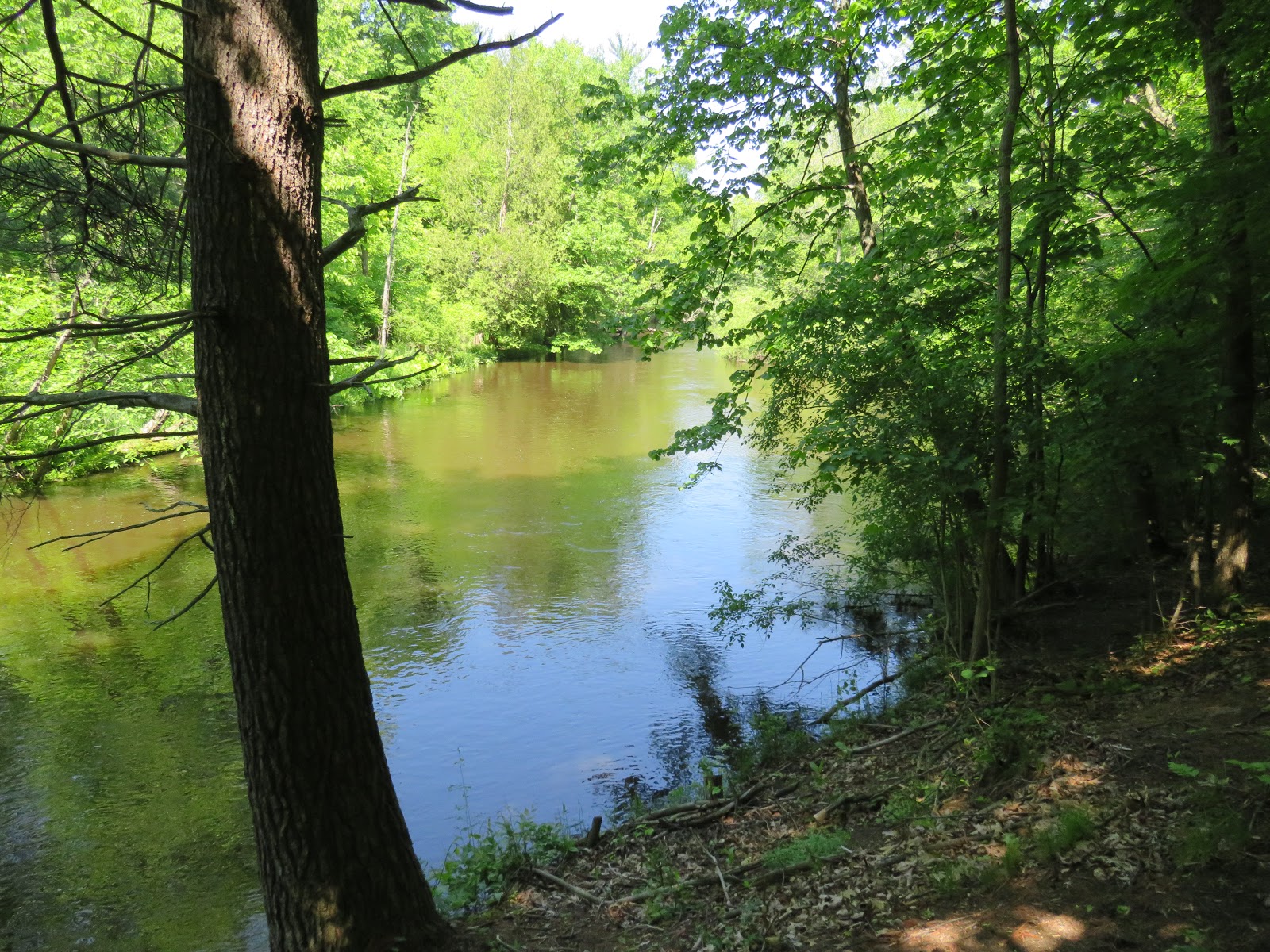
Another Chippewa River rendezvous awaits as I follow a narrow trail south through Indian Pines Park, an 80-acre, secluded forest off Valley Rd., northeast of Mt. Pleasant. The ½ mile hike through a dense woods from the trailhead to the river, allows me to hear the song of the Yellowthroat (stock photo), taste some wild Raspberries and spot a ¼ inch land snail crawling slowly over a Poison Ivy leaf. Also, I notice the tiny blossoms of White Avens vine and the artistic design on the wings of a resting Wood Satyr butterfly. After passing through a stand of aging White Pine trees, I arrive at the river’s edge and pause to observe the water flow gently to the east. Along the bank, a variety of wildflowers are in bloom including: St. John’s wort, Black-eyed Susan and Milkweed. While following the trail downstream, I also see a mixed patch of Deptford Pink and Oxeye Daisy. Also catching my eye is a ¾ inch Soldier Beetle on daisy petals and a ¾ inch Two-striped grasshopper on a Motherwort stalk. Continuing along the bank, I discover blossoms of a Sweet Pea vine as well as a Basswood tree. Barely able to see its transparent wings, I locate a colorful 1½ inch Common Green Darner dragonfly resting on a twig. Like Monarch butterflies, multiple generations of these insects migrate annually. The first generation emerges in the southern United States and Mexico and flies north. Here, they lay eggs and die, giving rise to a second generation that migrates south. A third generation, hatched in the south, overwinters there before laying eggs that start the process over again. On a nearby Catalpa tree, I estimate the size of one of its leaves to be about 12 inches from petiole to tip. After taking one last look at the river, I turn around and make my way back toward the car passing a Goat’s Beard flower that has gone to seed. Retracing my steps through the woods back to the car, I reflect on my ninth encounter with the river and look forward to those yet to come.

Its journey begins
Far to the west
A precious load
No time to rest
Thru farms and fields
Woods and lakes
Parks and towns
Its way it makes
Living waters
For man and beast
Greening the ground
Flowing east

D. DeGraaf

Tuesday, July 9, 2019

July 9


On a warm, humid morning, a swarm of mosquitos accompany me for a hike through a 40-acre forest owned by the Ithaca Public Schools. While the rising sun penetrates the dense canopy, I spot a 4-ft tall Bull Thistle plant ready to bloom as well as a ¾-in White Wave Moth nestled in the undergrowth. Continuing south, I come upon a 1-acre pond, still swollen from above average rainfall. Near the water’s edge, I can barely see a well-camouflaged Green Frog with a tympanic membrane much larger than its eye, indicating it’s a male. Moving ahead, the ground vegetation displays a mix of Royal and Sensitive Ferns in addition to some Gray’s Sedge with their spikelet seed heads. While gazing skyward, I hear the drone of an airplane followed by the squawk of a Red-Bellied Woodpecker. Facing another direction, I pick up the distant call of a Wood Thrush. Still exploring the damp forest floor, I come upon some white Slime Mold as well as tiny Orange Mycena Mushrooms. Turning back toward the car, I notice deer scat on the leaf litter. The texture and shape of these droppings indicate a moist, leafy diet in contrast to those of winter (stock photo). Looking around, I catch a glimpse of a perching Chipmunk. Reaching the clearing where the car is parked, I spot blossoms of Moth Mullein, Crown Vetch as well as Motherwort being fed upon by a Bubble Bee. Before heading home, I pause to remember how only a few years ago, this property, only 4 miles west of town, was well marked and maintained as a field trip destination for the district’s elementary students. Now, missing and broken signs indicate a lack of usage and missed opportunities for school kids to break away from sedentary desk work, get outside and hike these trails to connect with nature.

Nature in rhythm
July days ahead
Summer sky blue
Raspberries red
Creatures are born
Consume and grow
Vultures fly high
Frogs lie low
Pond floods full
Up to the brim
Neath the surface
Tadpoles swim

D. DeGraaf

Monday, July 1, 2019

July 1


On a sunny, warm afternoon, I’m in Nelson Park, strolling along the banks of the Chippewa River as it makes its way through the heart of the city of Mt. Pleasant. Near the water’s edge, I spot some Red Clover and a pair of Mallards while a human floater passes by. As I pause to take in the sights and sounds of the gently flowing river, I can also hear nearby traffic and lawn mower noise. The flow rate at the Mt. Pleasant station today is 431 cubic feet per second compared to 600 cfs that was recorded back on June 3 when I canoed the river in Deerfield Park. Further ahead, I come upon the ripening fruit of a Mulberry tree as well as a blossoming Bushy Cinquefoil shrub. While a group of kids wade in the water, I explore a nearby tributary that is teeming with minnows. Continuing north on a paved path, I cross the railroad tracks into Island Park where the river forks as part of the main channel is diverted to circumvent the park to create the “island”. Following the paved path north, I spot a Cabbage White Butterfly perched on a Dame’s Rocket flower as well as a blossom of Hedge Bindweed. Noticing a Wild Carrot plant among the lush vegetation, I pull it up to take in the fresh “carrot” aroma of its root. It won’t be long before these plants decorate the summer landscape with their lovely “Queen Anne’s Lace” blossoms (stock photo). Also, my eyes are drawn to a Silky Dogwood shrub with clusters of unripen berries that will turn a deep purple when ripe. Down at the river’s edge, I pause to look and listen as the water surges through a narrow channel. Turning around and retracing my steps back into Nelson Park, I observe a large stand of Staghorn Sumac displaying both dead panicles from last year as well as newly formed male flowers. Just before reaching the car, I spot a patch of White Clover and Creeping Jenny on the riverbank. Thus ends another encounter with the river as I reach the approximate halfway point on my journey to its mouth.

Singing birds, traffic span
River of nature, river of man
Soothing sounds, noisy clan
River of nature, river of man
Pristine banks, cola can
River of nature, river of man
Clean water, fishing ban
River of nature, river of man
Flowing free, levee plan
River of nature, river of man

D. DeGraaf

Monday, June 24, 2019

June 24


On this cool, cloudy morning in Chipp-A-Waters Park, I’m excited to reunite again with the Chippewa River as it begins it journey through the city of Mt. Pleasant. While observing the gently flowing water, my attention draws to a female Snapping Turtle (16 inch shell) digging into the riverbank in preparation for laying her eggs. Once a shallow bowl-shaped nest is dug, she will deposit 20-40 creamy white, ping-pong ball-sized eggs (stock photo), guiding them into the nest with her hind feet and covering them with dirt for protection. Incubation time ranges from 9-18 weeks after which the defenseless hatchlings must fend for themselves (stock photo). Since the eggs and hatchlings are easy prey, only a few offspring survive. Following a paved path next to the river, I spot a variety of yellow blossoms including: Mustard, Wintercress, Yellow Sweet Clover, Birdsfoot Trefoil and Hop Clover as well as white blossoms of Bladder Campion, Multiflora Rose and Oxeye Daisy. On the path ahead, I notice a Cowbird while across the river, an Eastern Kingbird catches my eye. The surface of a small pond beside the trail appears to be ice-covered but in fact is blanketed with fuzzy-white seed fibers that fell from surrounding Cottonwood trees. Approaching the Brandell Bridge, I come upon another Snapping Turtle mother preparing her nest. Pausing on the bridge, I first gaze far upstream through a corridor of lush vegetation and then downstream as the river meanders eastward through the park. Turning around and retracing my steps along the bank, I notice Reed Canary Grasses are blooming and from the canopy above, the squeaky song of an American Redstart (stock photo). Approaching my starting point, I spot a Song Sparrow on a twig and a Brown Damselfly on a piece of dead epidermal tissue, before bidding farewell to the river until next time.

Constant current
Steady stream
Cool waters
Morning steam
Soothing sounds
Along the way
Music of nature
Night and day
Chippewa River
Getting to know
Onward you journey
Forward you flow

D. DeGraaf

Monday, June 17, 2019

June 17


The late morning sun shines through the dense canopy of Sugar Maple trees as I begin my hike at the south trailhead of Lumberjack Park Nature Trail. The newly fallen green maple leaves littering the trail is a sign that tiny 1/3-inch larvae of the Maple petiole borer (stock photo) are actively feeding. Rarely seen adults are ¼ inch non-stinging wasps called sawflies (stock photo). Fortunately, this premature leaf drop is short term and does not kill the trees. Continuing north on the boardwalk, I’m greeted by several fluttering Ebony Jewelwing Damselflies. Emerging from eggs laid in surrounding water, these insects spend about a year in the submerged naiad stage (stock photo) before molting into winged adults that live about 2 weeks. Up ahead, my attention is drawn to colorful blossoms of Wild Iris peaking through the marshy vegetation. Turning east, I come to the newly repaired bridge over Mud Creek where I spot blossoms of Daisy Fleabane and wild Raspberry growing along the banks. Downstream, seeds from towering Cottonwood trees fall like snow on the flowing water. Making my way west onto the White Pine trail, I pause to look and listen to the commotion of Fox Squirrels chasing each other through the dense canopy. Nearby, a Black Squirrel (Melanistic Gray) stares me down while clinging to a tree trunk. Before reaching the north trailhead, I veer sharply to the left and follow the Riverview Trail to one of my favorite vistas where I rest to enjoy the sights and sounds of the gently flowing Pine River. Looping back to the north through a stand of mature White and Red Pines, I stop to notice a Little Wood-Satyr Butterfly resting on a leaf. Retracing my steps back toward the car, I listen to a chirping Chipmunk perched on the forest floor. Back at the car, I reflect on the good condition of the trail and the work that is being done on a new section that should open next summer.

Signs of spring abound
Mother Nature thrives
Frog sits and watches
Duck swims and dives
Nests fill with chicks
Forest fills with green
Warbler on a branch
Heard but seldom seen
Seasons are changing 
Summer arriving soon
May, a distant memory
Such are days of June

D. DeGraaf

Monday, June 10, 2019

June 10


Here I am hiking in Meridian Park, seeking another encounter with the Chippewa River as we both continue our 90-mile journey through the fields and forests of Mid-Michigan. Since I last saw this waterway leave Deerfield Nature Park, it has traveled about 2 miles southeast to this location. It’s a cool, cloudy morning as I navigate a narrow trail in this scenic riparian landscape west of Mt. Pleasant. Along the way, I spot a scattering of Birdsfoot Trefoil blossoms as well as a Field Sparrow, perched in the undergrowth. From a high bank, I watch as the meandering river flows slowly around the bend and notice how the outer edge of the channel, where the current is strongest, has cut into the slope. On the gravely ground, I see milkweed beginning to grow as well as evidence of Spittle Bugs attached to nearby vegetation (stock photo). Further ahead, I pause in the quietude as the river flows gently to the east while on the far shore, a wading Whitetail catches my eye. Continuing through a narrow corridor of lush undergrowth, I am pleased to eye a calling Rufous-sided Towhee. Next, I come to into a wooded area of mixed conifers where the trail is carpeted with dead White Pine needles. Far ahead, I see and hear a chirping Chipmunk singing a duet with a Mourning Dove. Turning around and retracing my steps, I re-enter a dense forest of broadleaf trees where the damp ground displays blossoms of False Solomon Seals and Canada Mayflower. Down the trail, I come across a few blossoms of Wild Columbine. Back in a clearing, I gaze across the river to the south at a stand of dead Ash trees that reminds me how the Ash Borer disease has changed the forest ecosystem in Mid Michigan and beyond. Back to the car, I pause in gratitude for another opportunity to explore this unique natural resource.

Chippewa waters
Come and go
Fluid of life
Ever to flow
Chippewa waters 
Sight and sound
Feed the fish
Nourish the ground
Chippewa waters 
Earthly span
Gift of nature
Treasure of man

D. DeGraaf

Monday, June 3, 2019

June 3


After ducking down to clear the Winn Rd. bridge, Caroline and I steer our canoe downstream on the Chippewa River as the channel meanders north through Deerfield Nature Park. On the far shore, a large Map Turtle moseys along while several trees with white blossoms can be seen on the bank. Upon closer look, I see they are a variety of Viburnum. After being serenaded by a Robin, we exit the canoe near the Lewis Pontiac bridge where I pause to look and listen as the river continues eastward through the park. Measurements taken today at Mt. Pleasant indicate the river is flowing at a rate of approximately 600 cfs (cubic feet per second). Depending on the time of year, the river is known to flow between a low of 19cfs and a high of 6,210cfs during peak runoff periods or flooding. The average flow for the river hovers around 394cfs. Following a trail east into a dense wooded area, I welcome the sight of this season’s broadleaves including: elm, oak and basswood. Also, the colorful male cones of Ponderosa Pine catch my eye. From the lush canopy, several warblers sing loud and clear. Unable to see them, they sound somewhat like Black & White (stock photo). Continuing east, I come to the suspension bridge. Crossing the swinging bridge, I turned west and come to a clearing where I spot blossoms of Goat’s Beard and Hawkweed. Heading back toward the Lewis Pontiac Bridge, I notice blossoms of Autumn Olive and Maple Leaf Viburnum. Back on the bridge, I pause once again to take in this week’s sights and sounds of the river and the warbler. Since my last encounter at Audubon Woods, the Chippewa has flowed about a mile northeast to this point on its journey to Midland.

Summer approaches
June has begun
Nature’s conveyor
Run river, run
Ripples and rapids
Shimmering sun
Verdant banks
Run river, run
Stream of life
Never is done
Gentle or strong
Run river, run

D. DeGraaf