Monday, October 14, 2019

October 14


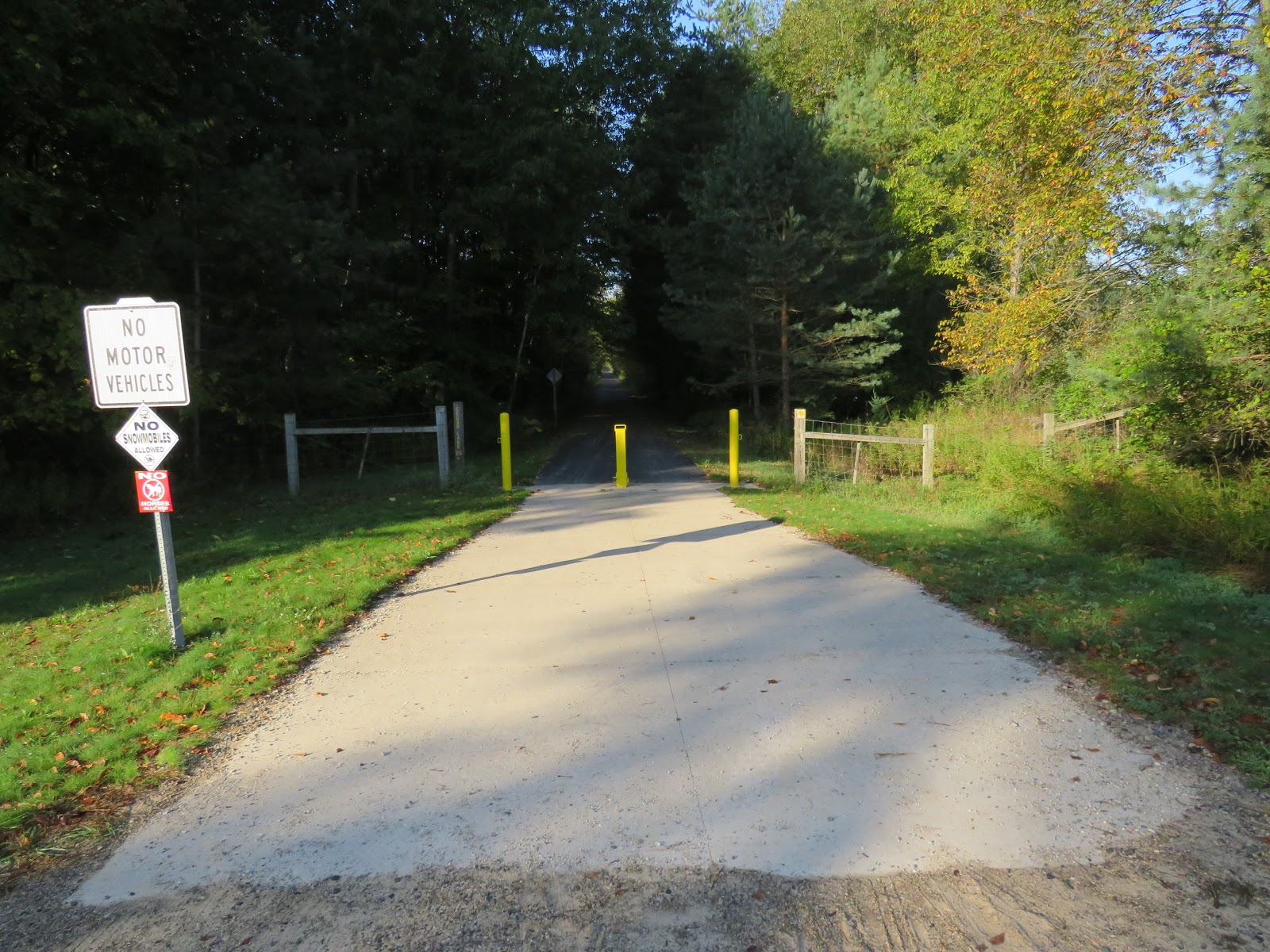
The midmorning is sunny and cool as I hike west on the Meijer bike trail into the heart of the Vestaburg State Game Area, 3000 acres of some of the most undisturbed natural landscapes in mid Michigan. Right away, I spot an abandoned paper wasp nest overhead in a pine tree. Signs of the season are everywhere. Cessation of chlorophyll production in leaves of some maples, oaks and birch is evident as red, orange and yellow pigments begin to appear. Fronds of Royal fern are turning brown. Next, I pause to observe a few leaves wafting from a towering Cottonwood tree to the path near my feet. Continuing west, I notice most of the blossoms of Queen Anne’s Lace have seeded out and folded up into “nests”. I open one of them to discover a tiny Pickleworm maggot. Mostly found in the southern US, these crop-destroying larvae will turn into a colorful moth (stock photo). Just ahead, I get a close-up view of a ½ inch Spotted Cucumber Beetle resting on a Sow Thistle blossom. Like the Pickleworm, these insects are considered agricultural pests. As often happens, the Milkweeds I come across are sources of biological activity. Some plants display pods bursting open to expose their silky white seed floss. Others display Milkweed Bugs in various stages of development. Still others, display Yellow Bear caterpillars (a relative of Wooly Bears). Still heading west, I recognize a couple of invasive species; a patch of Phragmites stalks swaying in the breeze and a few blossoms of Spotted Knapweed. After walking about a mile, I turn around to retrace my steps when my attention is drawn to a chipmunk calling from the dense forest. Just ahead, I see a 1-inch Spring Peeper sunning itself on a Tag Alder leaf. Seldom seen but often heard, the “peeping sound of these amphibians is a welcome sign of spring. Finally, just before reaching the car, I discover some Japanese Beetles  devouring a leaf. Back in the car, I begin my re-entry into the comforts and distractions of human civilization.

Autumn in stride
Heron still wades
Colder winds blow
Goldenrod fades
Whining Cicadas
Brown Wooly Bear
Turtles go deep
Logs are now bare
Swallows gather
South they’ll go
Cattails explode
October show

D. DeGraaf

Monday, October 7, 2019

October 7


The midday weather is cool and misty with a light breeze as I begin my hike in Alma’s Conservation Park. Heading west along the shore of the Pine River impoundment, I can barely see a few Mallard ducks far out in the slow moving current. Continuing west, I spot a few blossoms of Blue-stemmed Goldenrod, a 5-inch diameter Amanita mushroom and some Coral fungi. The leaf litter displays signs of the season including some spiny caps of Bur Oak acorns from which the tree gets its name. After taking one last look at the river, I turn south and then east on pavement through a lush green corridor of mature hardwoods and conifers. Pausing near the Eyer Bird Hut, I notice a bristly Tussock Moth caterpillar crawling on a milkweed leaf. Nearby, I spot the blue berries of Virginia creeper which are not edible and those of Wild Grape which look alike and are edible. Turning south, I proceed into a native grassland landscape where a few Purple Coneflowers remain while Bergamot blossoms are gone and only seed heads remain. Along the way, I find Pokeweed whose berries are edible to birds but not humans. Before leaving this prairie plot, I pause to watch the breeze sway the tall warm season grasses. After passing one of the many ponds on the southern border of the park, I turn north and pause near the girl scout cabin where I observe a Bubble Bee nestled in one of the few remaining blossoms of Queen Anne’s Lace as well as a ½ inch Black Ichneumon Wasp resting on a seed head of grass. These tiny insects are endoparasitic. Adult females use their sharp ovipositors to insert eggs into a living host –usually a grub or caterpillar. Their eggs hatch and larvae devour the host from the inside, eventually killing it before emerging. Many of these wasps prey upon hosts that also happen to be crop pests, and likely provide an invaluable service to agriculture. Making my way back toward the car, I pause to watch Bubble Bees feeding on New England aster flowers while a Hoverfly feeds on White aster flowers. Finally, while getting in the car, my attention is drawn to one more sign of the season; the bright red fruit of Viburnum.

Aura of autumn
Before snows come
From sunny glades
Colors and shades
Of scarlet and gold
Trees, young and old
Where frost of fall 
Glazes it all
In crystalline white
During longer night
Nature’s aglow
October show

D. DeGraaf

Monday, September 30, 2019

September 30


Now that the rain has stopped and the sun is peeking through, I exit my car next to the Lake Steven Preserve. This 1-acre property is the smallest of 22 preserves owned by the Chippewa Watershed Conservancy and is land I monitor annually for the Conservancy. Lake Steven is a small eutrophic lake nestled in the backwoods of Montcalm County, 4 miles northeast of Crystal. Walking along Birch Dr. on the preserve’s western boundary, I notice some Joe Pye Weed still blossoming as well as lots of Autumn Olive bushes, including some displaying fruit. Turning east, I enter a dense woodlot containing mostly white birch and healthy ash, not yet attacked by the ash borer. A single hickory tree whose leaves have turned red also catches my eye. Continuing to explore the preserve, I come across some fresh opossum scat as well as a decaying log showing a large number of Stump Brittlestem mushrooms and a dead tree trunk showing a Birch Bracket mushroom. This polypore fungus boasts antiseptic properties when used as a bandage. Users report that not only does the mushroom heal the wound, but that it also leaves no scar even when the wound is deep. Next, I pause to get a close look at a perching Crane Fly. These insects, that resemble oversize mosquitoes, only live 10-15 days as adults. Reaching the shoreline, I scan the landscape and am reminded that this property abuts to an outlet channel of the lake, not the lake itself. Also, I see the surface is densely covered with duckweed and lily pads. Turning back toward the road, I spot an Eastern Phoebe perched on a branch. These birds will soon migrate, finding wintering habitat in the southern United States and Mexico. Nearby, I notice a decaying beaver stump indicating their presence here many years ago. Continuing west toward the car, I come upon a couple of lone conifers bearing their cones namely White Cedar and Tamarack. Finally, I reach the car as a gust of wind rustles the leaves of birch and aspen, waving farewell until next time.

I welcome these days
New season in view
Leaves glow red
Berries shine blue
I welcome the sun
On its slow descent
Geese are gathering
The meadow is spent
I welcome the morning
Cool and clear
Greetings autumn
Glad you’re here

D. DeGraaf

Monday, September 23, 2019

September 23


Just a ½ mile left on my 90-mile journey to follow the main channel of the Chippewa River from its beginning in Barryton, back on April 29, to its end in Midland. The early morning weather is cool and sunny as I hike east on a narrow earthen path along a steep, 20-ft. bank of the river. The surrounding vegetation includes Prickly Ash, Dogwood and Buckthorn with its clusters of black berries. Pausing to enjoy the peaceful landscape, I look out on the slow moving river and see its water is murky with sediment from recent rains. Continuing east toward the rising sun, I notice wildflowers still in bloom include: Dame’s Rocket, Jerusalem artichoke and Aster while those going to seed include: Motherwort, Snakeroot and Burdock. Also, I pass by a patch of Poison Ivy with leaves beginning to change color and one with a Japanese beetle resting on it. Up ahead, I come across a few walnut husks on the trail. Picking one of them up, I break it open to reveal several tiny maggots feeding on the pulp. These larvae of the Walnut Husk Fly will feed on the husk for 3-5 weeks. Mature maggots will then burrow several inches into the soil to pupate. Most will emerge as adult flies (stock photo) next summer. With just a short distance to reach the river’s mouth, I spot clusters of Wild grapes as well as a Wild Cucumber vine with some of its spiny pod-like fruit. Suddenly, I see a Green Heron fly over the river and perch high on the far side. Since these birds migrate, they will soon head to the southern US or Central America for the winter. Continuing east, I glance up at the dense canopy and down at the leaf litter consisting mostly of willow leaves. Down by the water’s edge, a clump of Purple Loosestrife catches my eye. Nearing the river terminus, I gaze ahead at a footbridge called the “tridge”. Making my way onto this structure, I face west to watch the Chippewa River end its journey as it empties into the Tittabawassee River. Next, I face north to watch the Tittabawassee flow toward me, merge with the Chippewa River and then continue to flow southeast where it will spill into the Saginaw River which then flows into Saginaw Bay. With fond memories and my quest completed, I head to the car for my drive back to Alma.

Waters of life
Nourishes earth
Flows in her veins
River of worth
Wonder of nature
Beauty to inspire
Clean and clear
River to admire
More than a stream
More than a creek
Cherish the Chippewa
River unique

D. DeGraaf

Monday, September 16, 2019

September 16


Dawn is cool and misty as I begin my hike on the nature trail at Lumberjack Park. From the trailhead off Madison Rd., I head north and immediately notice some 3-inch Fly Agaric Mushrooms near the base of a maple tree. Down the steps and onto the boardwalk, I spot patches of Small Flower Asters near my feet and a curious young Whitetail buck staring at me from the dense understory. Following the trail east, I come across blossoms of Sky Blue Aster as well as a cluster of Jack-in-the-Pulpit berries. As a gust of wind passes through the leafy canopy, blossoms of Turtlehead and Snakeroot catch my eye. Snakeroot’s name derives from the erroneous belief among early settlers that the bitter rhizomes were beneficial in the treatment of snakebites. In fact, the foliage and rhizomes are highly toxic, causing fatalities from 'Milk Sickness' because the toxins can pass through the milk of dairy cattle to humans. Proceeding north on the bridge over Mud Creek, I spot a patch of Black-eyed Susan’s along the far bank as well as an Elephant Ear plant with its 12-inch long leaves. Turning west onto the White Pine Trail, I pass by a couple of tiny Puffball fungi and then stop to sample a few ripe berries from an Autumn Olive shrub. Taking a sharp left, I follow the Riverview Trail to a favorite overlook to see the channel of the Pine River, swollen with muddy water after a few days of rain as well as hear the repetitive, bird-like chirp of a distant chipmunk. Further along, I come upon a ¾ inch Banned Tussocks Moth Caterpillar crawling on one of the trail markers. Veering off the trail to the river’s edge, I notice blossom remnants of Joe-Pye-weed and Cardinal flowers along the bank as well as a couple of Water Striders skating near shore. Turning north through mature Pines, I spot some Orange Peel fungi on the trail. Retracing my steps back toward the car, I discover part of a Wild Turkey carcass with exposed skeletal bones indicating its part of the wing. Crossing Mud Creek again, I finally make it back to the car.

Mid of September
Summer bids goodbye
Monarchs leave the scene
Gone are geese that fly
Yellow drapes the meadow
Oaks let acorns fall
Fawns continue to grow
Crows continue to caw
Seasons ever changing
Maples showing red
Autumn comes soon
Nature cycles ahead 

D. DeGraaf

Monday, September 9, 2019

September 9

Back on home soil, I’m reuniting with the Chippewa River while marking my 12thencounter, following it from beginning to end. The weather is sunny and cool at the Chippewa Nature Center, west of Midland, as I take the River Trail north along its bank and pause to observe the confluence of the Pine River (left) with the Chippewa (right), resulting in a major increase in water volume and channel width. Exploring the riparian landscape, I spot large patches of Snakeroot mixed with Canadian Goldenrod. On the near shore, I notice a Clematis vine going to seed while on the far shore; a wading Blue Heron catches my eye. From the dense canopy, my ears tune in to the song of a Tufted Titmouse. As the trail passes Six-Island Pond, I glance over the water where several Painted Turtles rest on a log to bask in the sun. Curving east, my attention draws to Purple Loosestrife and Yellow Cress growing on the riverbank while the flowing water sparkles in the morning sun. On the paved path a scattering of grape-size haws appear. Fallen from overhanging Hawthorn trees, this fruit can be eaten raw but may cause mild stomach upset. It is most commonly used to make jellies, wines and ketchups. Other wildflowers seen include Panicle Aster and Jewelweed. As the trail turns south away from the river, I veer onto the Wood duck Trail where an Orthopteran chorus is loud and clear. Also, on one side of the trail, I notice a Monarch Butterfly feeding on a Green-headed Coneflower while on the other side, a stand of Joe Pye Weed. Gazing up at a large tree truck, I spot a cluster of raw Poison Ivy berries. In a few weeks they will ripen to a white color and be a food source for birds such as: flickers, phoebes, waxwings and woodpeckers. White-tailed deer and raccoons browse on them as well. Making my way toward the car, I discover a few signs of the season to come: red berries of Viburnum, red leaves of Virginia creeper and white blossoms of Turtlehead. Back in the car, I head home to Alma.

River scene
Banks of green
Water’s clean
Treasures glean
River flow
Current slow
Nature’s show
Not far to go
River sound
Beauty profound
Gaining ground
Homeward bound

D. DeGraaf

Monday, September 2, 2019

September 2


On a warm and sunny afternoon, I’m hiking in Lusthusportens Park along the shore of DjurgÃ¥rdsbrunnsviken, a bay on the north side of DjurgÃ¥rden Island, one of 14 islands that make up the metropolis of Stockholm, Sweden. This landmass is a tranquil oasis of parks and nature trails very close to hustle and bustel of the city. Following a paved path, I spot some familiar blossoms of St. John’s wort as well as a Coot and a female Horned Grebe swimming far off shore in the brackish water. Further ahead, I notice some Tansy blossoms along with a stand of Phragmites. Where as this reed is highly invasive in Michigan, the one here is not. Be that as it may, there are proposals to harvest the stalks, compress them into pellets and burn them in combustion units as a source of heat. Also, investigations are under way to establish reed plantations in exploited wetlands. Nearby, I come across the only cluster of Purple Loosestrife seen on my hike. However, this plant, another Michigan invasive, does not appear to be spreading along this shore. As the trail meanders, I spot the white, grape-size fruit on a Snow Berry shrub as well as the reddish, olive-size hips of Wild Rose. In the fall, the ripe, red hips are picked, dried and mixed with water, flour and sugar to form a soup called Nyponsoppa. Swedes serve it as a beverage or a dessert with vanilla ice cream along with small almond biscuits. Moving along, I pause to watch a bird in the underbrush; similar in size to a Chickadee, called a Great Tit, a common resident throughout Scandinavia. Also, not too far away in the shallows, a Great Blue Heron hunts for food. Next, the trail veers away from the water into a dense forest of oak and maple where I see blossoms of Alpine Blue Sow Thistle as well as Rose Pink Drift. Turning around, I retrace my steps back to the trailhead which is an open area where I look up to see the spiny husks hanging from a Horse Chestnut tree while under the tree, a few Barnacle Geese are foraging. Finally, I hail a cab for a short trip back to the hotel.

I searched the city
Noisy traffic sound
Searched everywhere
Looked all around
I drove to the east
Walked to the west
I could not find it
Could not rest
Found it in a park
Mother Nature fair
Away from urban din
Finally found it there

D. DeGraaf