Monday, March 21, 2022

March 21

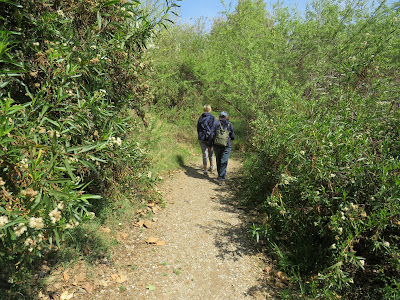
The midday sky is sunny with temperatures in the low 60’s and a steady westerly breeze as we hike in the 13-acre, Willow Wetlands Preserve in Gardena, California, 15 miles south of Los Angeles. In the mid-1970s, the City of Gardena planned to fill in this land and build a convention center. However, residents fought to stop destruction of the wetlands and preserve its value as a green oasis, a migratory stop for ducks, a home for resident birds, a haven for reptiles and amphibians and a natural mechanism for cleaning street runoff water before making its way to the Pacific Ocean. Immediately, colorful spring blossoms of Wood-sorrel and Poppy are a welcome sight. Just ahead, I watch a Monarch flutter around before landing on a Coastal Sunflower head. Scanning a pile of fallen branches, I catch a glimpse of a 4-inch, well-camouflaged Western Fence Lizard. These reptiles can “throw” their tail to get away from an enemy. Eventually, the tail will grow back; however, the female is very picky about courtship and won´t even look at a male who has lost its tail. Also, their powerful hind legs allow them to run fast and quickly change directions to escape predators. Other methods of escape include their ability to jump and rapidly climb trees. Following the path next to a busy street, I notice a blossoming cherry tree and a patch of blossoming Nasturtium while from a shallow pool, hidden my dense underbrush, I hear the familiar call of a Mallard. Up ahead, I watch a fast-moving, orange butterfly finally land so I can identify it as a Gulf Fritillary. This is one of several species being mass-reared commercially for release at outdoor events like weddings and garden parties. If done properly, it is a harmless and esthetically pleasing addition to the environment that may even help revive declining populations. Continuing down the trail, I pause to watch several honeybees feeding on blossoms of Black Sage and then spot blossoms of California Lilac. Rich in saponins, these flowers can be crushed and mixed with water to produce an excellent lather which is an effective and gentle soap. They were used by the North American Indians as a body wash, especially by the women in preparation for marriage, since they left their skin smelling fragrantly. Also known as ‘New Jersey tea’ , lilac leaves were used as a tea substitute during the American Revolution. Before leaving the preserve, on this first full day of astronomical spring, I pause to recognize the shining sun that reached its vernal equinox yesterday.


Star of earth

Sun of sky

We celebrate

Your place on high

Star of earth

Path ascends

Your energy

All life depends

Star of earth

Light of days

Glowing orb 

You I praise


D. DeGraaf

Monday, March 14, 2022

March 14


Sunny skies and temperatures in the upper 50’s accompany us on an early morning hike at Palos Verdes Peninsula’s Abalone Cove Reserve, named after the edible, but endangered mollusk with a colorful calcareous shell (stock photo). Abalone once were to California what lobster is to Maine and blue crab to Maryland, so plentiful they were harvested by the thousands (stock photo). Californians held abalone bakes, spun abalone folk tales and sang abalone songs. Abalone were integral to coastal Californian culture, until suddenly they weren’t. In the later part of the 20th century, these once-abundant animals were nearly wiped out by overfishing, disease, and climate change. Of California’s seven abalone species, two are federally listed as endangered and none are currently open to fishing. On a steep descent to beach, we pass yellow blossoms of Wild Mustard as well as a trail sign not likely seen back home. Approaching the shoreline, I get a closeup view of a Rock Wren. Their nest is often marked by "paving" of small stones, sometimes with bones and other debris, laid out on ground in front of the entrance (stock photo). Nearby, I spot a California Ground squirrel. These rodents reside on the ground and in burrow systems. The burrows can house many generations, forming a small colony, while each squirrel has a unique entrance. They use a variety of sounds, tail signals and scent production as means of communication. When threatened, they can belt out a high-pitched alarm call that can last for several minutes. Moving down to the beach. I notice clusters of Mussels sticking to a large rock as well as a Spotted Sandpiper hunting for food. Approaching a pile of washed-up Kelp, I’m not surprised to see tiny flies swarming over it. Upon closer look, I spot one of these tiny 5mm Kelp flies. Adult flies and their larvae play an important role in the beach food web by decomposing piles of Kelp while also being a food source for shorebirds and passerines. Thus, I’m not surprised to see a Song Sparrow foraging on a nearby pile. Moving down the beach, I first look down at Seagull tracks in the sand and then look skyward as a pair of Brown Pelicans fly by. Nearby, uplifted layers of sedimentary rock catch my eye. Heading back up the steep slope, I pass by blossoms of Coastal Bush Lupine and pause to look out at Catalina Island, 20 miles to the west. Nearing the car, my last observation includes pink blossoms of a Wishbone bush.


Winter winds

Prevailing east

Nature surrounds

Greatest to least

Steep cliffs

Rocky beaches

Pelican dives

Whale breaches

Falcon soars

Higher than most

Pounding surf

Carves the coast


D. DeGraaf

Monday, March 7, 2022

March 7

The morning sky is sunny with temperatures in the low 60’s as our daughter, Allison joins us for a hike on Fern Dell nature trail in Los Angeles’ Griffith Park. Covering more than 4,000 acres of natural terrain, this is the largest municipal park and urban wilderness area in the United States. We begin by following an earthen path along the edge of a narrow stream shaded by huge Sycamores, Live Oaks and Redwoods. Lush vegetation line the stream bed including, 2-ft long leaves of Elephant Ear and Philodendron. Up the trail, I pause to watch Koi fish swimming in a shallow pond. These fish are an ornamental species that descended from the carp family. In the 1600’s, Chinese farmed carp in rice paddies, a practice that traveled to Japan where the Japanese noticed color variations and bred them, creating the Koi species. Japanese bred them for perfection, prized them in collections of royal families and immortalized them in royal artworks. Chinese farmers originally bred Koi for eating, however, later they were bred as pets for their unique and striking colors and not for consumption. It wasn’t until the 1900’s that Koi were bred in the United States. Moving along, since the trail name includes the word “fern”, it’s not surprising to spot some, including, Button, Lady and Sword. Nearby, colorful blossoms of Fuchsia and Elephant Ear catch my eye while high up a snag, I get a quick glimpse of an Acorn Woodpecker. These birds are best known for their habit of hoarding acorns: they drill small holes in a dead snag, then harvest acorns in fall and store them in these holes, to be eaten during winter. Such a "granary tree" (stock photo) may be used for generations and may be riddled with up to 50,000 holes. Nesting is a group activity, with several adults (up to 12 or more) taking part in incubating the eggs and feeding the young in a single nest. They also spend considerable time catching insects on the wing. Turning around, I pass a stand of Bamboo stalks and a Fox Squirrel digging for nuts. Near the car, I stop to notice the colorful blossoms of a “yesterday-today-and-tomorrow” plant. Its long name fits for more than one reason. The flowers change their color from one day to the next, starting out purple, then turning lavender and finally becoming white as they mature. Plus, this tropical evergreen shrub is a long, persistent bloomer. After the first, heavy bloom in the spring, it will produce more of its showy, fragrant flowers in the fall, or anytime during the year.


Waning winter

Wandering west

Treading trails

No time to rest

Waterfalls

Mountain crest

Verdant valley

Osprey’s nest

Still my cause

Still my quest

Exploring nature

Her most and best


D. DeGraaf


Monday, February 28, 2022

February 28

Mostly sunny skies, temperatures in the upper 50’s and a stiff west wind surround us as we begin hiking a perimeter trail around the 26-acre, Ballona Freshwater Marsh as many planes takeoff and land at LAX, only a few miles to the east.  After being filled and farmed for decades, this wetland was restored to not only provide refuge for wildlife but also collect and naturally clean stormwater runoff from nearby streets. At first, my attention is drawn to colorful blossoms of Coastal Sunflowers and Wild Rose. From distance, I watch the open water teeming with fowl while up close, I observe Geese, Shovelers and bright white Egrets, buffeted by wind gusts. A common question about Egrets is, without plumage colors to camouflage them, like blue herons, how do they escape predation? First, they often choose urbanized locations like this over isolated locations because isolated locations have more predators. Also, they use flight to escape from terrestrial animals and are known to have innate recognition and avoidance of poisonous snakes. After passing a stormwater drain, I’m surprised by the sight of deciduous Sycamore trees beginning to leaf out already after dropping their leaves in late autumn. Turning back to the water, I spot a Cormorant diving for fish and a never-before-seen Cinnamon Teal swimming among some Shovelers. Further ahead, I come upon the male flowers of a Coyote bush and the now-familiar call of a Tree frog from the dense underbrush. From afar, I can see feathery tops of Pampas Grass sticking up above sedges and willows.  Overhead, against a blue sky, I see a noisy flock of Geese, a soaring Egret and a lurking Osprey. An Osprey is often seen hovering and then plunging feet-first to catch fish in its talons. After a successful strike, the bird rises heavily from the water and flies away, carrying the fish head-forward with its feet. Bald Eagles sometimes chase Ospreys and force them to drop their catch. On my way back, red galls on an Arroyo willow leaf catches my eye. The cause of this gall is a Redgall Sawfly, a type of primitive wasp (stock photo). As the tree’s leaves are expanding the adult sawfly insert the eggs into the expanding tissues in early June. A single female lays up to 50 eggs. This causes the leaf to swell into a lump or chamber, which nourishes and protects the developing grubs. Most of them emerge by fall and over-winter in a cocoon in the surrounding leaf litter.

Once there were acres

For creatures to roam

For trees of the forest

To make their home

Once there were acres 

Of water and sky

For fish to swim

For flocks to fly

Now there are acres

Where humans thrive

What is the future?

Who will survive?


D. DeGraaf

Monday, February 21, 2022

February 21

Afternoon temperatures are in the low 60’s under sunny skies as I make my way along a section of southern California shoreline, southeast of White Point Park, for my annual solo tide pool exploration. At the first pool, I pause to watch a small snail shell, occupied by a Hermit crab, crawl along the sandy bottom. Since these crabs (stock photo) lack a hard carapace, they use empty shells for partial containment and protection from predators. Nearby, I spot a Sunburst Anemone clinging to the rocks. These colorful creatures feed by firing harpoon-like filaments into their prey when they touch their tentacles, injecting a paralyzing neurotoxin and guiding them into their mouths. However, out of the water, these colorful creatures fold in their tentacles and expose their adhesive sides that are covered with bits of shell, rock and seaweed. Moving down the beach, I notice the parallel layers in the rocks at my feet and realize these are the eroded ends of a sedimentary formation that had been laid down millions of years ago and subsequently uplifted, folded by tremendous geological forces and now exposed by an ebb tide. At another tide pool, I notice a patch of reddish Coralline algae and a clump of Kelp with its air-filled bladders that keep their long stems afloat. Along the exposed beach, I watch an immature gull foraging for whatever the intertidal zone has to offer. Exploring rock faces near shore, I come upon a cluster of Mussels. These bivalve mollusks secrete protein fibers, called byssal threads. from a gland in the foot that secures them to hard surfaces and to each other. Another rock displays a few tiny Limpets. These small herbivorous marine snails feed by scraping the rock’s surface with a strong, toothy organ called a radula. It is very difficult for sedentary animals or plants to become established in their territory because they scrape it clean in a relatively short period of time. Soon, I observe a rock displaying a variety of organisms including a ½ inch Chiton with its coat-of-mail shell resembling the segmented armor on a knight's gauntlet. These marine mollusks have a relatively good fossil record, stretching back 400 million years. On my last rock face, I see more limpets along with masses of tiny barnacles. These creatures feed through feather-like appendages called cirri. As the cirri rapidly extend and retract through the opening at the top, they comb the water for microscopic organisms. 

Ocean recedes

Ebb the tide

Shallow pools

Creatures reside

Anemones

Tiny crabs

Piles of kelp

Rocky slabs

Water floods

Surging flow

Nature’s cycle

What a show!


D. DeGraaf


Monday, February 14, 2022

February 14

The early morning sky is sunny with temperatures in the mid 60’s as we hike the steep terrain of the 155-acre Forrestal Preserve, another property of southern California’s Palos Verdes Peninsula Land Conservancy. Soon, I come upon a foraging California Towhee. Poison oak is one of the hazards of outdoor recreation in California. It lines trails (stock photo) and covers hillsides, seemingly waiting to inflict its itchy, weeping rash on the unwary. But it’s also an integral part of the landscape and part of the daily life of California Towhees. Many build their nests in poison oak and feast on the plant’s copious crops of pale white berries. Next, I spot the dark pink blossoms from an Ice plant and a honeybee feeding on Bladderpod blossoms. Proceeding on a narrow earthen trail, I pause and listen to the call of a Bewick’s Wren. This bird (stock photo)was named by John James Audubon for Thomas Bewick, a bird watcher and amateur naturalist, who was well-known for his published illustrations. Widespread and common in the western US, these wrens have completely disappeared from most areas east of the Mississippi River during the last few decades. A likely theory for the dramatic decline is competition with other birds, primarily the House Wren, a smaller but more aggressive relative. Up ahead, I come to a hillside of exposed rock with a range of slope conditions, including vertical walls. Between 1920-1950, this place was a quarry for mining basaltic rock that was used for building breakwaters around nearby Long Beach Harbor. Turning westward, I look afar at Santa Catalina Island, a 42,000-acre land mass that is the largest of 8 “Channel Islands” spread north to south along the California coast. Back in the 1920’s, a small heard of bison was left on the island by a movie crew. Currently, the Catalina Island Conservancy maintains a herd of about 150 of these animals while protecting both them and the island's landscape. Continuing along the rugged path, I notice a perching Allen’s Hummingbird. The bird’s name commemorates Charles Andrew Allen, an American collector and taxidermist who identified the bird in 1879 in California. Nearby, I see a perching Anna’s Hummingbird. This bird was named for Parisian Princess Anna de Belle Massena. John James Audubon himself was charmed by her, but it was naturalist René Lesson who named it in her honor. Back toward the car while exploring a meadow, I come upon some tiny pink blossoms of Stork’s bill as well as a Honeybee feeding on blossoms of wild Mustard.


Feet on the hilltop

Eyes to the west

An ocean scene

One of the best

Cays and coves

Miles of sand

Beyond the surf

Isle of land

Sea and sky

Amazing views

Blues and greens

Colors and hues


D. DeGraaf

Monday, February 7, 2022

February 7

It’s mostly cloudy, in the mid 50’s as we hike through Southern California’s, 35-acre Dominquez Gap Wetlands. Water from the LA River and local urban runoff are routed through these wetlands to naturally reduce pollutants such as fecal coliform and heavy metals while sustaining a year-round habitat for plants and native wildlife. The open space provides opportunities for public recreational amenities such as equestrian trails, bike paths and walkways. Following an earthen trail lined with Coastal Sunflowers, we pass by a Eucalyptus tree displaying pink blossoms and a Cherry tree displaying white blossoms. Nearby, a Fetid Passionflower catches my eye. Beyond its beautiful flower, this species is easy to recognize in the field by its disagreeable odor when disturbed. Also, the plant can trap insects on its bracts, which excrete a sticky substance that contains digestive enzymes, minimizing predation on the young flowers and fruits. It’s unclear whether the plant receives nutrients from these insects, so it’s considered “protocarnivorous.” Scanning the open water, I watch a mating pair of Mallards swimming by and a Song Sparrow perching among 8-ft tall Sawgrass. Moving past colorful blossoms of Black Sage and Evening Primrose, I pause to enjoy the long melodious song of a House Finch.  Continuing down the path, I spot a male Allen’s Hummingbird. On their territory, these birds have a spectacular display, starting with a pendulous, shuttling flight followed by a high-speed, J-shaped dive from about 100 feet. As if the display alone weren't enough, the dive is accompanied by a loud buzz and metallic shriek. These birds are also extremely aggressive, routing any other male Allen's, other hummingbird species—and even birds several times larger than themselves, such as kestrels and hawks. Next, I pause to look at and listen to a Northern Mockingbird. The vocalizations of these birds copy other songbirds, dogs barking and even machinery. Some mockingbirds learn as many as 200 songs as part of their vocal repertoire. Turning around and making our way back to the car, I notice the bright red “flowers” of the ubiquitous Bougainvillea vine. Each “flower” consists of papery-looking bracts surrounding three tiny flowers (stock photo). Although the bracts are leaves, they don't photosynthesize. Instead, their main function is to protect the tiny flowers and help attract pollinating insects and hummingbirds to the plant with their bright colors.


Bird of the wild

How can it be?

Acres of concrete

Rarely a tree

Tainted air

Smoggy sky

Sprawling buildings

Nowhere to fly

Urban racket

Drowns your song

What have we done?

It seems so wrong


D. DeGraaf