Monday, August 15, 2022

August 15

The midday sky is overcast with temperatures in the upper 70’s and a light westerly breeze, as I begin exploring Chippewa Watershed Conservancy’s 1-acre nature preserve on the shore of tiny Lake Steven in Montcalm County. A strip of open field next to the road display pink blossoms of Joe-Pye-weed and white blossoms of Boneset. Native Americans used Boneset to treat many ailments. Many say the fused, opposite leaves led to the notion that this plant could help heal and strengthen bones. Others say that pioneers called these plants “boneset” because they used them to treat fevers that made one’s bones ache. Nearby, I come across a Yellow-collared Scape moth resting on a leaf. This moth is unusual in that it is one of few that fly during daylight. Because it is vulnerable to visual predators, it must have special protections to survive. The black with a yellow “collar” is suggestive of warning coloration. Some authors suggest the moths are mimicking dangerous wasps or other insects. Still exploring the field, I spot a Pearl Crescent butterfly on a Sow Thistle blossom. On another Sow Thistle blossom, I notice a Hoverfly while on a Chicory blossom, I notice another one. Often mistaken for a bee or wasp, Hoverflies are common predators of aphids and other small, slow-moving insects. The larvae are tiny legless maggots that range in color from creamy-white to green or brown. (stock photo). Moving toward the lake shore, I pass through a small, dense woods with surprisingly a large variety of broadleaf trees including birch, maple, oak, cherry, mulberry, ash, hickory and willow. Even a few evergreens are seen including pine and cedar. Pausing at the shoreline of what really is an outflow channel of the lake, I see the surface water is choked with a thick blanket of Lily pads. Upon closer look, I spot a lovely white water lily blossom. This blossom is either day 2 or 3 of a 3-day life of this flower. On the first day, the petals are not fully open and thus form a cup-like structure (stock photo) filled with a fluid containing sugars. Beetles and bees enter the flower and often fall into the fluid, which washes off pollen onto the stigma and fertilizes the flower. On the second and third days, no fluid is produced, and the flowers open wide. Insects that land on the flower on these days get covered with pollen and transport it to flowers that are just opening and hence receptive to pollination. On the fourth day, the whole structure is pulled underwater, where the seeds mature in a seed pod (stock photo). Finally, I turn around and find my way back toward the car.

Far from motors 

That race on roads

Door opens to 

Noises of nature

Song of a Sora

Chorus of crickets

Fugue of frogs

Cardinal calls

Redwings respond

Chipmunks chime in

Music of the marsh


D. DeGraaf

Monday, August 8, 2022

August 8

It’s sunny with a refreshing breeze and temperatures in the mid 60’s as I begin my morning hike in the 15-acre, Stearns Preserve, located in Gratiot County’s village of Riverdale. My first stop is the bank of the Pine River where I spot blossoms of Purple Loosestrife and Joe-Pye-Weed. Glancing downstream, I watch morning sun beams reflect off the flowing water while nearby, a ½-inch Pearl Crescent Butterfly catches my eye. Exploring the floodplain, I notice patches of Carolina Cranesbill displaying many flower buds as well as stunning Cardinal Flower blossoms. Nearby, I pass by blossoms of Fringed Loosestrife and then pause to watch a ½-inch Grove Snail feeding on a Milkweed leaf. Proceeding onto the Meijer bike trail, I come upon a ½-inch Scorpion Fly and a 1-inch Wood Satyr Butterfly with torn wings, likely caused by a bird or bat attack. Moving back to the riverbank, I first spot a pair of perching Ebony Jewel Wing Damselflies and then pause to watch a swarm of tiny Whirligigs swimming offshore. On my way back to the bike trail, I come upon a batch of fresh, edible Oyster Mushrooms. These fungi have a subtle seafood flavor and a faint, earthy taste. Cooked oyster mushrooms bring a soft, meaty texture to soups, stir-frys, and salad recipes. Back on the bike trail, I proceed under some leaning Boxelder trees before noticing an American Elm tree with dying yellow and brown leaves, symptoms of Dutch Elm disease. In the early 1900’s, Dutch scientists discovered the fungal pathogen that eventually killed millions of Elm trees in western Europe. The first North American Dutch elm disease epidemic began when the pathogen was introduced in the 1920’s by furniture makers who used imported European elm logs to make veneer for cabinets and tables. The disease spread up and down the U.S. east coast and west across the continent, reaching the west coast in 1973. Over 40 million American Elm trees have been killed by this disease that currently is still very destructive. The fungus kills an Elm tree by destroying its vascular tissue. The Elm Bark Beetle (stock photo) spreads the disease by carrying spores from one tree to the next. Turning around toward the car, I observe a 2-inch Eastern Comma Butterfly. This species is one of two look-a-like butterflies named after punctuation marks. This one has what looks like a sideways comma on the underside of the hindwings (stock photo). The other, called the Question Mark Butterfly has what looks like a question mark turned on its side on the underside of the hindwings (stock photo)


Hiking the bank

You by my side

Shaping the earth

Glide river, glide

Natural beauty 

For me you show

Rapids and ripples

Flow river, flow

Glistening waters

Reflect the sun

Sustainer of life

Run river, run


D. DeGraaf

Monday, August 1, 2022

August 1


The early morning sky is sunny with temperatures in the mid 60’s as I enter another privately-owned, conservation easement east of Alma. As a volunteer for the Chippewa Watershed conservancy, I’m hiking a grass trail on this 38-acre parcel to check whether the owner is continuing to manage this land for optimum wildlife habitat. Soon, I gaze skyward as a dozen or so chirping Barn Swallows flying overhead. While faintly hearing a few Sandhill Cranes taking off in the distance, I notice a spike buck Whitetail deer staring at me from the meadow. Up ahead, I watch the short flight of a large grasshopper with flashy wings before it lands. Upon closer inspection, it turns out to be the short-horned variety. Veering off the trail, I spot a Blue-eyed Darner dragonfly perching on the seedhead of grass. Darners mate in flight. The male places a sperm packet on his abdomen and, once joined in flight, a female will pick it off him and use it to fertilize her eggs, which she has attached to vegetation near water. Females then place fertilized eggs in warm, slow moving waters like ponds, swamps, creeks and small streams. Once hatched, the naiads (stock photo) live in the water, feeding on small aquatic insects, tadpoles and even small fish. Approaching a small pond, I get a close look at a Snowy Egret wading in the shallows. In the early 20th century, this bird was hunted extensively for their long breeding plumes that fashionable ladies wore on their hats. This trade ended in 1910 in North America and the population recovered. Because we are in the northern most section of their summer range, Egrets are rarely seen around here. In addition, most of them migrate in the fall to their breeding grounds along the Gulf Coast. Suddenly, the Egret takes off along with a noisy Great Blue Heron and Green Heron. Exploring the pond perimeter, I observe a large patch of Canadian Thistle flowers that have seeded out and a Honeybee feeding on a Purple Loosestrife blossom. Other pink blossoms that catch my eye include Swamp Thistle and Vervain. At my feet, I see a Broadleaf Plantain plant including its leaves and seed stalks. This plant can be eaten entirely, but the young leaves are the tastiest and are used like spinach in salads and sandwiches. Older leaves are edible as well, but they tend to be more bitter and stringy. Plantain leaves work wonders on mosquito bites, bee stings, and minor cuts and scrapes. The simplest way to use them is to crush up a leaf and rub it on the bite or scrape. Turning back toward the car, I look afar to see the head of a Woodchuck sticking out of the tall grass. At my last stop before the car, I scan a small pond as a noisy Killdeer flies by.


Middle of summer

August to greet

Rose hips red

Mulberries sweet

Goldenrod yellow

Chicory blue

Purple Coneflowers

Still in view

Monarch larvae

Consume the green

Redwing Blackbirds

Leave the scene


D. DeGraaf

Monday, July 25, 2022

July 25

The early-morning temperature is 73 degrees under sunny skies with a westerly breeze as I enter a privately-owned, 24-acre conservation easement just east of Alma. Years ago, the owner contracted with the state to maintain this land for wildlife habitat. As a volunteer for the Chippewa Watershed Conservancy, I hike the property annually and report on the owner’s level of compliance. Following a perimeter path, I spot 2 types of newly-formed Goldenrod galls, nut and flower. Since much of the land is open grassland mixed with a few shallow, marshy ponds providing good dragonfly habitat, I’m not surprised to see several of them flying and alighting. First, I spot a Widow Skimmer in the underbrush. Up ahead, a Meadowhawk catches my eye. This dragonfly will eat almost any soft-bodied flying insect including mosquitoes, flies, small moths, mayflies, and termites. Nearby, I see a Saddlebags Skimmer whose nymph is green with bits of browning coloring (stock photo). Following the mown trail, I come upon a Banded Pennant. The “pennants” are among the few dragonflies whose wings are marked a bit like butterflies. They perch according to their name – like flags at the tip of twigs or stems. They even sway and pivot in the summer breezes.  Moving off the trail to get a closer look, I notice a patch of Purple Prairie Clover and a patch of Black-eyed Susans. Also, I come upon a Milkweed plant displaying a young 1-inch seedpod. Since it’s edible at this stage, I break it off and enjoy its mild flavor. After trudging through a stand of 6-ft tall Reed Canary Grass, I approach a small Cottonwood tree where a Yellowthroat is singing loud and clear. Further ahead, I observe a Clouded Sulfur Butterfly in the dense grass. Its caterpillar is smooth and green with light stripes on the sides (stock photo). Soon, I spot a Little Wood Satyr Butterfly resting on a decayed log. Its caterpillar is greenish brown, with lighter lengthwise stripes and numerous tubercles (stock photo). Turning back toward the car as the wind picks up, I look down to see some swaying Bottlebrush grass and look up to see swaying Cottonwood leaves. Scanning the meadow, I spot a single blossom of Purple Coneflower and a single blossom of Sow Thistle. A variety of sedges, each with their characteristic seedheads catch my eye, including Fox, Nut and Crested. Back on the long driveway to the car, I pause to listen to a Killdeer flying overhead. These birds can be seen flying or walking, but since they lack a hind toe, they do not have the ability to perch.


Time to slow down

Summer speeds along

Smell a milkweed flower

Hear a cicada’s song

Time to leave the trail

Ease the hiking pace

Alighting swallowtail

Lovely Queen Anne’s Lace

Time to be seated

Lo, a mourning dove

Taste a wild berry

Eye the clouds above


D. DeGraaf

Monday, July 18, 2022

July 18

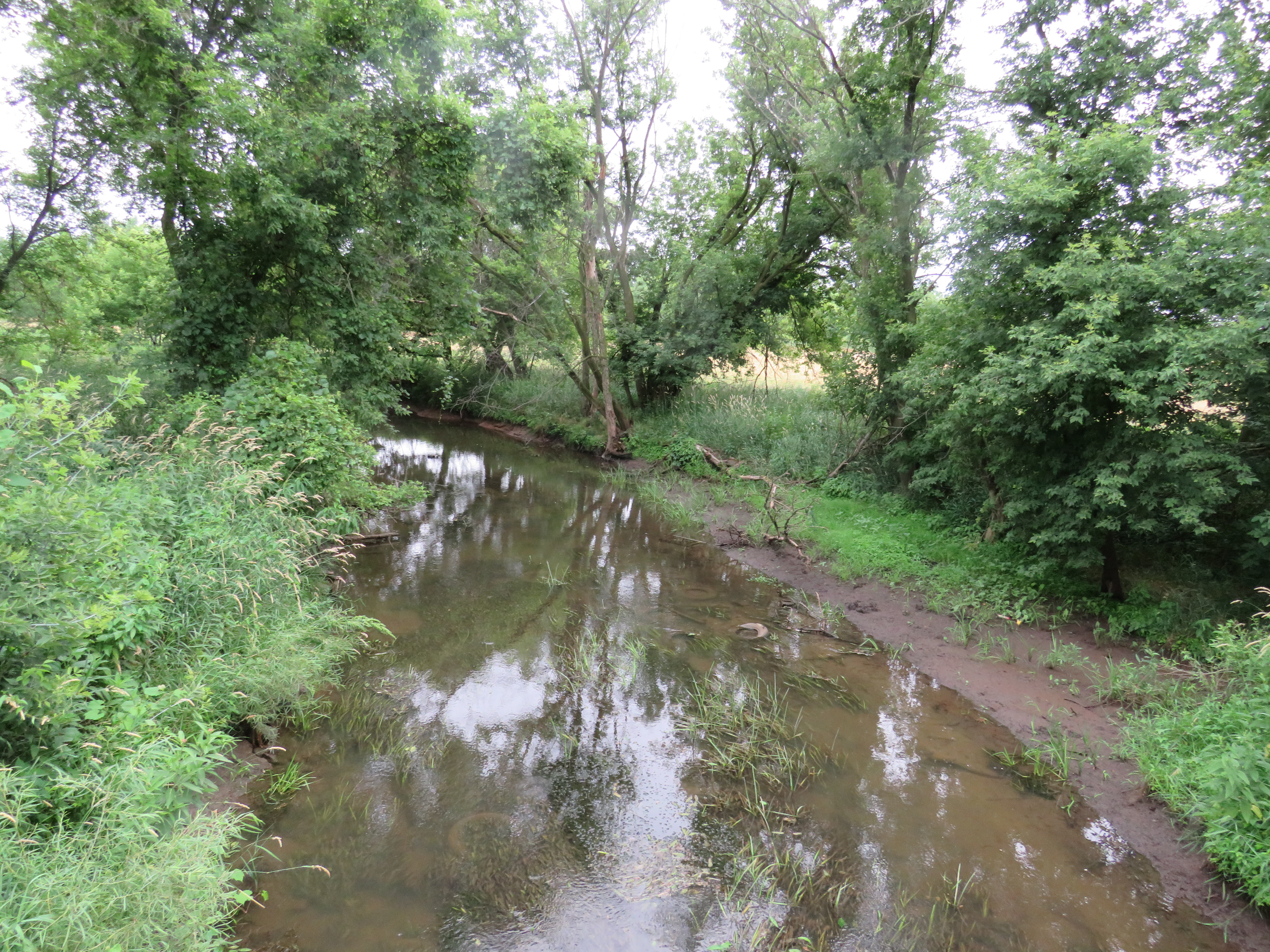
Two months ago, I was in the village of Muir to begin my quest to explore the Maple River from mouth to source by watching it flow into the Grand River. Traveling upstream, I saw it flow through Maple Rapids, under US 127 next to the massive marsh of the State Game Area, over the dam in the village of Elsie, under the bridge in the village of Ovid and through the fields of Clinton and Shiawassee Counties. This early morning, I’m just south of the town of Corunna where it’s sunny and breezy with temperatures in the mid 60’s as I watch the murky Maple River carry sediment that washed in from heavy overnight rain. Near the bank, I spot blossoms of Soapwort (Bouncing Bet) as well as Catnip, being fed on by a Bumble Bee. As far back as the 1600’s, Europeans used Catnip as a mild sedative, brewing tea with its leaves, making juice from them and even smoking or chewing them. In the 1960’s, catnip was occasionally used as a substitute for marijuana, with some users claiming it caused hallucinations and euphoria when smoked. However, in most cases this was not true. Also in the 1960’s, scientists discovered that catnip's active chemical acts as a mosquito repellant - more powerful than DEET. After driving to another nearby access point, I find the river to be nothing more than a drainage ditch next to a farm field. Looking around, I am pleased to see my first Monarch Butterfly of the year. Overall, eastern Monarchs have declined by around 85% since the mid-1990’s due to habitat destruction and climate change. However, the number of butterflies in Mexico’s forests this past winter was 35% greater than the previous year. This increase marks a sign of recovery—albeit a fragile one—and gives some reason for hope for the future of this iconic species. Tracing the overgrown ditch up stream, I could not see the river water but could hear resident Green Frogs. Working my way back to the car, I come upon a Northern Pearly-eye Butterfly and a Widow Skimmer Dragonfly. Unlike other dragonfly species where males guard egg-laying females, Widow Skimmer males leave the female by herself, 'widowing' her as she lays her eggs just under the surface of the water. Near the car, I notice blossoms of Swamp Milkweed and Bladder Campion. Driving a few miles east, I make my final stop to observe the source of the Maple River which is merely a man-made ditch called the Maple Swamp Drain. After following the river some 70 miles from end to beginning while accessing it 9 times, I bid farewell to this unique watercourse.


From muddy banks

Watched you grow

Living waters

River flow

Birdsongs and bees

Fawn and doe

Reeds and trees

River show

Life and death

Taker and giver

Riparian wonder

Maple River


D. DeGraaf

Monday, July 11, 2022

July 11

I’m in Shiawassee County, about 8 miles southeast of my last Maple River encounter, making my way from the car to the channel. It’s mostly cloudy, breezy with temperatures in the low 70’s as I follow a 2-track where I spot tall stands of Phragmites as well as blossoms of Red Clover and Common Mullein. Reaching the bank of the 10-ft wide, slow-moving river, I scare up some Wood ducklings as the mother flies up and squeals in their defense. Following the watercourse upstream, I notice the first blossoming Queen Anne’s Lace of the season as well as blossoms of the toxic and lethal look-a-like, Water Hemlock. Nearby, I pause to observe a ½ inch White Spring Moth resting on a leaf. Its larva is a light green, inch-worm caterpillar that provides camouflage while it feeds on leaves of apple, maple, cherry, beech, and hawthorn trees (stock photo). It pupates overwinter and emerges as an adult in early spring. Adults are active night and day and often flutter around exterior lights at night. Up ahead, large white blossoms of Elderberry (Elderflowers) shrubs catch my eye. Both Elderberries and Elderflowers have been used for medicine for thousands of years. While both have been used to boost the immune system and fight off infection, Elderflower tea can provide soothing relief for acute cold systems. A concoction of elderflower, yarrow and mint is a great fever fighter and was often used historically for measles and chickenpox. Elderflowers can also be used to treat conjunctivitis and soothe red itchy eyes, reduce pain and swelling in acute joint inflammation, and relieve toothaches. They are natural antihistamines, and when taken prior to the appearance of pollen, can ease symptoms of seasonal allergies. While heading back to the car, I  listen to the song of a Goldfinch and notice some Horsetail stalks displaying cones. These specialized structures, called strobili, will develop large numbers of reproductive spores. Next, I’m driving south to a nearby road bridge where I stop to watch a Muskrat swimming in the river. Turning the car east, I come upon another road bridge to watch the shallow river pass under. From here, I spot a Sandhill Crane walking along the edge of the dirt road. The greatest chance to spot these large, gorgeous birds comes during their annual fall migration when thousands of them return to roost at Big Marsh Lake in Baker Sanctuary, east of Battle Creek, before flying south to Florida for the winter.


Weekly retreat

Place to unwind

No cares or worries

Left those behind

Following the river

Breathing fresh air

Treading along

Nature everywhere

Pausing to look

Then proceed

Escaping the havoc

I’m free indeed


D. DeGraaf

Monday, July 4, 2022

July 4

This morning, I’m 40 miles southeast of Alma watching the Maple River flow through the small village of Ovid. The village was named by settlers from Ovid, Seneca Falls County, N.Y., who purchased land, sight unseen, in what would be their new home. Noted residents of the village in 1836 included Samuel Barker and Jabez Dennison - who was famous as a "slayer of bears," killing 19 in the area. Incorporated in 1869, Ovid grew many industries in the late 1800s and early 1900s, including a cooperage, flour mill, lumber company, foundry, sawmill, tannery, as well as numerous retail businesses and hotels.  The most well-known business was Schafield and Danforth carriage makers.  Ovid Carriage Days, which is observed each September, celebrates the industry and its heritage. The temperature is in the mid 60’s under sunny skies with a refreshing north breeze, as I make my way along the Meijer bike path where I spot a Boysenberry tree and sample some of its tasty fruit. This plant is named after Swedish immigrant, Rudolf Boysen, who created it in the 1930’s in California by crossing loganberry, raspberry and blackberry. Nearby, I notice other ripe fruit including, raspberry and honeysuckle. Moving my way along the riverbank, I come upon patches of Field Bindweed displaying both white and pink blossoms. Soon, I pause to watch some Cabbage White Butterflies flutter and feed among the Bindweed. Up ahead, I watch a Milkweed Beetle crawling on a Milkweed leaf and a Bumble Bee feeding on Milkweed Blossoms. Also, I see several blossoming Water-Parsnips plants scattered along the bank. While the stems and leaves of this plant are toxic and will kill livestock, the roots are edible and were widely eaten by Native American tribes. Regarding medicinal uses, an infusion of the crushed root has been used as a poultice to bring relief from the pain of a broken limb. However, this plant bears a strong resemblance to the highly toxic and lethal Water Hemlock plant. The differences are subtle, having to do with leaf and stem structure. After hearing the familiar call of a Yellowthroat, I turn around to head back where I spot a Cottontail Rabbit, well camouflaged in the tall grasses. Working my way back to the car, I first pause to smell the leaf of a Catnip plant and then pause to be entertained by the variable songs of a Catbird. Finally, near the car, I spot pink blossoms of both Canadian Thistle and Swamp Thistle.


Early summer

‘Neath a mackerel sky

Lush riverbank

Jewel-wings flutter by

Blanket of ferns

Cover the glade

Breaking silence

Vireos serenade

Oaks and Maples

Shadow the trail

Nature abounds

On hill and dale


D. DeGraaf