Monday, June 17, 2024

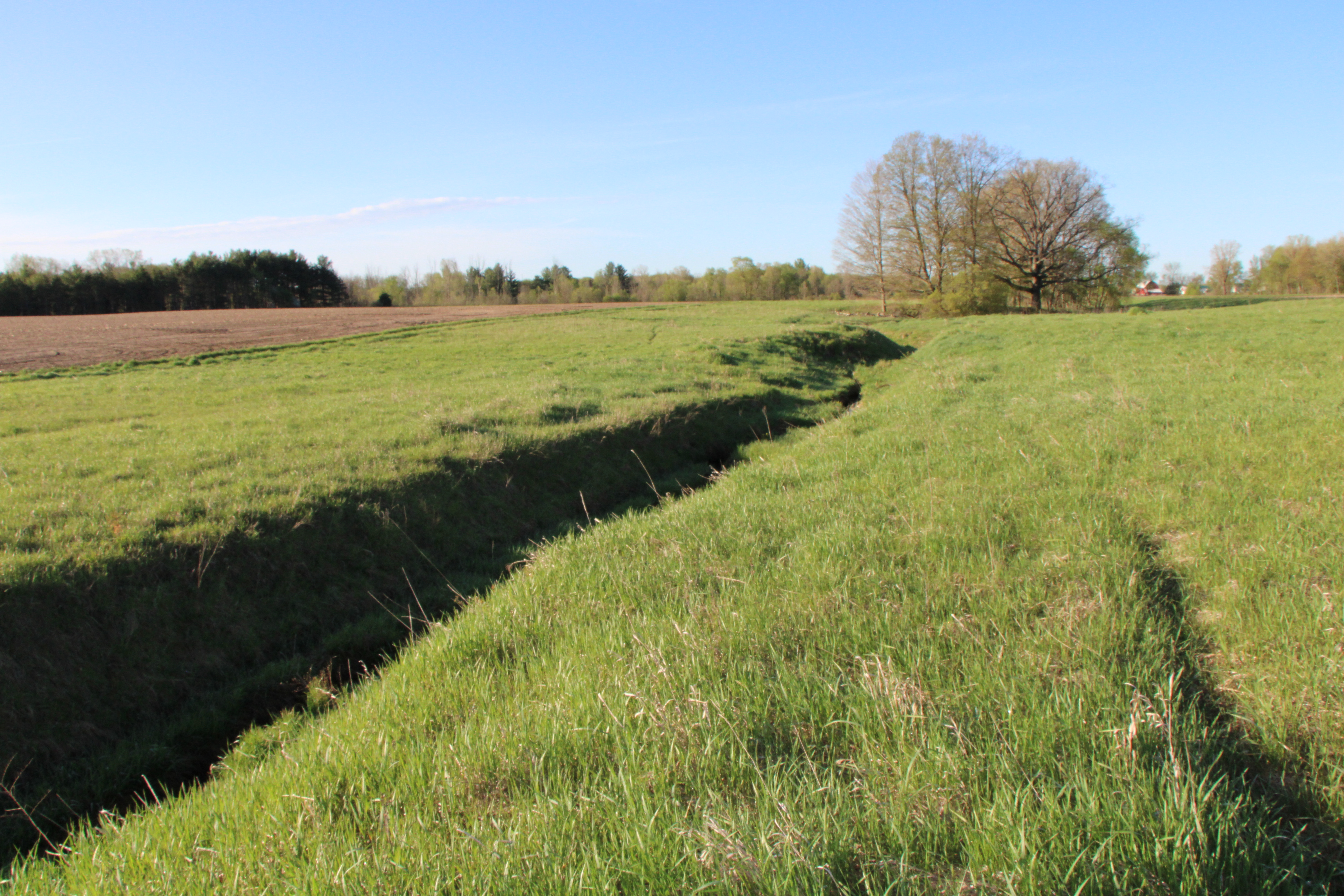
For my 6th encounter with Honeyoye Creek, I’m standing on the east side of Winans Rd listening to birdsongs and watching creek water flow slowly downstream. The early morning skies are sunny with temperatures in the upper 40’s as I pause to look and listen to water flowing from a drain tile into the creek. Exploring the lush buffer zone, I spot white blossoms of Hoary Alyssum, pink blossoms of Dame’s Rocket as well as an 8-inch diameter web made by an orb weaver spider. These spiders are typically nocturnal. During the day, they either sit motionless in the web or move off the web. At night, they become more active, working to repair any damage on the web or sitting in the middle waiting for prey. For some species, once morning comes, the spider will tear down the web, eat most of the silk and rebuild the web by nightfall. Looking down from a steep bank, I spot the narrow leaflets of Chinese Bush-Clover plant. This species was introduced in the late 1800s by federal and state agencies for use in bank stabilization, erosion control and soil improvement. It has been escaping from plantings for many years, evolving into an invasive species. Once established, it out-competes and displaces native plants forming extensive monocultures. Its high tannin content makes it unpalatable to livestock and most native wildlife. Nearby, I come upon a 1/16 inch Shiny Flower Beetle and a perching Firefly. Also known as lightning bugs, these insects are winged beetles. They aren’t endangered, but scientists are worried about them. In recent years, fewer fireflies have been spotted during the summer. Pesticide use and loss of habitat have likely impacted the population, as has light pollution. For fireflies, light pollution interferes with their attempts to signal each other. After watching the creek water flow under Winans Rd, I follow a nearby 2-track where far ahead in the shadows a whitetail deer stares me down. Next, I come upon a deer carcass being consumed by hundreds of blowfly larvae (maggots). Adult female blow flies (stock photo) lay their eggs on a food source, such as this decomposing flesh. The eggs hatch into maggots within 12–24 hours. The maggots feed on the food source while molting through three stages. The third-stage maggots leave the food source and move into dry soil to pupate. Pupation lasts 6–12 days after which adult blow flies emerge. Back in the car, I drive a short distance to pause and watch the creek water flow south under Jackson Rd.

Out of the water

Climbing the reed

No longer a nymph

Ready for speed

Cruising the creek

Hunting the edge

Cellophane wings

Landing on sedge

Darting and dipping

Beauty you bring

Searching for prey

Dragonfly of spring


D. DeGraaf

Sunday, June 9, 2024

June 10

It’s early morning as I leave my car parked on the side of Ennis Rd to make my way east toward another encounter with Honeyoye Creek. With temperatures in the mid 60’s, under partly sunny skies, I pass an Opossum carcass before pausing in a patch of Mayapple where I spot my first Ebony Jewelwing of the season. This attractive damselfly will eat almost any soft-bodied flying insect, including mosquitoes, flies, small moths and mayflies. Continuing toward the creek, blossoms that catch my eye include white Multiflora Rose and yellow Goat’s Beard. Exploring the dense vegetation at my feet, I notice one of many ¾ inch Amber snail. These semi-aquatic gastropods with translucent shells eat plants, algae and fungi. They are not considered plant pests but wet conditions can encourage more activity. They start life as males and become females as they age. They lay transparent eggs in sticky bunches on plants, in the soil, or on the undersides of stones. The eggs hatch into tiny snails in about two weeks and mature within a year. While trudging through tall patches of flowering Reed Canary Grass, I hear the sound of an approaching male Redwing Blackbird. Soon, he’s right overhead, noisily swooping and hovering to chase me away as he defends a nearby nest. Finally, making it to the creek, I’m being serenaded by a Song Sparrow, while watching the gently flowing water pass by a suspicious drain tile. Looking far downstream, I observe a Whitetail doe with her newly born fawn on the water’s edge next to the steep, lush bank. Moving away from the creek, I notice a small, ¾ inch Least Skipper butterfly perched in the tall grass. This species rarely flies higher than a couple feet above the ground as it slowly and somewhat choppily moves through the vegetation.. Also, in the undergrowth, I spot a Nimble Meadow Katydid. These small, ½ inch insects with their distinctive nighttime sounds are found from central Michigan south to the lower third of Ohio and west to extreme eastern Kansas and Nebraska. Nearing the car, I stop to observe a Four-line Plant Bug on a leaf with damage spots caused by its feeding behavior. This extremely rapid damage is due to the insect’s enormous salivary glands, which enable it to inject copious amounts of enzyme-rich saliva into the plant tissue. This bug is a common garden pest that can attack many different types of plants, including mint, dogwood, forsythia, marigold, peppers and potatoes. Back in the car, I drive a short distance and stop on the shoulder of M-46 to watch the creek water flow southwest toward Winans Rd.

Who enslaved you

I wish to know

Altered your ways

Flow, water, flow

Drained the fields

Crops could grow

Tainted runoff

Flow, water, flow

Back to nature

You’re free to go

A creek unique

Flow, water, flow


D. DeGraaf

Monday, June 3, 2024

June 3

It’s mostly cloudy with temperatures in the upper 50’s as I stand on the edge of Winans Rd while the water of Honeyoye Creek flows eastward through a narrow buffer zone of vegetation that is supposed to protect it from tainted cropland runoff. Looking more closely along the bank, I notice white blossoms of Wood Anemone and multi-colored blossoms of Dame’s Rocket. Despite its attractiveness, Dame’s Rocket is an invasive species in Michigan. It can spread quickly and replace native wildflowers, disrupting the local ecosystem. Moving to a new access point, I make my way toward the creek bank while spotting one of many 1-inch, Red Admiral caterpillars feeding on Nettle leaves. After it pupates in a chrysalis, a colorful adult butterfly will emerge (stock photo). Nearby, I notice a 1½-inch Northern Bluet Damselfly resting on a leaf, covered with raindrops. Bluets don’t sting or bite humans but they are formidable predators of other insects, including flies, mosquitoes and bees. Up ahead, I come upon a ¾-inch, Black-banded Owlet Moth, perched on a blade of grass. This species has been known to slow its metabolism and freeze solid to survive winter, thawing and reviving as temperatures rise. Arriving at the edge of the creek, I pause to watch its water flow gently to the south while listening to a Song Sparrow. Heading back toward the car along a wooded bank, I come upon a cluster of Scaly Ink Cap Mushrooms. These mushrooms are edible but only if alcohol is avoided. Eating them within a few days of consuming alcohol can cause flushing, dizziness, headaches and stomach aches. Still making my way through the woods, I pass by a large patch of Skunk Cabbage as well as the femur and tibia bones of a Whitetail deer. Approaching the car, I look down to see a scattering of several 1/8-inch instar nymphs of Box Elder Bugs. These nymphs feed on leaves, fruits and soft seeds by inserting their beaks into the tissues. They continue to feed throughout summer until they reach adulthood (stock photo). Near the car, I spot a 1/3-inch, pink spotted ladybird beetle crawling over a blade of grass. A native North American insect, it is found throughout the eastern two-thirds of the US from Canada through New England and into many southern and midwestern states. Both adult and larva (stock photo) are important predators of aphids. Adults can consume 50 aphids per day, while larvae kill 10 to 25 per day. Back in the car on my way home, I stop on Madison Rd to view the creek one last time as it flows south toward M-46.

Concert opens the month of June

Sounds of spring, creatures in tune

On the blossoms, buzz of the bees

Westerly wind rustles the leaves

On the maple, fox squirrel chatters

Music of the wild, all that matters

On the pond, green frog croaks

Cardinal calls, high in the oaks

Robin, the melody, Downy, the beat

Nature in harmony, choir’s complete


D. DeGraaf

Monday, May 27, 2024

May 27

The morning temperatures are in the mid 70’s, under sunny skies as Caroline and I hike with our friends, Jeff and Maria Reynolds on a nature trail in Giant City State Park, near their home in Carbondale, ILL,500 miles SW of Alma.  Soon, I come upon a resting Harvestman. One of 60 species of North American Daddy-long-legs, this one is known for its uncanny ability to detach a limb to evade predators, a self-defense tactic accompanied by a twitching motion to distract the threat while it escapes. Its diet is diverse, consisting of small invertebrates, decaying vegetation, and fungi. Up ahead, I spot white blossoms of Indian Physic and purple blossoms of Limestone Wild Petunia. Each Petunia flower only lasts for a day, but the plant has a very long flowering period, starting in early spring and going strong through the fall.  It is named because the plant is primarily found in areas of the state underlain by limestone. Next, I follow the trail between giant walls made of sandstone. This sandstone was formed over millions of years as sandbars and dunes in a prehistoric river delta of sediments were compacted and cemented together. After that, earthquakes uplifted, cracked, and crumpled the earth in this area to form hills, bluffs and the giant cracks or fissures in the rock. Subsequently, erosion by wind and water etched the bluffs by removing softer minerals, forming pocket-like depressions, called honeycombs. Adding to the slow weathering of the bluff walls are the mosses and lichens that cover rock surfaces, including this Orange Wall Lichen. Around the bend, I spot a small Black Bee fly. Bee flies are a family of true flies and are not bees at all. Lacking the ability to sting or to bite, their bee mimicry helps them avoid many would-be predators. Near the path, I observe a patch of May Apple plants with one displaying a one-inch, green “apple”. All other parts of the plant (e.g., rhizomes, leaves, stems, and unripe fruit) are considered toxic to humans. After ripening the edible fruit is soft, yellowish and tastes like a mix of pineapple and Starburst candy. Wildlife that have been observed eating the fruit, include raccoons, deer, and squirrels. Continuing down the trail, birdsongs come from all directions. One originates from a Red-eyed Vireo (stock photo) another from a Carolina Wren (stock photo). Nearing the car, I look down in a stony creek bed to see a Question Mark Butterfly with partially open wings. These butterflies are quite unusual because the undersides of these wings are camouflaged and resemble dead leaves (stock photo) allowing them to hide from predators. 

Dome of autumn

Yellow and red

Oaks and maples

Begin to shed

Bare branches

Backdrop of blue

Winter clouds

Showing through

Canopy closes

Springtime scene

Forest ceiling
Fills with green


D. DeGraaf

Monday, May 20, 2024

May 20


For my 3rd encounter with Honeyoye Creek, I’m about ¼ mile east of Madison Lake, standing on Rich Rd. as its water flows slowly eastward through a culvert into a large, open marsh.. With the early morning temperatures in the mid 50’s, under partly sunny skies, I explore the ground nearby where I notice a plant leaf displaying a small mass of frothy bubbles that looks like spit. This white foam blob is produced by the nymph of a spittlebug, a small insect related to an aphid (stock photo). Fluids secreted by its epidermal glands is forced out of the abdomen under pressure and as it is mixed with air, forms bubbles. The foam serves a number of purposes, protecting the nymph from predators as well as providing insulation from temperature extremes and a low humidity. A few feet away, the tiny yellow blossoms of Wintercress catch my eye. The young leaves of this plant are indeed edible in the early spring but they later become quite bitter (lending to another of its common names – bittercress). Following a trail northeast along the expansive marsh, I listen to birdsongs and watch a Cottontail rabbit hop along far ahead of me. Further ahead, I observe lovely female flower of a Shagbark Hickory tree. Male flowers cluster as catkins at the tips of twigs (stock photo). Both male and female flowers form on the same tree, meaning it is capable of self-pollination. Nearby, I spot a Wild Grape vine with clusters of tiny, green buds ready to flower. All wild species of grapes are dioecious, which means that male and female flowers (stock photo) are located on separate vines. Male vines will not produce grapes. At the far end of the marsh, I resume tracking Honeyoye Creek as it flows eastward through a dense, scenic woodland. Along the watercourse, I come upon a 3-inch freshwater Mussel shell and a few Pheasant Back mushrooms. These mushrooms can be eaten fresh or dried. They can be added to stir-fries, soups and stews, dried in an oven, ground or powdered to flavor other dishes or made into Pheasant Back mushroom jerky. They taste best when sauteed or roasted. After following the six ft.-wide, meandering creek about a ¼ mile, I pause to see its water rush downslope and continue eastward. Turning around, I follow a different path toward the car where I first spot new fronds of both Sensitive and Lady ferns followed by white blossoms from a Hawthorn tree and pink blossoms from a Honeysuckle bush.. Near the car, I’m pleased to conclude my hike listening to the melodious song of a male Baltimore Oriole.


From white of winter

To the season of birth

Nature’s artistry

Decorates the earth

Mosses and sedges

Shades of every green

Color the muddy floor

Waken the forest scene

Petals of yellow

Among decaying leaves

Blossoms of pink

Beneath Maple trees


D. DeGraaf 

Monday, May 13, 2024

May 13

With early morning temperatures in the low 50’s, under mostly cloudy skies, I leave my car on the edge of Madison Rd., hike about ¼ mile north past cropland and across a wet flood plain before reaching the bank of Honeyoye Creek where I’m greeted by sounds of its flowing water as well as a Northern Cardinal. On the far bank, I spot two, eight-inch wide Pheasant Back mushrooms displaying their distinct feathery pattern. Another way to identify this fungus is by its un-mushroom like odor, smelling more like a watermelon rind or a freshly sliced cucumber. Following the creek downstream, I listen to the mimicking songs of a Gray Catbird. Beside its cat-like meow sound, this bird has a large repertoire of songs that can last up to 10 minutes. Up ahead, I spot a patch of Cursed Crowfoot with its small yellow blossoms. This species is more toxic than most buttercups. During earlier times, beggars reportedly smeared the juices of the foliage on their faces and arms to create blisters that would solicit sympathy and money from passers-by. In the lush grass on the ground, I notice a vegetative form of Horsetail as well as a Jack-in-the-Pulpit. The hooded inflorescence of this plant resembles a pulpit (a spathe) while a “Jack” (a spadix) standing in the center as if delivering a sermon (stock photo). Continuing east toward Madison Lake, I come upon a patch of Marsh Marigold. While parts of the plant are used medicinally, handling the plant can cause skin irritation and uncooked parts are toxic to human consumption due to irritant yellow oil called protoanemonin. Finally, I pause to watch the creek water empty into 12-acre, Madison Lake. While most lakes in Gratiot County are either excavated, gravel pits filled with ground water or impoundments behind a dammed river, Madison Lake is one of only a couple formed by glaciers that covered this land during the most recent ice age, about 18,000 years ago. Huge masses of ice carved out depressions and scrubbed the land as they moved slowly along. When the glaciers melted, water filled them, forming lakes like this. Nearby, I notice a few snags which are standing dead or dying trees, also known as wildlife trees. These can be caused by disease, lightning, fire, animal damage, too much shade, drought, root competition and old age. Snags provide important habitats for wildlife, including shelter, nests, and perches. Turning around and heading back toward the car, my ears perk up to a trio of birdsongs, including a Redwing Blackbird, a crow and a new spring arrival, a Common Yellowthroat (stock photo).

Signs of the season

Timid and bold

Out of the mud

Marsh Marigold

Peepers on pond

Killdeers on high

Lighting on litter

Cabbage Butterfly

Creepers climb

Bluebells ring

Nature’s glory

Expressing spring


D. DeGraaf

Monday, May 6, 2024

May 6

The early morning sky is sunny with temperatures in the low 50’s as I stand on the edge of Gratiot County’s Jefferson Rd. and watch the water of Honeyoye Creek begin its eight mile journey south and east. For the next several weeks, I plan to follow this tributary as it passes through Madison Lake and makes its way to the Pine River, just west of Alma. Gazing south, I notice its narrow channel is shielded from surrounding cropland by a mere 10 ft. buffer strip, Buffer strips are areas of permanent vegetation between agricultural fields and water courses that help slow runoff and improve water quality. They can also: provide habitat for pollinators and other beneficial insects, reduce riverbank erosion, help hold soil in place, and reduce the amount of harmful phosphorus that reaches lakes. Down in the water, I spot a patch of blossoming Wild Mustard. Later on, the seeds of this plant can ground up and mixed with vinegar to make a white table mustard. Commercial varieties of this plant are grown as oilseed crops in North Dakota, Montana, and South Dakota. The yellow color of the table mustard most of us prefer is achieved by adding lots of Turmeric. Proceeding southward, I notice the creek banks are steeper and the buffer strips are plenty wide at around 100 feet. At my feet, I spot a Bumblebee crawling slowly through the grass. One possibility is that this cold-blooded insect is waiting for the sun to warm it up before flying away. Another possibility is it is weak because of a shortage of its main food source, nectar producing blossoms. Continuing south along the creek edge, I pass a section in a more natural surrounding where I observe a perching Song Sparrow and try in vain to video record a few dipping and diving Tree Swallows (stock photo). On the far bank, I barely make out a few yellow blossoms of Buttercup and a few fuzzy seed heads of Pennsylvania Sedge. Further ahead, I come upon a Black Current bush with its yellow trumpet flowers, often pollinated by Honeybees and Bumble bees. Black currant fruit (stock photo) has been used by humans for centuries. Both Native Americans and newly-settled Europeans used the fruit to make jams and jellies. Turning around to make my way back to the car, I pause to notice both a perching male and female Redwing Blackbird. Nest building is happening now as the female gathers plant materials such as cattail stalks and weaves them into a basket-like nest just above the water level (stock photo). Meanwhile, the male will stand guard above the nesting area.

Gone, winter white

From the forest ground

Below a closing canopy

Floor of barren brown

Behold, vernal sun

Warms the litter scene

Mosses and sedges

Introduce the green

Finally, spring colors

Long overdue

Finally, Mother Nature

Sprinkles violets blue


D. DeGraaf