Saturday, February 25, 2012

February 25


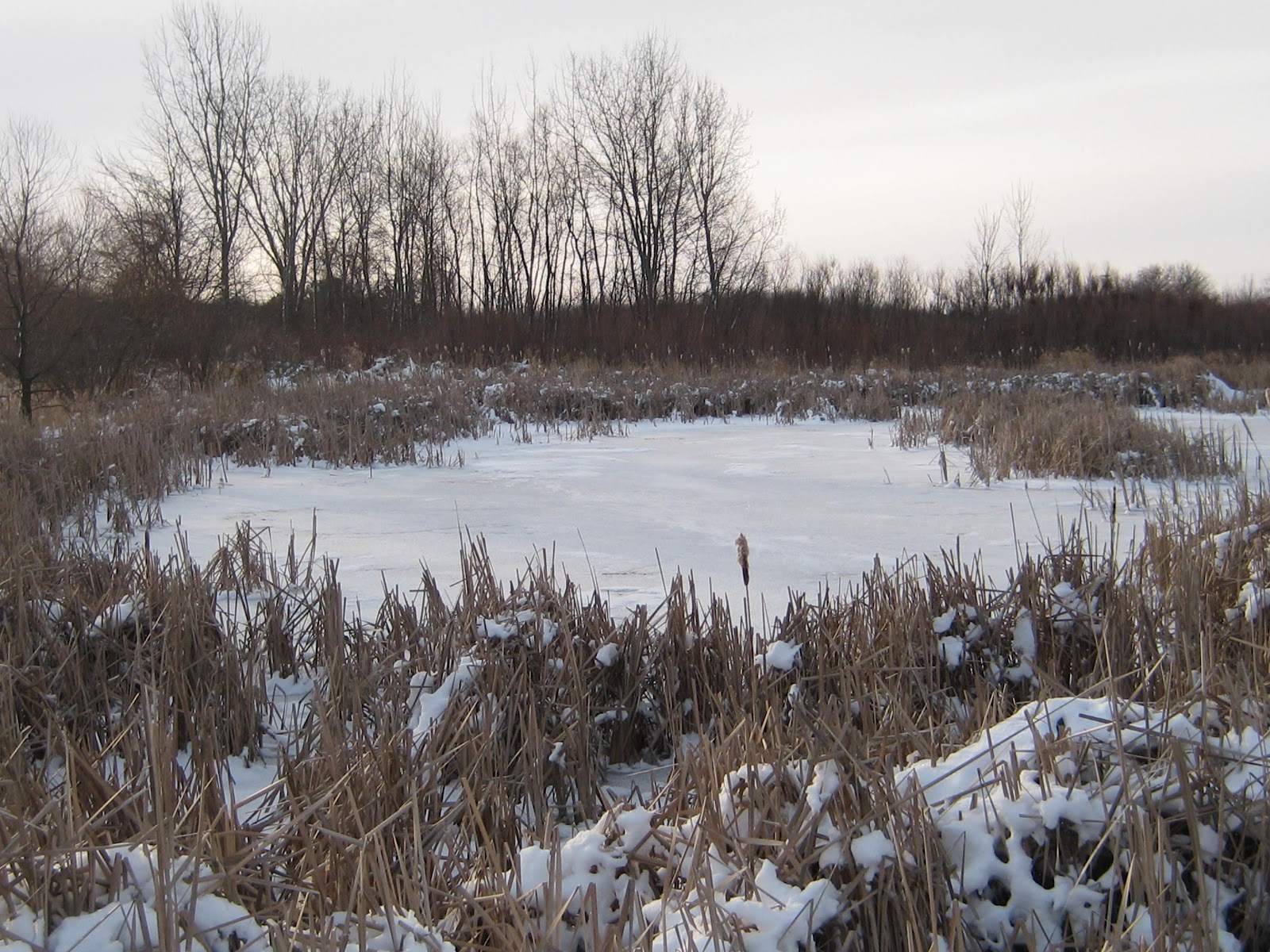
Saturday was a good day at Forest Hill for a hike with my dog, Remi. The early morning weather was partly sunny with a temperature of 25 degrees and a steady breeze out of the northwest. Before descending the hill, I gazed to the west and noticed how 4 inches of fresh snow had blanketed the ground once again. I passed Mallard Marsh and walked through Bobolink Meadow where I was disappointed to see fresh snowmobile tracks. The snow cover made me wonder how the creatures of summer were doing. For example, how was the Garter Snakes’ hibernation going? Their hibernation, more properly called brumation, is quite different from hibernation in mammals. They do not sleep the winter away nor do they live off their fat reserves. They are alert, if sluggish, and if it’s cold enough, they don’t even lose weight. Because they’re cold-blooded, their metabolism slows down so much that they hardly use any energy. They don’t eat for months. They survive underground below the frost line in dens where temperatures remain above freezing, although some minor dips below freezing can be tolerated. They generally hibernate in aggregates and have become famous in some locations, notably Manitoba, Canada where one den may hold 10,000 snakes. Here in Michigan, smaller groups of garter snakes hibernate together in such places as old groundhog burrows or rocky outcrops, in spots safe from predators and with enough moisture to keep them hydrated. Turning at the entrance to North Woods, I followed the trail south toward Willow Wallow. I passed the pond and entered Succession Field where I saw a pair of bluebirds flying near the birdhouse. Next, I stopped to check the deer carcass, barely visible through the snow. I continued along the edge of South Woods toward Artist Overlook where the rising sun shown through the bare birch trees. I turned north back to Willow Wallow and followed the trail along the edge of the pond. Before ascending Reflection Hill, I observed a pair of cardinals fluttering through the autumn olive shrubs. I climbed the hill, gazed at Grebe Pond, descended the hill and headed toward Brady Cemetery. Passing the cemetery, I entered Native Grassland and followed the trail along the east side of Grebe Pond where I spotted a dozen Mourning Doves and 3 Starlings perched on the power line. As I got closer, only 1 dove remained. Arriving back at the Classroom Building, I noticed that the birdfeeders were quiet. I was pleased that our new webcam will allow everyone to observe birds at one of the feeders anytime. Finally, I jumped in the van, turned on the heater and headed for home.

I welcome you to the feeder today
A woodpecker, a dove and even a jay
A cardinal, a junco and a chickadee
A wonderful sight for eyes to see
You all seem to know your place
You dart in and out with such grace
Grains and seeds I will provide
Snow has covered your food supply
Winter is long. There’s chill in the air
Come eat your fill. I have feed to spare
My ears enjoy your every song
There’s plenty of room. You all belong
The cold weather will soon go away
I welcome you to the feeder today.

D. DeGraaf


Saturday, February 18, 2012

February 18


Saturday was a good day at Forest Hill for a hike with my dog, Remi. The early morning weather was partly sunny with a temperature of 30 degrees and a stiff wind out of the north. Before starting the hike, I paused to gaze west and noticed 4 inches of overnight snow had whitened the landscape. I descended the hill, passed Mallard Marsh and walked through Bobolink Meadow where I was surprised to see 3, quarter-inch larvae crawling on the snow. Entering North Woods, I followed the trail west. I exited the woods and stopped to see the deer carcass that continued to decompose. I assumed the hawks and crows that I had seen around here earlier in the week had been feeding on the flesh. I walked around the edge of Succession Field and observed a few white oak leaves still clinging to a tree. Entering South Woods, I hiked along the edge of Swanson Swamp. I exited the woods and continued to Artist Overlook where I paused to observe Sora Swale. A solitary Mourning Dove flew overhead heading east. Following south trail, I noticed some twig galls on a small white oak tree. Galls are abnormal growths comprised of plant tissue found on twigs or branches. These deformities are caused by a tiny wasp that produces a chemical inducing the plant to produce large, woody twig galls. Most galls are aesthetically not pretty, but normally cause little damage to the tree. Gall formation begins when a female gall wasp injects her eggs into a stem. Upon hatching from the eggs, the larvae begin feeding on the host tissue surrounding them. The plant’s defensive reaction to this intrusive irritation is to isolate the toxins or activities of the invader in a tough, tumorous mass of tissue called a gall. Ironically, in doing so the plant provides food and shelter for the developing larvae. After completing their growth and metamorphosis, often many months later, the adult wasps escape by chewing an exit tunnel through the wall of the gall. Next, I turned south at Frog Fen and was surprised how close I got to a single crow perched high up in a leafless Cottonwood tree. Heading toward Brady Cemetery, I noticed clusters of dehydrated wild grapes on one of the white pine trees. Passing the cemetery, I entered Native Grassland and followed the trail north along the edge of Grebe Pond. I arrived back at the Classroom Bldg. to see lots of movement at the bird feeders . Finally, I got in the van and headed for home.

Winter lingers,
as though,
Mother Nature
is unfulfilled.
Snow falls insistently,
endlessly, it seems.
Insulating life within
a cocoon of purest white
covering our world
with a blanket of
coldness, aloneness.
Each solitary flake
securing its place
within nature's plane
securing solitude,
and timelessness,
within its icy touch.
Isolating, insular
encapsulating
Mother Nature's
chilling season.

Hazelmarie Elliott

Sunday, February 12, 2012

February 12


Saturday would have been a good day at Forest Hill for a hike with my dog, Remi. However, we were 90 miles north in Missaukee County near Lake City hiking with our friends, Jeff Reynolds and his dog Winnie where we planned to hike on his 80 acre hunting preserve. The afternoon weather was partly cloudy with a temperature of 21 degrees and a breeze out of the west. On our drive to the site, we were pleased to spot a Bald Eagle perched high up a tree. We arrive to notice a couple inches of fresh snow covering the 5 inches already on the ground. We left the cabin and followed the trail through a lovely stand of Balsam Fir. Just off the trail, we noticed a large, dead birch tree covered with Pileated Woodpecker holes. We got off the tail and headed into a cedar swamp where we followed several Coyote tracks. Coyotes are opportunistic and will eat almost anything available. Small mammals such as mice, voles, shrews, rabbits and squirrels are preferred foods. However, insects, fruits, berries, birds, frogs, snakes, plants, and seeds round out their diet. In areas with high deer numbers, carrion is an important food source. Coyotes are most often seen during their breeding period, which occurs in Michigan from mid January into March. They are active day and night; however, peaks in activity occur at sunrise and sunset. They generally feed at night. Next, we moved along toward a clearing where we saw lots of dead Bracken Ferns on the ground. In the open field there were lots of deer tracks as well as places where they scraped away the snow to look for edible grass. We also found some coyote scat and the remains of a deer. We got back on the trail and followed it through a stand of Tamarack trees where we noticed their tiny brown half-inch cones. Tamarack or Larch trees grow mostly in the cold regions of Northern America. They are unusual in that they are deciduous, their soft, needle-like leaves, borne in dense clusters, drop in the fall, and new leaves do not appear until the following spring. The bark of this tree is good for medicinal purposes. The inner bark is used as a poultice in treating wounds, frost bites, boils and hemorrhoids. The outer bark is used together with another plant as a treatment for arthritis, cold and general body aches. Tamarack wood is described as tough and durable often chosen as a material for snow shoes, knees for wooden boats, posts and poles. Other uses include firewood, lumber for wood houses, boat paddles, kitchenwares like spatulas, and handcrafted objects. Next, we arrived back at our starting point and noticed some beautiful Blue Spruce trees. Finally, we got back in the car and headed for their house.

I stood beside a hill

Smooth with new-laid snow,
A single star looked out

From the cold evening glow.
There was no other creature

That saw what I could see

I stood and watched the evening star

As long as it watched me.

Sara Teasdale
                                                                                                       

Saturday, February 4, 2012

February 4


Saturday was a good day at Forest Hill for a hike with my dog, Remi. The early morning weather was partly sunny with a temperature of 25 degrees and no wind. Approaching the bird feeders, I saw the usual visitors plus a couple of Purple Finches. Also, I was pleased to see the new heated birdbath. Having decided to reverse my course, I passed the Barn and continued south into Native Grassland. I stopped to gaze at Grebe Pond that was covered with an opaque layer of grayish-brown ice. Next, I passed Brady Cemetery and headed due west past the “Road Ends” sign and followed the two-track along the edge of a our neighbor’s field. Observing our southern boundary, I was pleased to spot several, small, healthy Norway spruce trees that we planted 2 years ago. Also, I noticed some fresh deer tracks in the mud. Turning north onto the south trail, I hiked along the edge of Sora Swale where I spotted some opossum tracks in the snow. Also, just off the trail, I saw some rabbit scat on a patch of snow. Rabbits produce two types of scat or droppings; dry brown pellets like what I saw and soft green pellets, composed of only slightly predigested plant food. The soft green ones contain essential nutrients and are rarely seen because the rabbit eats them, a process called reingestion, or coprophagy. I paused at Artist Overlook to observe a snowless landscape reminding me how mild the winter weather has been. After descending the hill, I hiked along the perimeter of Succession Field. Entering South Woods, I walked along the edge of Swanson Swamp where I noticed the sun peaking through the trees. Exiting South Woods, I continued around a snowy trail of Succession Field and stopped to see the deer carcass that was being scavenged by some unknown animal. I entered North Woods and followed the trail east to the boardwalk where I noticed a pile of fresh wood chips on the boardwalk and 3”X 6” hole about 20’ up a Beech Tree. It was quite clear that a Pileated Woodpecker had recently been there. This bird is about 15 inches in length and is one of the largest woodpeckers in North America. It has a black body, a red crest, white stripes on its neck and black and white stripes on its face. In the spring, I often hear their drumming sound as they establish nesting territories. Exiting North Woods, I hiked east through Bobolink Meadow where I could see the Classroom Building and Barn in the distance. As I climbed the hill from Mallard Marsh to the Storage Building, I noticed a few fresh mole mounds. Finally, I found my van and headed for home.

…Reaching my sacred spot

I stand in quiet reverence

Woodpecker tapping loud

Chickadees in winged chorus

The only sounds heard
Peace fills me

The music of the universe

Plays within my soul

Breaths slow, warmth spreads

Despite winter's chill
Stilled as a statue in place

A hushed whisper in my ear

As snow flakes fall upon dry leaves

Life's burden lightened, spirit renewed

Pilgrimage complete, turning in retreat

Hastened steps return me home

Richard Bramante


Saturday, January 28, 2012

January 28


Saturday was a good day at Forest Hill for a hike with my dog, Remi. The early morning weather was overcast with a temperature of 32 degrees and light snow carried by a steady south wind. Before starting the hike, I paused at the crest of the hill to look west at the snowy landscape. I started down the hill, passed Mallard Marsh and continued through Bobolink Meadow where I scared up four pheasants. Ring-necked pheasants are native to China and East Asia, but they have been successfully introduced in North America. In autumn, ring-necked pheasants form flocks in which they will live until the following spring. These birds are most comfortable on the ground, where they forage for grains, seeds, berries, insects, and, occasionally, small animals. They can fly and launch themselves airborne with an abrupt, noisy takeoff, but typically run from trouble. Also, I saw some of their tracks on the trail. Turning at the entrance to North Woods, I walked south to Willow Wallow. I turned west, followed the path into Succession Field and veered off the trail into North Woods where I observed a huge granite rock. It looked like another glacial erratic. Also, I saw a discarded augur feeder reminding me that this property used to be a farm. I returned to the path for a short time before getting off to check the deer carcass that I had discovered a few weeks ago. I was surprised how well preserved it still was. Completing my circuit of Succession Field, I paused at Artist Overlook to gaze at Sora Swale. Moving along the south trail, I observed some samaras hanging from a box elder tree and concluded it must be a female tree since it is the only one to bear fruit. These trees tend to keep samaras well into the winter or even into spring. Continuing on the trail, I spotted some tiny tracks and a snow tunnel of a Meadow Vole. Meadow Voles are active year-round, usually at night. They eat grasses, sedges and forbs including many agricultural plant species. They occasionally consume insects and snails. Meadow Voles occasionally scavenge on animal remains and cannibalism is frequent in periods of high population density. In winter they consume green basal portions of grass plants, often hidden under snow. Other winter diet components include seeds, roots, and bulbs. The Meadow Vole is an important food source for many predators such as snakes, owls, hawks, and carnivorous mammals. Next, I turned north at Frog Fen, climbed Reflection Hill and faced south to feel the snow hitting my face. I descended the hill and stopped behind the Classroom Building to observe lots of bird tracks next to the feeders. I wandered past the observation deck to the edge of Grebe Pond to check the ice conditions. Finally, it was back to the van and heading for home.

We trod a trail, my dog and me
I open my senses to hear and see
What nature’s expressions will be?
Whiteness covers brown and gold
Tales of the living cannot be told
Sounds of silence fill the air
Where is the bird or even the hare?
Snow hides most living things
No butterfly soars or cricket sings
I am delighted and rather fond
To see ice covering the pond
Leafless trees line my way
I hope to see some deer today
Animal tracks describe the night
A squirrel scampers in my sight
End of January is colder than cold
Winter stories are yet to be told.

D. DeGraaf

Saturday, January 21, 2012

January 21


Saturday was a good day at Forest Hill for a hike with my dog, Remi.  The early morning weather was sunny with a temperature of 1 degree and no wind.  The frigid overnight temperature covered everything with crystalline hoarfrost. On this hike, I planned to focus on the sounds of winter, both natural and man-made. As I started out, my questions were: How quiet was the Nature Area in the depths of winter? What sounds would Mother Nature offer today? How would these sounds compare to a similar hike I made last June? Before descending the hill, I looked west over the landscape and heard a motor running from the dairy farm next door. Beginning my hike, I paused at Mallard March where silence replaced the familiar songs of perching Redwing Blackbirds that I remembered from last summer. Walking through a serene Bobolink Meadow, I picked up the rhythmic crunching sound of my boots walking over the frozen snow. Hiking through peaceful North Woods, I saw a squirrel run up a tree and was reminded of the crunching noise this creature made last June as it ran over the dry leaf litter. Also, I noticed some fresh deer tracks while listening to a few crows off to the north. I exited the woods and circled the far western edge of Succession Field where I saw a couple of Downy Woodpeckers perched against trees while hearing one of them call out. This was the spot where I remembered hearing the beautiful song of an Indigo Bunting last summer. Entering a very quiet South Woods, I moved off the trail and walked onto the ice of secluded Swanson’s Swamp where I found some fresh rabbit and raccoon tracks. I paused, closed my eyes and recalled last June hearing the drumming sound of a Bull Frog coming from this location. Exiting the woods, I hiked toward Artist Overlook where I recalled the melodious sound of a Song Sparrow last June. I continued along the south trail where I spotted a male and female Cardinal while hearing the familiar sound of a lone Chickadee. Turning north at Frog Fen, I climbed Reflection Hill where my ears perked up to hear the distant drone of a passenger jet high above giving off a white vapor trail against a clear blue sky.  I paused to gaze at a silent Grebe Pond. Next, I descended the hill where I noticed how the additional inch of snow would help make the hill prime for sledding next week. Also, I was pleased to see several old Xmas trees that some of the guides had piled up to make a rabbit habitat. Next, came the sounds of chirping birds at the feeders where I spotted Buntings, Goldfinch and Juncos. Finally, I arrived at the van, listened one last time to nature’s quietude and headed for home.

The leaves drop to earth
Leaving the trees bare and gray
No shield from the cold
The animals hide
And they sleep for the winter
Now the land is bare
Strong gusts of wind blow
As white snow swirls everywhere
The world is blinded
The blizzard settles
Leaving the landscape pure white
There is no color
The snow is gentle
As it drifts slowly downward
And the world sparkles

Unknown

Saturday, January 14, 2012

January 14


Saturday was a good day at Forest Hill for a hike with my dog, Remi.  The early morning weather was mostly cloudy with a temperature of 18 degrees and a slight wind out of the northeast. First, I paused to scan the western vista and noticed that snow cover had returned after a long dry spell. I followed the trail past Mallard Marsh and through Bobolink Meadow where I blazed a path through the powdery snow. A few crows welcomed me with their loud caws. I entered North Woods and continued along the trail where I looked up to see some blue sky through the leafless canopy. After exiting North Woods, I observed an unusual snow mound just off the trail.  I walked over and brushed the snow away to reveal a dead deer lying in the grass. I examined the body and noticed it was a button buck with no external signs to indicate cause of death. A button buck tends to be a buck that is only 6 months old. Since it is within the first year, it only has little nubs where the antlers will develop. While lamenting the passing of this magnificent creature, I was reminded of nature’s ageless cycle that from death comes life for others as carnivores and scavengers will gain sustenance from the flesh and the surrounding vegetation will gain soil nutrients. I continued along the far side of Succession Field where I paused at a bench and measured the snow depth at 5 inches. I passed through the stand of white cedar and saw a squirrel’s nest up about 30 ft. in a tree. Heading toward Artist Overlook. I changed my usual route and turned north toward Willow Wallow. I walked down to the edge of the pond to see a muskrat lodge out on the ice. I followed the trail along the edge of the pond and ascended Reflection Hill from the west. Circling the hill, I gazed down at a snowy Grebe Pond.  Heading south, I descended Reflection Hill and hiked past Frog Fen toward Brady Cemetery.  I walked up the slope into the cemetery and gazed west at the surrounding landscape. I left the cemetery and turned north into Native Grassland where I observed the dried flowers of Aster, Queen Anne’s lace, Thistle, Black-eyed Susan, Milkweed and Burdock.  From the east side of Grebe Pond, I noticed a stand of cattails with their fuzzy flower heads. Finally, I arrived back at the Classroom Building where I spotted some birds at the feeders including Buntings, Goldfinches and one Mourning Dove. Finally, it was time to hop aboard the minivan, turn on the heater and head for home.

Amongst the quiet of Nature with wooded hills around
The harsh cawings of the ravens the only living sound
In the nice Winter sunshine it is a pleasant day
From life's many cares and worries a place for to hide away,
Of an Earthly Utopia 'tis not hard to visualize
Where Nature in all of her splendor is beauty to the eyes
I too am part of Nature like all creatures great and small
And memories of Nature's beauty are marvelous memories to recall,
An artist on her canvas would try to capture such a scene
And I enjoy remembering the beauty I have seen
And the unmistakable sounds of Nature on a sunny Winter's day
Like the clear flute of the magpie on trees not far away
A lovely day in Winter of around eighteen degrees
And in the stony valley there is scarce a puff of breeze.