Monday, May 27, 2019

May 27


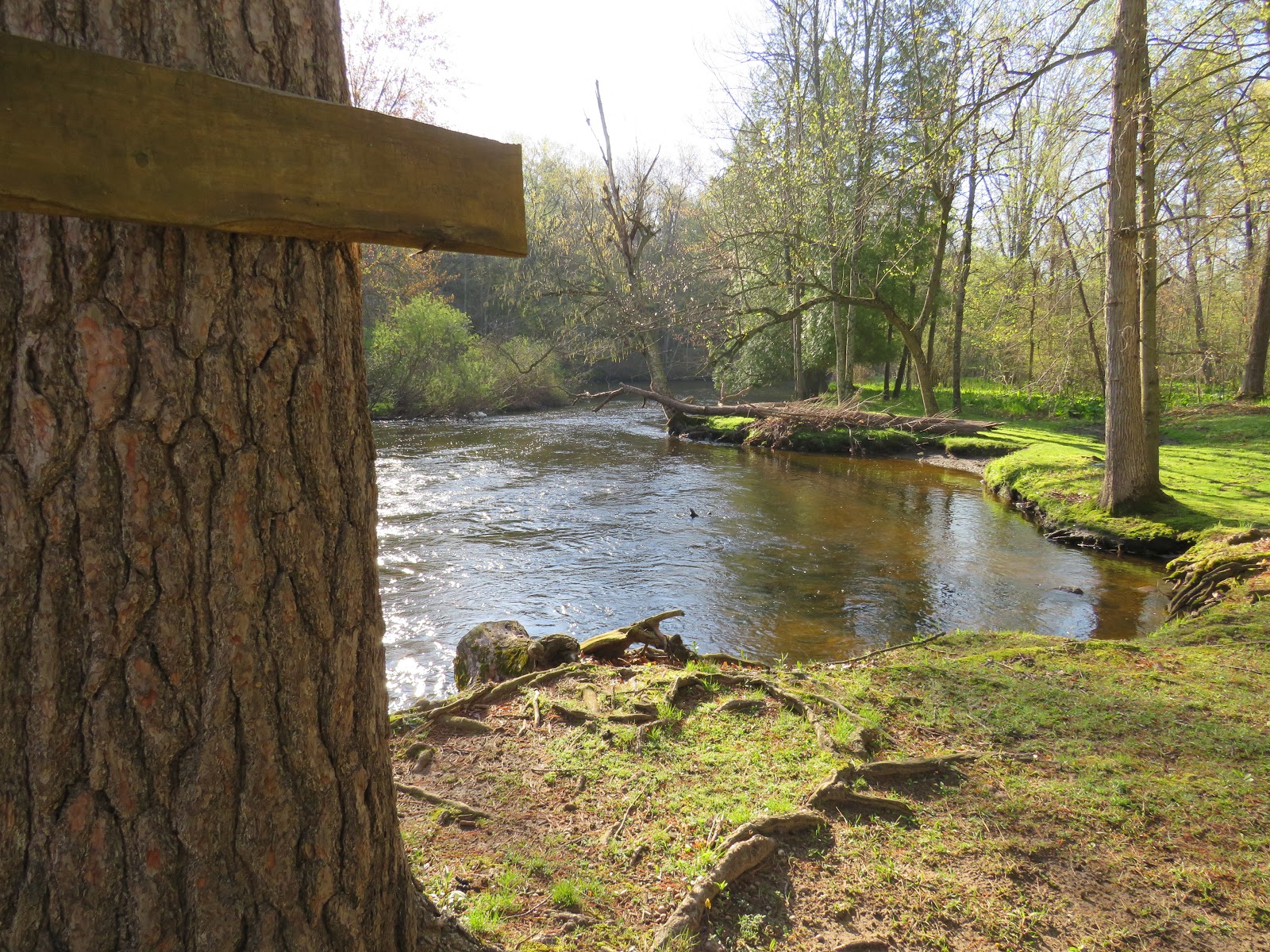
After an early morning thundershower, the temperature is mild and sky is clear as I hike an earthen trail in Audubon Woods Preserve. I’m on my way to another encounter with the Chippewa River as part of my goal to explore this riparian corridor from its source in Barryton to its mouth in Midland. Descending a gradual slope through a lush broadleaf forest of Beech and Maple, I come across a 4-inch, wax-cap mushroom being fed on by some tiny flies as well as a 2-inch, Orange Peel fungus. Along the way, I spot some Trillium and Yellow Violets among the leaf litter. Nearby, the cut end of a decaying tree trunk totally covered with Turkey Tail fungi is a fascinating sight to behold. Reaching a high bank, I take a moment to greet the river, once again. Since my last encounter at Sylvan Solace, it has flowed due south about 3 miles to this point. Climbing down to the flood plain, I notice Marsh Marigold flowers and a rarely seen, tiny Wild Ginger blossom, hidden under the leaf. Exploring the mud flats, a variety of ferns catch my eye including: Maiden Hair, Sensitive, Lady and Cinnamon. On a fallen log in a small vernal pond, I spot a 3-inch Green Frog. In the nearly closed canopy above, I listen to an Eastern Phoebe (stock photo). Before heading back, I pause once more to watch the river, as it turns northeasterly toward the city of Mt. Pleasant. Ascending the slope back toward the car, I pass a decaying conifer log displaying a reddish color due to resin and tannin contained in the heartwood. Also, I see a few Wood Anemone blossoms. Continuing back through the quiet forest, I enjoy the song of an Ovenbird (stock photo). Completing the hike and heading home, I reflect on another memorable river rendezvous.

I welcome your waters
Your journey is long
River, my muse
Take me along
Burgeoning banks
Your current is strong
River of life
Take me along
Learning your secrets
I hear your song
River of nature
Take me along

D. DeGraaf

Monday, May 20, 2019

May 20


The early morning weather is clear and cold as I hike through a section of Lumberjack Park that is to become an extension of the current nature trail. From the south trailhead, I hike west on Madison Rd. over the Pine River, turn right and make my way through a dense wooded area where I’m amazed to see the ground bursting with hundreds of white Trillium flowers. In all my nature walks around here, I’ve never seen so many of them in one area. What’s even more amazing is the many deer that live in these woods haven’t eaten them. While beautiful to look at, they are extremely fragile and picking them effectively kills them, ensuring none will grow in their place. Pink blossoms of Spring Beauty, although not completely open, also blanket the forest floor. Smaller patches of Phlox, Yellow Bellwort, Violet and Wild Geranium are evident as well. All of these wildflowers, called spring ephemerals, occupy a short, yet glorious interval in the park, blooming and setting seed during a small window of sunlight between snowmelt and when the trees leaf-out. While heading northwest through the campground, I pause to look and listen to a Baltimore Oriole perched high in a tall tree. Next, I veer off the trail to the river’s edge where I observe the gently flowing water reflecting the surrounding landscape. On the muddy shoreline, I notice opossum and duck tracks as well as weasel and deer. Just ahead, I spot a May apple plant displaying a tiny green flower bud and a few fern fiddleheads that are tender and tasty this time of year. On a nearby log, I spot some “hairy” Coyote scat as well. Leaving the woods, I pause once again as the babbling river flows over some rocks. Continuing past some pavilions to Lumberjack Rd, I cross the bridge to the north trailhead of the current nature trail. After doing some grooming and adding a few signs to this area of the park, we hope to have the “Campground Trail” open to the public by next summer.

Floor is barren brown
Nature’s ways to keep
Green shoot reveals
Midst of forest deep
Stalk soon appears
From muddy ground
Three leaves sprout
Single bud so round
Three pedals white
Unveiling you bring
Dainty Trillium flower
Speaks to me of spring

D. DeGraaf

Monday, May 13, 2019

May 13


On a cool, cloudy, early morning, I’m hiking an earthen trail in Sylvan Solace Preserve, anticipating another encounter with the Chippewa River. From the last time I saw the river, it flowed from the spillway on the east side of Lake Isabella and meandered southeast about 4 miles to this access location. From the parking lot, I walk north on the Meadow Lane trail where I spot a couple of Chipping Sparrows on the path ahead. Turning west on the River Loop trail, I proceed into a forest of hardwoods where the leaf litter reveals another sign of the season, the green foliage of a patch of May apple. Reaching the river, I descend the steep bank and pause to take in the scenic riparian landscape as the swollen watercourse flows rapidly southward. On the shore nearby, I observe nature’s version of a green salad, skunk cabbage along with some baby horsetails and ferns. Back up the slope, I follow the trail south along a bluff where I spot a few blossoms from a Service Berry tree as well as a silk nest in the crotch of a young cherry tree containing some 1 cm.-long Tent Caterpillars. Far ahead on the trail, a sudden movement draws my attention to a well-camouflaged Whitetail doe. Continuing on the River Loop trail, I head northeast where, above me the forest canopy is beginning to close up and at my feet Pennsylvania Sedge and Wild Strawberry are beginning to flower. Heading back toward the car on the Meadow Lane trail, I notice a white substance on a pine tree trunk where the watery sap has condensed to reveal the sugars and other minerals contain in it. Also, no hike at this preserve would be complete without stopping to watch the comings and goings of one of many mound ant colonies. Finally, what seemed like an appropriate conclusion to my hike was a serenading Chipping Sparrow.

Welcomed scene
Glad to know
Sustaining life
Flow, river flow
Fish and fowl
Fawn and doe
Living water
Flow, river flow
Farwell for now
Onward you go
Until next time
Flow, river flow

D. DeGraaf

Monday, May 6, 2019

May 6


Since leaving its source in Barryton, the Chippewa River meanders southeast about 14 miles before emptying into Lake Isabella. On a cold, misty morning, I’m hiking in Gilmore Park on the northwestern shore of the lake. This 700-acre impoundment was created 50 years ago when a dam was built on the river by a private real estate developer. The park trail I follow is partially flooded from recent rains as I take in the sights and sounds of a wooded area of mature broad leaf trees. After spotting fresh Whitetail tracks in the mud, I spook one of them as it hightails it away. From the fishing platform, I scan the lake through thick fog and spot a lone Common Loon swimming and diving. While not classified as ducks, these waterfowl spend the winter either along the Atlantic coast or the Gulf of Mexico. Migrating here in the spring to breed, they require adequate fish to feed on, undisturbed shorelines for nesting and quiet bays for chick rearing. Back on the trail, I notice some lichens as well as colorful Red Tree Brain Fungi thriving on a decayed log. While only growing on poplar or aspen trees, the fruiting bodies of these fungi are dull and crust-like much of the year, but swell into crimson, jelly-like blobs in the spring. Looping back toward the car, I pause to first hear the alarm call of a Redwing Blackbird followed by a chirping Robin. Nearby, silhouettes of sumac panicles catch my eye. Moving on, I come upon fresh evidence of a wood-chipping Pileated Woodpecker. Back in the car, I drive around to the east side of the lake onto the Pines Golf Course to observe the dam and spillway where the water rushes down into the river channel and continues its journey southeastward through the fields and farmlands of mid Michigan.

Life in the wild
From the oak above
In the morning mist
A cooing dove
From a leafless maple
A catbird sings
On the earth below
First blossom clings
Nature surrounds
She wakes once more
Dresses for spring
She sets the decor

D. DeGraaf

Monday, April 29, 2019

April 29


With the temperature just above freezing and the morning sun shining bright, I’m in the village of Barryton gazing across the mirror-like surface of an impounded lake at a small dam and spillway where the main branch of the Chippewa River begins. Today is the first leg of my adventure to explore the entire 90-mile length of this river from here to the city of Midland where it empties into the Tittabawassee River. Periodically, over the next few months, I plan to access the river from public parks, preserves and maybe even a canoe, investigating the riparian flora, fauna and geology. From shore of the impoundment, my attention is drawn skyward to a singing male Redwing Blackbird and a gibbous moon. Next, I drive a short distance north to Sterns Park where I follow a paved path toward another access point of the impoundment. From a deck overlook, I notice the hanging male catkins of Tag Alder while barely catching a glimpse of some retreating Buffleheads. Looking upstream, I spot a pair of geese honking at me on this chilly morning as puffs of steam blow out of their bills. Wandering along the wooded shoreline, I come across evidence of beaver activity while on the ground, ice crystals on Trout Lily leaves have not yet melted. In a nearby tree, I notice a male Goldfinch whose plumage has turned from the muted yellow of winter to the bright yellow of spring. High up in another tree against an azure sky, a male Cardinal is singing his song. Not to be outdone, in yet another tree, a male Brown Thrasher is singing his song. These birds, like catbirds and mockingbirds, are mimics with varied repertoires of songs. While mockingbirds tend to repeat phrases three or more times, Thrashers typically sing phrases only twice. Making my way back to the car, I can’t help but notice bristly green catkins on a willow tree. As I drive back to Alma, I’m pleased with my introduction to the river and look forward to the next encounter.

Lifeblood of earth
Is what you bring
Your current calls
Your waters sing
Spring treasures
A garter snake
School of trout
A Mallard drake
Vistas of beauty
Your banks bestow
Chippewa River
Onward you flow

D. DeGraaf

Monday, April 22, 2019

April 22


In the hush of a cold, murky morning, I’m exploring the Stearns Preserve near the small village of Riverdale. My first stop is the edge of the rushing Pine River where I tune in to a singing robin. Wandering around the clearing, I spot a dime-size Banded Snail in the leaf litter. In the winter, this gastropod burrows under leaves and hibernates. Its heart hardly beats at all while its blood contains chemicals that prevent it from freezing. As I begin to hike east on the paved Heartland bike trail, I’m aware of the green patches of Equisetum (Horsetail) along the edge. A closer look reveals that some stalks have spore-bearing terminal cones and some do not. Next, I pause on the bridge and gaze south as the river flows rapidly downstream. On the far side of the bridge, I turn south and follow an earthen path along the river’s edge where I’m fascinated by a decaying tree trunk displaying an assortment of fungi and mosses. Further along, my attention is drawn upward to a tree branch whose bark has been recently girdled by some critter. My guess is was a porcupine. At my feet, I notice the sandy soil is littered with tiny red flowers of Red Maple. Turning around and retracing my steps, I look across the river and notice a clump of leafless Red Osier Dogwood shrubs. Back on the paved trail, I continue east where the deciduous canopy is showing signs of growth. Along the edge, Honeysuckle leaves are beginning to sprout. Down on my hands and knees, I look closely at the sporophytes that are emerging from a bed of moss. Just ahead, I come to one of my favorite sections of the preserve, a cedar swamp. However, because of flooding and lack of proper footwear, I’m unable to venture off the trail down into this unique habitat. At the eastern boundary line, I turn around and retrace my steps under an arching Box Elder tree before reaching the car and heading home.

Remembering Earth Day

Mother Earth, child of the sun
You are a very special one
Water to drink, air to breathe
Life abounds on land and sea
Some worlds are far too cold
Living things cannot take hold
Some worlds are way too hot
Uninhabitable at every spot
Mother Earth, dwelling place
Rightful region in outer space
Sphere of white, sphere of blue
We dedicate this day to you

D. DeGraaf

Monday, April 15, 2019

April 15


From the trailhead, I’m hiking east on the White Pine trail in Lumberjack Park. With overcast morning skies, a gusty north wind and temperatures in the mid 30’s, it seems like the weather has retreated from spring back to winter. Continuing east along the Pine River, my ears tune in to the call of a Red-Bellied Woodpecker while high up the trunk of an aspen tree are fresh, baseball-size holes made by a foraging Pileated Woodpecker. Gazing skyward reveals a leafless canopy. Making my way down to the river’s edge, I pause to watch the flowing water as Titmice sing in the distance. Tracks in the mud mark the place where deer came to drink. Down in the leaf litter, I spot a turkey feather as well as another sign of spring-the mottled leaves of Trout Lilies. Curving north through a stand of tall Red and White Pines, I notice a log covered with harden Oyster Mushrooms that were fleshy and edible last fall. Picking up the Mud Creek Trail, I turn south and approach the creek to observe the disabled bridge that was partially displaced by spring floods. While the bridge is functional, a group of park volunteers are in the process of repairing it. From the middle of the bridge, I pause to watch the water gently flow west where it empties into the river. Following the trail west, I spot some green vegetation in the wetlands as duckweed and sedges appear. Next, I turn south across the boardwalk and pause to observe another sign of spring-maroon sprouts of Skunk Cabbage. Up the stairs, I loop around the Sugar Maple Trail back to the boardwalk, back over the bridge, through the pines, down the slope and pick up the White Pine trail as it heads west to the trailhead. Finally, I make it back to the car where I’m pleased by the condition of the trails and look forward to working on a new section in 2019.

Riparian wonder
Runs free and clear
Carries the fish
Quenches the deer
Washes the rocks
Cleanses the ground
Water of spring
Flows eastbound
Current is strong
Her banks confine
Nature’s creation
River called Pine

D. DeGraaf