Monday, May 30, 2022

May 30

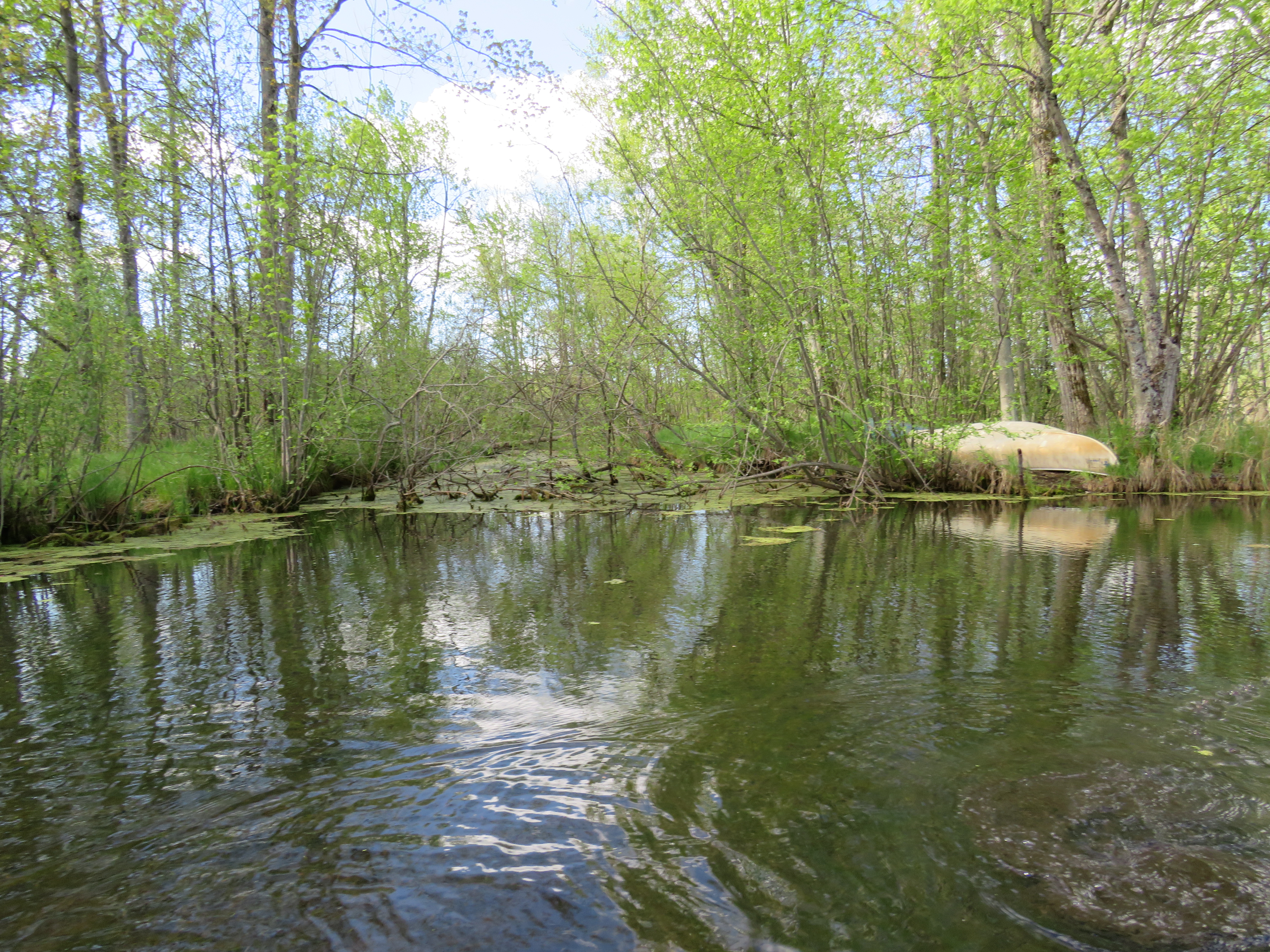
Continuing my quest to follow the Maple River from its mouth to its source, I’m on a morning hike in a section of the State Game Area just west of Clinton County’s village of Maple Rapids. With temperatures in the low 50’s, under party sunny skies, I stand on the muddy shore of the Maple River listening to a chorus of birdsongs as the water flows slowly past. Moving along the riverbank, I spot white blossoms of Foxglove Beardtongue as well as a few, 1-inch Fragile Forktail damselflies perching on blades of grass. This species, especially the females, are among those that eat other damselflies, including their own species. They will grab small flying or perched insects and have even been known to rob spider webs. Following a gravel road parallel to the river, I gaze skyward to see a perching Great Crested Flycatcher and look down to see the fresh carcass of a an 18-inch, juvenile River Otter. Up ahead, I come upon an oak sapling with leaves riddled with holes. Upon closer look, I notice tiny, ½ inch Spongy Moth (formerly Gypsy Moth) caterpillars feeding on the leaves. Called instars, these larvae go through several molts before reaching full size. Large numbers of adult caterpillars have been known to defoliate an entire stand of trees, especially oak. Back to the river’s edge, I spot an aggregation of ¼-inch Whirligig Beetles (stock photo)skating on the water while listening to the mimicking vocals of a Catbird. Next, my attention is drawn to both the lovely aroma and blossoms of Pink Honeysuckle. Turning my gaze back to the river, I notice the glittering water surface, a chorus of birds including, American Redstart and Baltimore Oriole followed by a muskrat swimming for shore. Turning around, I come upon a fisherman who shows me a recently caught, 20-inch Channel Catfish. What makes these fish so remarkable is their acute senses. Every available space on their bodies is allotted for taste-sensing. Even their whisker-like barbels are covered in taste buds. Beside taste, their sense of smell, hearing and seeing are second to none. They can smell compounds as weak as one part per billion. Their whole-body acts like an ear drum allowing them to detect the faintest noises. Even extremely low frequency sound can be detected using tiny hair-like projections inside the fish’s pores. Catfish eyesight is so good that they can spot other fish from quite a distance in clear water. In addition, these fish, much like sharks, can detect electrical fields in a sense known as electroreception. They use this when searching for their prey in mud. Approaching the car, I get a quick glimpse of a female, Baltimore Oriole looking for food.


Mid-morning of the day

Riverbank shows the way

Weeping willows sway

Skyward, noisy Jay

Perching, Catbird gray

Souring hawk eyes its prey

Frisky fawn wants to play

Green leaves, here to stay

Nature’s springtime display

Fond farewell to May


D. DeGraaf

Monday, May 23, 2022

May 23

Little over a year ago, Dave Shepherd and I were halted by fallen trees in our attempt to access Chippewa Watershed Conservancy’s 3-acre, Riverbank Preserve by canoeing on the south Branch of the Pine River west from the Rolland Rd. bridge in Isabella County. Under sunny skies with mid-morning temperatures in the mid 50’s, a stiff north wind and Dave’s chainsaw, we try again. Before heading out, I notice a pile of branches that were first cut and gathered by beaver to dam up the road culvert and later removed by workers to prevent flooding of the roadway. Moving slowly upstream through a narrow, greening riverscape, we perk up to the sound of a Yellowthroat and the sight of what appears to be a perching Willow Flycatcher. Flycatchers don’t learn their songs from their parents, as many other birds do. Instead they hatch knowing their songs. Scientists tested this by raising Willow Flycatchers in captivity while letting them listen to an Alder Flycatcher sing its song. Despite hearing only this song all day, Willow chicks grew up to sing their own song. After Dave clears away a large branch, we move ahead where I notice that the floating florae include, Wooly algae and a mixture of Curly-leaf Pondweed, Narrow-leaf Pondweed and Duckweed. Near shore, I spot flowering Pennsylvania Sedge and sprouting cattail shoots. After about a half mile, we paddle through an extreme meandering section of the river that makes up the Riverbank Preserve where I look skyward to see a perching Tree Swallow and look near shore to see a basking Blanding’s Turtle, distinguished by its helmetlike shell and mustard-yellow throat. Though not listed as an endangered species, it is one of special concern in Michigan where its habitats have been fragmented by roads and development. Pioneer physician William Blanding first stumbled onto this beautiful turtle while exploring the Fox River in Illinois in 1830. His pickled specimen still resides in the collections of the Philadelphia Academy of Natural Sciences. In 1838, herpetologist John Holbrook published its formal description, which included this statement: “first observed by Dr. William Blanding of Philadelphia, an accurate naturalist, whose name I have given this species.” Turning around to head back, we take a narrow side channel northward that curves into a wide, oxbow-like lake where I spot a pair of perching Yellow Warblers and an active nest of a Canada Goose containing 6, 3-inch white eggs. Turning around again, we paddle back to the car, pleased to have finally explored this remote, scenic preserve.


From a very hectic pace

To calm and quiet place

From acres of concrete

To a riparian retreat

From busy urban scene

To verdant meadow green

From over-crowded rooms

To fields of colored blooms

From loud sirens sound

To birdsongs surround

When life cages you and me

Mother Nature sets us free


D. DeGraaf

Monday, May 16, 2022

May 16

It’s mid-morning near Ionia County’s village of Muir as I pause on a muddy bank to watch the Maple River flow from left to right and empty into the Grand River. Thus begins a new adventure as I hope to explore the natural environment of this meandering watercourse upstream. The Maple River is a 74-mile-long tributary of the Grand River flowing east to west through central Michigan.  It begins in Shiawassee County, south of the city of Corunna and flows west through Clinton and Gratiot Counties before emptying into the Grand River where I stand. Other villages it flows through include Bannister, Ovid, Elsie and Maple Rapids. Part of its watershed make up the massive Maple River State Game Area. Also, from the muddy bank, I notice some Coyote tracks. The sky is partly sunny with temperatures in the upper 60’s as I hike along the riverside on the paved Meijer bike trail and pause to hear the steady, purring, mating calls of several male American toads. Up ahead, I spot a patch Trillium on my left and a floral combination on my right that includes, yellow Dandelion, pink Dead Nettle and white Garlic Mustard. Nearby, just off the trail, I notice a Catbird and a rarely-seen Lincoln’s Sparrow. John James Audubon named this bird after his travel companion Thomas Lincoln, who accompanied him on an expedition to the coast of Labrador. The expedition found the sparrow in a valley in Quebec, and Mr. Lincoln was the only person who managed to bring back a specimen for study. Continuing my hike, tree blossoms of Pin Cherry and Wild Cherry catch my eye. Turning my attention to the river, I see a couple of Painted Turtles basking on a log. Moving toward the car, I observe patches of Trout Lilly,  Wood Anemone and Wild Geraniums. Finally, near the trailhead, I pause to look at a patch of Wild Ginger, with their distinctive kidney-shaped leaves. Stooping down, I lift one of the leaves to expose tiny, purple blossoms. This unusual growth is believed to have evolved to help early spring insects locate the flower for food and pollinating. Later, ants will carry seeds back to their colony where they will eat the fleshy nodules and discard the actual seed, which is then left to grow in the nutrient-rich plant waste underground. While it is not to be confused with the more common type of Ginger that is used to season food, there are still some recipes that call for using Wild Ginger as a spice substitute. Because of its antibiotic contents, Native Americans and early Euro-American settlers used it as a topical treatment for wounds. 


Verdant banks

Muddy shore

New watercourse

For me to explore

Gentle current

Flowing corridor

Flora aplenty

Fauna galore

Not just a river

So much more


D. DeGraaf

Monday, May 9, 2022

May 9

The mid-afternoon temperatures are in the low 60’s, under mostly cloudy skies as I hike on a little-known park trail in the small village of Sumner, 10 miles SW of Alma. In 1854 the land was settled by George Bell and Titus Stover. The two had difficulty in deciding what to name this new community. George referred to it as ‘Belltown’ and Titus called it ‘Stover’. In 1855, the township was titled ‘Sumner’, named after another early settler, Charles Sumner. Finally, in 1887 the village decided to avoid confusion by switching its name to ‘Sumner’ once and for all. At that time it was a thriving lumber town with four churches, cobbler shop, general store, hardware store, harness shops, hotel (stock photo), meat market, millinery store, saloons, sawmill, schoolhouse and wagon shop. From the car, I head west and pause to watch the water of the rain-swollen Pine River flow rapidly past. From the riverbank where I spot a couple of Muskrat holes, I veer unto a grassy trail displaying blossoms of Woodland Violet and Chickweed. Up ahead, I scan the flooded floodplain where I listen to Robins and Redwing Blackbirds while looking at the lush green leaves of Skunk Cabbage. Also, through a window of fallen branches, a swimming Mallard drake catches my attention. As the trail loops back, I come upon the uniquely shaped leaves of Blood Root. Next, I pull up and break a root to reveal the red-orange sap that gives this plant its name. This “blood” was a traditional medicine used by American Indians to treat fever and rheumatism. Other traditional uses were for treatment of ulcers, ringworm and skin infections. It was, and still is, used to produce natural red, orange, and pink dyes. Currently, Bloodroot is being studied for use as an anti-cancer agent, particularly for the treatment of skin cancer and as a dissolving agent for skin growths such as warts. Nearby, I pause, look up at the leafless canopy and listen to the song of what sounds like a Baltimore Oriole. After, stopping to observe the white blossoms of a young Service Berry tree, I chase after a fluttering Cabbage White Butterfly that finally lands. These Lepidopterans are seen flying around from now to late fall. Their larvae are velvety-green with a row of yellow spots running laterally along the body (stock photo). In the US, the caterpillar is known as a cabbageworm and is a common pest on cultivated vegetables like cabbage (thus the name), horseradish, kale, radish, and broccoli. 

Signs of the season

Timid and bold

Out of the mud

Marsh Marigold

Peepers in pond

Killdeers on high

Landing on litter

Cabbage Butterfly

Creepers climb

Bluebells ring

Nature’s glory

Expressions of spring


D. DeGraaf

Monday, May 2, 2022

May 2

The mid-afternoon sky is sunny with temperatures in the upper 40’s as I enjoy a solo hike at Forest Hill Nature Area, a place I’ve explored hundreds of times since it was established in 1993. From the south trailhead, I pass by a male Box Elder tree displaying his flowers and then spot a perching Common Grackle. Turning west and arriving at Sora Swale, I watch a Brown Thrasher perched in the underbrush and a few Painted turtles basking on a log. Turning west. I pass through a row of Paper Birch before following a trail into South Woods where I spot a Chipmunk before pausing at Swanson Swamp to take in the sounds of this remote wetlands. After side stepping some Coyote scat on a boardwalk, I make my way around to North Woods where I observe blossoms of Spring Beauty, my first ephemeral wildflower of the season. Spring ephemeral wildflowers, as their name suggests, bloom for a short time each spring. As understory forest dwellers, they only have a short window of suitable conditions for aboveground growth between frozen ground in winter and full shade of the summer canopy. These plants bide their time underground as lowly root tissue for most of the year, and sprint to photosynthesize, flower, and produce seeds in the early spring when there is ample light reaching the forest floor. Nearby, the unopened umbrella leaves of May Apple catch my eye. Just before exiting North Woods, I scare up a half dozen Wood Ducks from a vernal pond. Proceeding south, I arrive at Willow Wallow where the Tree Swallows are swooping around me as they catch insects off the pond surface. Heading east toward Reflection Hill, I observe a perching Song Sparrow and an Eastern Bluebird. From the hilltop, I look down on Grebe Pond as well as some of the buildings that make up the Nature Area headquarters. Also, amber patches of Switchgrass catch my eye. Descending the hill southward toward the car, I spot a mound of pea-size mud balls on the ground.. These “chimneys” are built by crayfish, but not the stream- and swamp-dwelling kind. These crayfish rarely visit open bodies of water, preferring to spend their days in water-filled chambers three to six feet underground. Burrowing crayfish (stock photo) are seldom seen, exiting their burrows only in spring and summer on rainy or very humid nights to forage for food or search for mates. 

May stage is set

Opening scene 

Curtain rises

Gatherings of green

Nature’s in her place

Props of spring

Violets bloom

Amphibians sing

Welcome back

Right on cue

Swooping the pond

Swallows of blue


D. DeGraaf

Monday, April 25, 2022

April 25

I begin my morning nature hike alone in St Louis Michigan at the Emma Burnham Outdoor Center with temperatures in the low 50’s, mostly cloudy skies and a stiff west wind. Shortly after entering a dense, leafless forest of oak, maple and beech, I hear the distant call of a female Wood Duck as she takes off from one of the many vernal ponds. Soon thereafter, from a bare canopy, I hear the loud call of a Pileated Woodpecker and from the ground below, I see a tree stump that it had shredded earlier in searched for food. After walking over a thick layer of leaf litter, I come upon an oak tree with a large, 3-ft burl on its trunk. A burl is a collection of tree cells called callus tissue. Normally, this tissue is formed by a tree in response to a disease, insect or storm damage. As a burl grows, it incorporates the tree’s undeveloped buds that surround it and folds them into its expanding form. Although burls grow into weird shapes and sizes on trees that otherwise look normal, a burl itself is not diseased or contagious. Over the years, burl wood has become quite valuable for making unique furniture (stock photo). Up ahead, other subtle signs of the season include a few Trout Lily leaves on the ground and a Honeysuckle shrub beginning to leaf out. Nearby, I spot a patch of Wild Leeks. Also called ramps, these plants are one of the earliest wild edibles to emerge, and, for some, they're the holy grail of wild edibles. They're really a type of wild onion with a unique garlicky-onion flavor. Historically ramps were considered a spring tonic in the Appalachians. Early settlers looked forward to harvesting them after long, hungry winters, as it would have been one of the first vegetables they had eaten in months. Fungi that catch my attention include Oyster and Turkey Tail mushrooms. Looping back toward the car, I explore a small pond while noticing a perching male Redwing Blackbird establishing his nesting territory and the fuzzy nubs of a Pussy Willow. These soft silver tufts—as well as the plant itself—are named for their resemblance to tiny cats’ paws. These tufts actually are flower buds just before they bloom. The soft coating of hairs acts as insulation to protect these early bloomers from cold temperatures. On the eve of Earth Day, it seems fitting to observe through the trees a rotating wind turbine- a source of clean energy for our planet that reduces dependence on fossil fuels and resulting air pollution from their combustion.


Planet earth, child of the sun

You’re a very special one

Water to drink, air to breathe

Life abounds on land and sea

Some worlds, far too cold

Living things can’t take hold

Some worlds, way too hot

Does life exist? Probably not

Sphere of blue, sphere of white

Your place in space, just right

Mother Earth, this much is true

Human survival depends on you


D. DeGraaf

Monday, April 18, 2022

April 18

Sunny skies and temperatures in the lower 40’s greet Riley and me as we begin a morning hike on Lumberjack Park’s nature trail. Heading north, we take the boardwalk over a shallow wetland, accompanied by a welcome sign of spring, the familiar call of a Tufted Titmouse. Crossing the foot bridge over Mud Creek, I pause at mid-stream to watch the water flow gently west toward the Pine River while listening to a Robin. Following the trail through tall pines, I approach a large tree that had fallen to block our way. Upon a closer look, I notice meandering grooves in the cambium layer made by Ash Borer larvae that had killed the tree long before it blew down. Next, I come to the muddy shore of the Pine River and pause to watch the water flow gently past while listening to the clear birdsong of a Northern Cardinal. Following the sound to the treetops, I listen again. In most species, only the male sings. Not so for the talented Cardinal. Males and females sing equally well. These songs, an important coordinating behavior in the life of these birds, includes at least 28 different phrases. They sing during courtship and territory formation. In either context, while perched in different places, they countersing. One bird sings a phrase and the other responds, often with a repeat of the first one’s song. After a little while, the first bird changes the song and the other copies the new song. Cardinals’ call and response countersinging can continue for good parts of the day. Up ahead, I spot one of many patches of Common Greenshield Lichen growing on tree bark, being concerned that some display a pinkish hue rather than the normal green color (stock photo). Many lichen species, like this one, are sensitive to air pollution and develop structural changes, including reduced photosynthesis and bleaching. Air pollution can also cause the death of the lichen algae, discoloration and reduced growth of the lichen fungus, or kill a lichen completely. Nearby, I come to a favorite place on the riverbank where I stop to take in the beauty of this riparian landscape, Crossing the Lumberjack Rd. bridge, I make my way along the opposite riverbank where the morning sun glistens off the slow flowing water. Further along, we listen to the water surging downstream. After making our way through the campground, I pause one last time to look upstream at this colorless riverbank except for the colorful branches of a Red Osier Dogwood shrub.  


Nature trail stark

April breezy chill

Few signs of spring

Waiting for senses to fill

Atop a leafless tower

Against a grayish sky

Crested Cardinal sings

Lovely tune draws nigh

Robed in red

Loud and clear

Favorite season

Is finally here


D. DeGraaf