Saturday, October 3, 2015

October 2


Friday, Remi and I along with my wife, Caroline and my sister Peg, visiting from California, hiked at Forest Hill Nature Area. The mid-afternoon weather was mostly sunny with a temperature of 55 degrees and a strong easterly wind. We descended Energy Hill and passed Mallard Marsh where I spotted a cluster of Milkweed Bug nymphs on one seed pod and a couple of adults on another. With a chilly, stiff wind at my back, I hiked west through Bobolink Meadow and entered the shelter of North Woods where the canopy remained dense and green. Exiting the woods, I could barely make out a Turkey Vulture soaring high above Succession Field that no longer had a yellow hue since the Goldenrod blossoms were seeding out. Circling the field, I entered South Woods where the path meanders through a grove of Witch hazel trees. These understory trees bloom in October as they’re shedding leaves and often continue to bloom after they’re completely dormant. While the blooms are open, the seedpods from the previous year mature and eject tiny black seeds up to 30 feet. In short, Witch hazel trees go dormant, bloom and spread their seeds all at the same time, processes that most plants widely separate over several months. I left the woods, passed Sora Swale and followed the south trail east where I spotted a one of many Clouded Sulfur Butterflies on the grassy path. From Frog Fen, I circled south past Brady Cemetery and turned north into Native Grassland where some yellow blossoms of Sow Thistle provided the last color of the season. After pausing at Grebe Pond, I continued north around the pond where, to the east, dozens of Tree Swallows gathered on the power lines before leaving for warmer latitudes. Arriving at Raske barn, I quickly turned west and ventured out on the dock to scan the pond where the wind had cleared the surface allowing sunlight to glisten off the water. Finally, we piled in the car and headed home.

One of nature’s finest
Harbinger of spring
Waking the wetlands
Acrobat on the wing
Iridescent blue
Swooping low and high
Your beauty revealed
In the summer sky
Flocks gather in autumn
Bearing south they’ll go
Farewell Tree Swallows
Next April you’ll show


D. DeGraaf

Friday, September 25, 2015

September 24


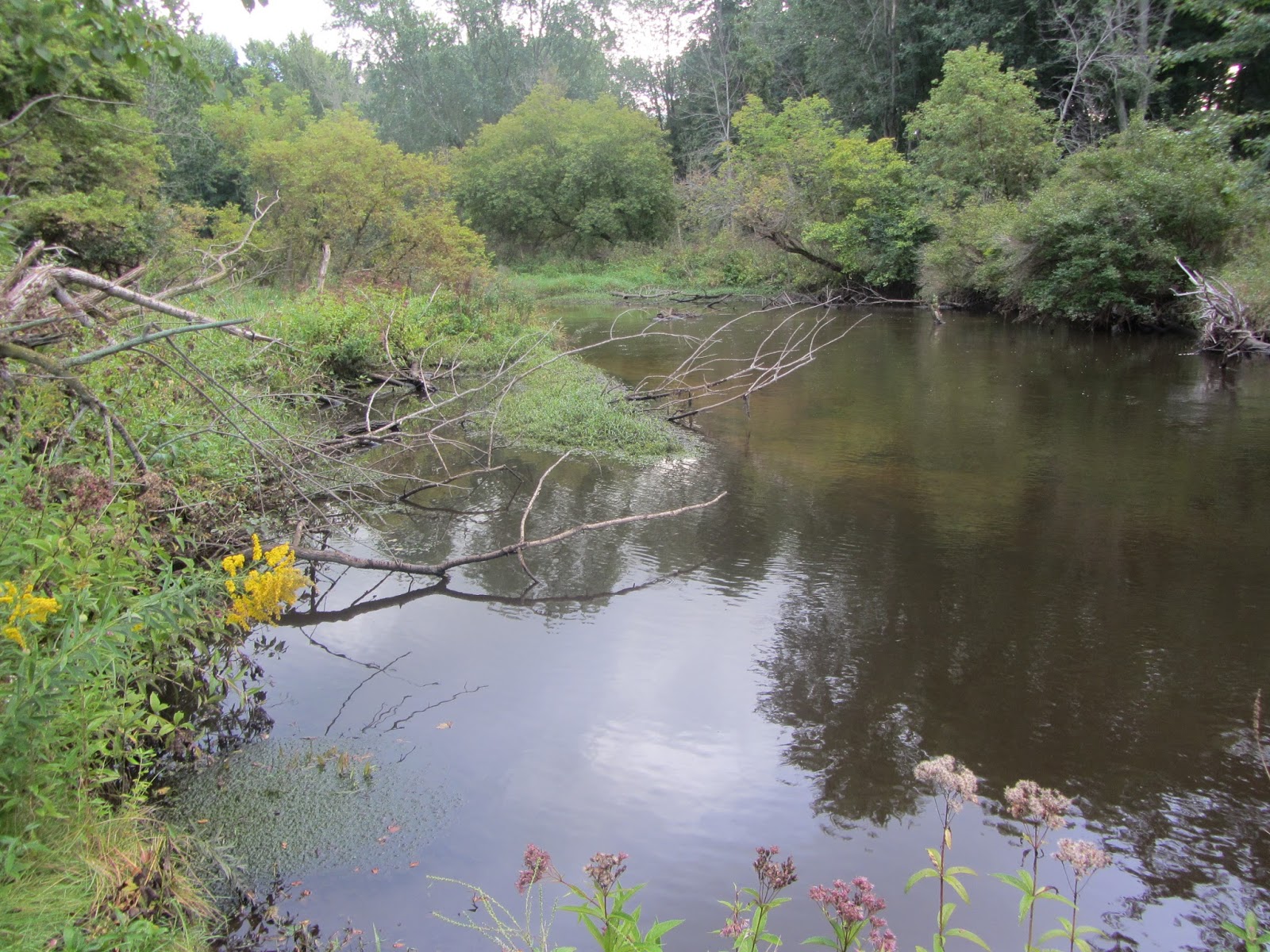
Thursday, Remi and I traveled to E. Lansing to hike the 35-acre Sanford Natural Area on the campus of Michigan State University. The mid-morning weather was sunny with a temperature of 55 degrees and no wind. Before starting out, I paused to recognize the sun as yesterday it crossed the celestial equator to usher in the fall season. I followed the earthen trail as it headed northwest through a forest of mature Beech and Maple trees. On either side of the trail, the ground was covered with Sugar Maple seedlings and Spicebush shrubs whose leaves have a pleasant aroma and can be used in tea. The extremely tall trees that made up the canopy were hard to identify since their leaves were too far up to see. However, the leaf litter revealed that some were Red Oak. The trail curved west along the edge of the Red Cedar River where I noticed a pair of Mallards swimming toward the shore. Nearby, I spotted blossoms of Bluestem Goldenrod and Enchanter Nightshade, both typically found in a riparian ecosystem such as this. Also, I noticed a few blossoms of White Snakeroot. Leaves and stems of this plant contain tremetol, which is extremely poisonous. It is unpalatable to animals, but they will consume it if other forage is scarce. If sufficient amounts of white snakeroot are consumed, animals develop a condition known as ''trembles'' that may cause death. Lactating animals excrete the toxin in their milk, which can then pass to humans drinking the milk. The condition produced, known as "milk sickness", was common in early colonial times. A great milk sickness epidemic occurred in local areas of the eastern U.S. in the early nineteenth century resulting in many deaths.  As the trail moved away from the river, I saw some small vernal ponds as well as a stack of 10-inch diameter edible, Oyster Mushrooms growing from a downed Beech tree. As the trail circled back toward the beginning, I noticed a few plants of White Baneberry near the ground. Leaving the Natural Area and heading back to the car, I saw some Common Pokeweed growing along a fence. Finally, we got back to the car for the trip home.

Sun of the earth
Star of the day
Your path is sure
You do not stray
Solstice to solstice
Halfway there
Farewell summer
Chill in the air
Sustainer of life
Warming sphere
Sun of autumn
Glad you’re here


D. DeGraaf

Saturday, September 19, 2015

September 18


Friday, Remi and I returned to Forest Hill Nature Area for our weekly nature hike after being away for 6 weeks. The early morning weather was overcast with a temperature of 64 degrees and no wind. Arriving at Energy Hill, I gazed west at the late summer landscape and was amazed how the willows in front of Mallard Marsh had grown tall to block the distant view of Bobolink Meadow and North Woods. Proceeding down the hill past the marsh, I noticed the pale yellow color of Bobolink Meadow was not only due to the fading Goldenrod blossoms but also the changing color of Milkweed leaves. Entering the dark, heavily shaded North Woods, I stopped to look at lots of standing water in the large vernal pond and could not recall a time when the pond stayed wet the entire summer. I exited the woods, circled Succession Field and passed through Birch Row where a few leaves were beginning to turn yellow. Into South Woods, I spotted clusters of Yellow-centered Waxy cap Mushrooms on a decaying log as well as the Christmas-like colors of a Winterberry bush on the edge of Swanson Swamp. I exited the woods where I immediately saw a beautiful, 6 inch-diameter Amanita Mushroom. Turning south, I passed Sora Swale and turned east to follow the south trail while listening to the Orthopterans singing as well as Remi panting. At Frog Fen, I quickly hiked north up Reflection Hill and gazed down on Grebe Pond where I noticed a patch of Gray Dogwood shrubs nearby had turned red to match the barn color in the distance. Turning around, I descended the hill south toward Brady Cemetery where an American Toad hopped across the path in front of me. While passing the cemetery, I also noticed leaves of Virginia creeper vines were turning red. Turning north into Native Grassland, I couldn’t help but notice tall Blue Stem and Indian Grass leaning over the trail. Continuing north along the edge of Grebe Pond toward the barn, I caught a glimpse of a Blue Heron flying high overhead as well as a rare Herb Willow plant that was turning red. Finally, I passed the barn, made a brief stop on the dock to check the pond surface weeds before returning to the car and heading home.

Takes leaves of green
Gives us those of red
Takes a green meadow
Gives us yellow instead
Takes a redwing’s song
Gives us a cricket’s call
Taking away summer
Soon to give us fall
Seasonal transitions
Nature gives & takes
After a year asleep
Lady Autumn awakes


D. DeGraaf

Sunday, September 13, 2015

September 12


Saturday, I drove 10 miles west of Alma to Riverdale where Remi and I hiked a section of the Meijer Heartland Trail as well as the adjoining Stern Preserve. The early morning weather was partly sunny with a temperature of 46 degrees and a light variable wind. We left the parking lot and followed the paved trail east on a bridge over the Pine River that flowed fast and full due to recent rains. Continuing east, I noticed signs of transition from summer to fall including the dying back of Bracken ferns and dropping of Basswood leaves. Other signs I observed were the many blossoms of Sky-blue Aster and the reddening leaves of Sumac. Also, I paused to enjoy the ripe fruit of Autumn Olive. Hidden in the grass next to the trail I spotted half dozen fresh Horse Mushrooms. Turning around, I retraced my steps that included passing through a tunnel of over hanging Box Elder trees on my way back to the car. Arriving at the parking lot, I turned north to explore a small piece of property owned by the Chippewa Watershed Conservancy called the Stern Preserve. Established in 2008, this property consists of 14 acres and 1,400 feet of natural habitat along the Pine River. It is named in honor of Clayton and Mary Lee Stearns who were long-time residents of Riverdale. A large part of the land was an open field of grasses and sedges along with Goldenrod and thistle. Turning east toward the river, I noticed mature spruce and hardwoods along with a few invasive Autumn Olive shrubs. At the river’s edge, I paused to take in the scenic landscape. Finally, we returned to the car and headed home.

Late in summer
Nature’s décor
Sun shares less
Asters share more
Nests are empty
Redwings gone
Vigilant, the doe
Bolder, the fawn
Marsh still lives
Dragonflies hover
Blue Herons wade
Fish to discover


D. DeGraaf

Tuesday, September 8, 2015

September 7


Labor Day Monday, being able to see again after successful cataract surgery, Remi accompanied me as I traveled 23 miles south of Alma to hike once more at the Maple River State Game Area. The early morning temperature was mostly sunny with a temperature of 73 degrees and a light breeze out of the west. We left the parking lot and stopped at the boat launch ramp to observe the scenic wetlands and listen to the birds and orthopterans. Proceeding south, I followed the trail along a berm where I saw muskrat trails through the duckweed near shore. While scanning the lush landscape, I spotted large patches of Water Smartweed near the trail. The term smartweed is thought to be a more sanitized version of the original word “arsmart” for the use of the plant in medieval times to relieve itching and swelling of the human posterior. Also, growing out of the water were patches of Arrow Arum. Herbivores avoid eating this plant because of its toxicity: both the roots and foliage contain crystals of calcium oxalate that can cause severe irritation of the gastrointestinal tract and kidney failure. Turning east, I was surprised to see duck hunters ahead so I turned around and retraced my steps where I observed some Slender Nettle. This Nettle is less heavily armed with stinging hairs than Stinging Nettle. While many people dislike Nettles because of these hairs, they are important food plants to several species of butterflies. The young leaves of Nettles are edible if they are boiled in water and transformed into a creamy soup; they are supposed to be an excellent source of several vitamins and minerals. Approaching the car, I nearly stepped on a juvenile Leopard Frog before pausing to sample some sweet wild grapes. Near the car, I noticed blooming Common Plantain on the ground. Shredded leaves of this plant can be used to treat mosquito bites and poison ivy rash. Finally, we hopped in the car and headed home.

Observations on my weekly walk
Sound of a killdeer, sight of a hawk
Frogs that leap, willows that sway
Pheasant’s call at the break of day
Muskrat swims among the reeds
Breeze blows the thistle seeds
Down on the ground, a garter snake
Up from the pond, a mallard drake
In the sky above and earth below
Mother Nature’s late summer show


D. DeGraaf